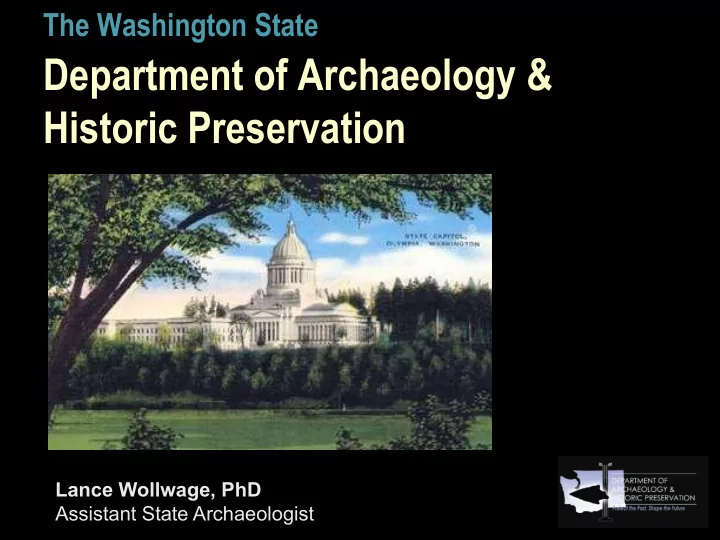
SLIDE 1 The Washington State
Department of Archaeology & Historic Preservation
Lance Wollwage, PhD Assistant State Archaeologist
SLIDE 2 Established by the federal 1966 Historic Preservation Act Funded partly through the Historic Preservation Fund Also established by state legislation RCW 27.34
State Historic Preservation Office(r)
SLIDE 3
DAHP’s Mission
RCW 27.34.200
To Preserve and Protect the Cultural Resources of Washington State For Future Generations
SLIDE 4 DAHP regulates
- Archaeological sites & excavations (RCW 27.53 &
WAC 25-48)
- Indian Graves & excavation (RCW 27.44)
- Care and maintenance of abandoned Cemeteries
(RCW 68.60)
- Inadvertent discoveries of human remains that are
not crime scenes (68.60 & 27.44)
SLIDE 5
RCWs 27.53 & 27.44
RCW 27.53: It is unlawful for any person or entity to knowingly and willfully alter or excavate any historic or prehistoric archaeological resource or site without a permit from DAHP RCW 27.44: INDIAN GRAVES AND RECORDS--burial sites, cairns, and glyptic markings located on public and private land are to be protected.
SLIDE 6
Common archaeological resources along shorelines
Shell Midden
SLIDE 7 Glyptic Records
Culturally Modified Tree (CMT)- historic period, Gifford Pinchot NF Culturally Modified Tree (CMT), Gifford Pinchot NF Pictograph & Petroglyph Klickitat County, Columbia River
SLIDE 8 Fish weirs
Mud Bay, Thurston County
SLIDE 9
Other types of archaeological resources near shorelines
Historic ferries and ferry landings Sites associated with timber extraction: docks, mills, storage facilities Fish processing sites (canneries) Military Installations Railroads, railroad camps Fur trade Exploration (i.e. Lewis and Clark) Irrigation features And much, much, more.
SLIDE 10 Submerged Resources
- Shipwrecks – can be in shoreline zone but also much deeper waters
- Other submerged archaeological resources:
Galloping Gertie 1940
SLIDE 11 Galloping Gertie 2006
SLIDE 12
Good places for cultural resources
Behind bulkheads, contemporary and old shorelines, buried shorelines (under fill), river deltas, confluences of creeks and rivers, confluences of creeks and Puget Sound, sandspits, wetland perimeters….
SLIDE 13
How does a property owner know they have a site or cemetery on their property?
By Accident (not preferred)
SLIDE 14 Instead...
- Require surveys/archaeological work before the projects starts; SMA
and SEPA allow local governments (lead agencies) to prevent damage to sites during development by requiring surveys and data gathering in advance of the project
- Local governments have most authority in local permitting process or
administering the SEPA or SMP review
- DAHP makes recommendations to local governments when they
seek our opinion
- State laws only provide for after-the-fact punishment, not pre-
construction protocols
SLIDE 15 We recommend…
- Building archaeological consideration into normal permitting and
planning process, as with other environmental factors
- Include clear timelines so all parties know what is expected and how
long process will take
- Making the process as straightforward as possible, giving certainty to
the development community
- Ensuring the process conforms with RCW 27.53, 27.44 & cemetery
statutes
SLIDE 16 Planning Resources from DAHP
- We keep the data:
- National Register Listed Properties
- Archaeological sites and Cemeteries
- Survey reports
- GIS based maps of known sites and historic properties
- GIS based survey layers
- WISAARD online www.dahp.wa.gov
SLIDE 17
Call DAHP anytime for questions, concerns, etc.
Lance Wollwage, Assistant State Archaeologist, (360) 586-3536
www.dahp.wa.gov