
SLIDE 1
Dr Andy Heald, Director / Managing Director, AOC Archaeology
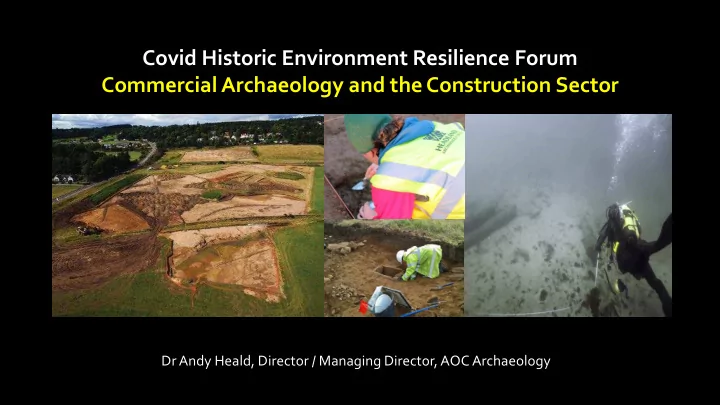
Covid Historic Environment Resilience Forum Commercial Archaeology - - PowerPoint PPT Presentation
Covid Historic Environment Resilience Forum Commercial Archaeology and the Construction Sector Dr Andy Heald, Director / Managing Director, AOC Archaeology TODAY AY Today I have been asked to discuss two main questions: What
Dr Andy Heald, Director / Managing Director, AOC Archaeology
questions:
to the country’s recovery?
Commercial archaeology is linked to national and local legislation. Archaeology is a material consideration within the planning system which manages the impacts that development may have upon
Most of this work is on undesignated sites (not protected by listing or scheduling) in which the scale, quality and significance of the archaeological site is often unknown fully before it is considered through the planning process. Thus, applied archaeology sits firmly within the planning system. It is also important to note that we are very well integrated into the construction sector, often working side-by-side with main contractors.
The advisory planning officers who administer the legislative framework Representatives of various owners of the delivery
Commercial Archaeology is critical to delivering a sustainable economic recovery, respecting our historic environment
Last year UK commercial archaeology revenue was £260m, of which around £220m was related to development management. Regional Planning archaeologists facilitate this £220m system; the cost of these services is around £15m per annum. Thus, for every pound spent on local planning authority archaeologists the local economy sees around £15 in return. ALGAO Scotland’s annual survey for 2018-19 saw that 8% of new planning applications required archaeological mitigation with around 1100 programmes of archaeological work managed and overseen.
There are around 7,200 archaeologists currently employed in the UK: 5,300 work in commercial archaeology and 270 work as local planning authority archaeologists, 23 in Scotland. Thus almost 77% of UK archaeologists work in the development management system.
Commercial archaeology plays a key role in delivering successful development, particularly by reducing delays. Delays due to archaeology discovered late in the construction process can increase associated costs by 3-7 times. Thus, with the current spend of £220m per annum, archaeology in the development management system could be saving the UK up to around £1bn per year. These UK figures are broadly transferable to Scotland. Scottish commercial archaeology turnover is around 6%
archaeologists and number of people employed.
Although a significant proportion of Scottish archaeologists were placed on furlough many others did work on some fieldwork (largely essential services)
Thus, even during Covid-19 many commercial archaeologists have continued to contribute to the wider Scottish and UK economy. Unlike many of their colleagues, the over-whelming majority of archaeologists working in planning, particularly in Local Authority Archaeology Services, have not been furloughed and have, again, been facilitating the planning process, protection of our heritage, and aiding the economy.
BUSINESS CONFIDENCE SCORES OF DEVELOPMENT AND MAJOR ‘OVEN READY’ INFRASTRUCTURE PROGRAMMES, SUCH AS THE £30M TRANSPORT SCOTLAND ARCHAEOLOGICAL FRAMEWORK (E.G. A9, A96 ETC) AND THE EDINBURGH TRAM EXTENSION EITHER READY TO START OR RESTART WHICH WILL AID THE ECONOMIC RECOVERY OVER THE SHORT, MEDIUM AND LONG-TERM MORE PEOPLE EMPLOYED IN COMMERCIAL ARCHAEOLOGY THAN EVER – WE ARE READY TO HELP TO KICK START THE ECONOMY THESE PROJECTS WILL ALSO HAVE SIGNIFICANT ECONOMIC BENEFIT TO LOCAL SUPPLY CHAINS INCLUDING MUCH AFFECTED SECTORS SUCH AS HOSPITALITY AND ACCOMMODATION ACROSS THE WHOLE OF SCOTLAND, PARTICULARLY IN RURAL AREAS.
CIFA, Prospect and Construction Leadership Council Site Operating Procedures.
initiated Covid-19 risk assessments and procedures to keep the archaeology and site projects going and our
safety over the last 3 months, particularly on active infrastructure and construction sites, and we are happy to share this learning with the wider heritage sector, so we can restart the economy as quickly and safely as possible.
Support Govt Sustainability and Climate Change agendas, particularly through work on infrastructure and energy projects. The recent Crown Estate announcements and reinvigorated energy sector should see a significant push towards a sustainable economy. With our continual improvements in digital technology we can move to ‘greener’ and more sustainable ways of undertaking archaeological work.
As enshrined in Scottish Government thinking it should always be the case that sustainable economic growth is not achieved at the expense of other interests, particularly the environment and our shared heritage. Our existing curatorial systems will ensure that our economy is always archaeologically accountable and socially responsible.
Commercial Archaeology enables health, wellbeing, and education agendas that strengthen our communities
Our Clients’ Resilience Curation and the Overall Process
There are threats to our sector - No Deal Brexit and a post-Covid Recession being
market confidence and some of our main contractors may decide to defer developments or move them to other regions. But, with the strong pipeline of work in infrastructure, energy, forestry, extractive industries, and some housing markets we are confident. The £30m Transport Scotland Archaeological Framework could not have come at a better time; not just economically but also with associated public benefits.
Many applied archaeologists rely on funding from bodies such as HES and NTS and we need to know now the likely effects of Covid-19 on these key funding streams. What will happen, for example, to funding of community projects, the Property in Care, Conservation and Human Remains Call-Off Contracts? And will funds still flow to institutions like CIFA and FAME that are critical to upholding professional standards?
Enormous benefits of the current Local Authority curatorial structure. There should be no attempt to kick start the economy in a way that contravenes our longer- term commitments to our shared heritage. A key outcome of a recent Scottish Archaeology Strategy workshop was that we needed more, not fewer, curators, particularly at regional level.
Over the next 4 years there will literally be thousands of new finds, digital and paper records, and samples from working on, for example, Government backed infrastructure projects. If curators and museums are unsupported in this crisis what happens to these archives, finds, and results from this new pipeline work? Who else is there to use this information to embed and celebrate the results within Scottish schools?
Construction archaeology is so much more than just facilitating or delivering a planning application for a private developer and we cannot lose sight of this in
The current system which marries Local Authority and commercial sector expertise is perhaps best- placed to help Scotland recover from Covid-19 and deliver many of the Scottish Government’s National Performance Framework Objectives.