Definitions Ventricular Tachycardia Degenerating To Ventricular - - PDF document

definitions
SMART_READER_LITE
LIVE PREVIEW

Definitions Ventricular Tachycardia Degenerating To Ventricular - - PDF document

Important Epidemiological Sudden Cardiac Death Concepts Prevention Trials Relative Risk reduction is a population effect Raul Weiss MD FACC, FAHA, FHRS, CCDS Absolute Risk reduction is a Individual Associate Professor Of Cardiovascular


slide-1
SLIDE 1

1

Sudden Cardiac Death Prevention Trials

Raul Weiss MD FACC, FAHA, FHRS, CCDS

Associate Professor Of Cardiovascular Medicine The Ohio State University

Definitions

  • Sudden Cardiac Death (SCD): is defined as

unexpected death that occurs immediately or within one hour of an abrupt change from a stable clinical state

  • SCD Primary Prevention: Therapy that

attempts to reduce mortality in patient at risk for SCD but no prior event

  • SCD Secondary Prevention: Therapy that

attempts to reduce mortality in patient with Aborted SCD, HD unstable VT or VT in a setting of structural heart disease

Important Epidemiological Concepts

  • Relative Risk reduction is a population

effect

  • Absolute Risk reduction is a Individual

effect

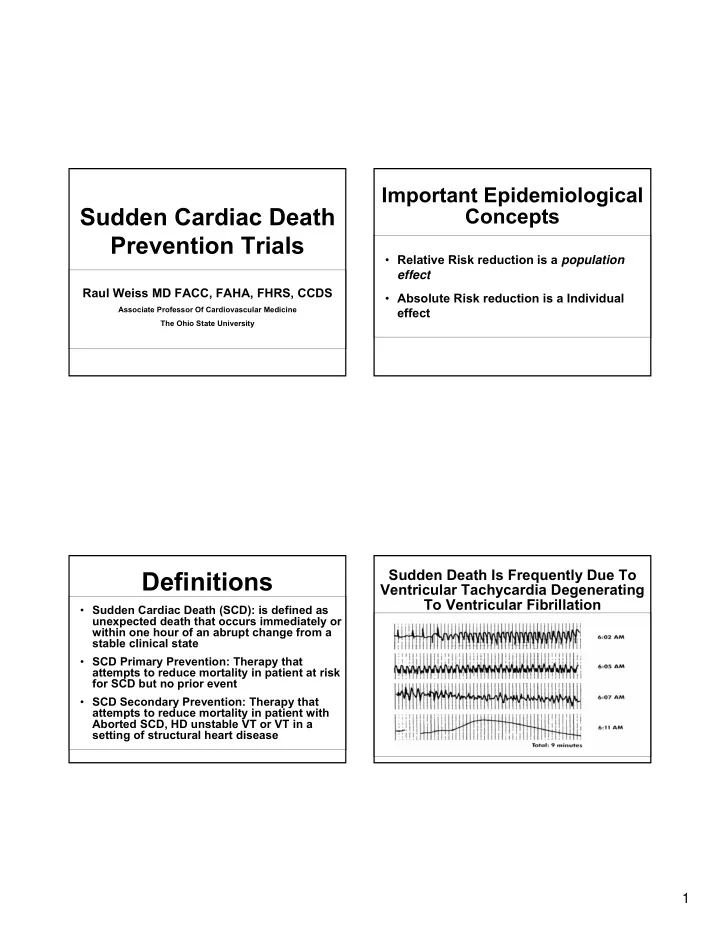
Sudden Death Is Frequently Due To Ventricular Tachycardia Degenerating To Ventricular Fibrillation

slide-2
SLIDE 2

2 Incidence of SCD in Specific Populations and Annual SCD Numbers

Myerburg RJ. Circulation.1998;97:1514-1521. GROUP 300,000 Patients with high coronary-risk profile Patients with previous coronary event Patients with ejection fraction < 35%, congestive heart failure Patients with previous

  • ut-of-hospital cardiac

arrest Patients with previous MI, low EF, and VT General population 200,000 100,000

  • No. of Sudden Deaths

Per Year

30 25 20 15 10

Incidence of Sudden Death (% of group)

5

Magnitude of the Problem

National Vital Statistics Report, Vol 49 (11), Oct. 12, 2001

Sudden cardiac arrest (SCA)

0% 5% 10% 15% 20% 25%

Septicemia Nephritis Alzheimer’s Disease Influenza/pneumonia Diabetes Accidents/injuries Chronic lower respiratory diseases Cerebrovascular disease

Other cardiac causes All cancers

Only after the deaths from ALL cancers are combined does anything cause more deaths each year than sudden cardiac arrest . SCD accounts for greater than half of all cardiac deaths and up to 15% of total mortality in the United States

  • U.S. estimates of sudden cardiac death

300,000-350,000 derived figure from the 70s

  • National center for disease statistics in

2001 estimated a total of 456,000 SCD

  • Oregon/Seattle 2002/4 <200,000

Magnitude of the Problem

Urgency of Sudden Cardiac Arrest

Resuscitation Success vs. Time

10 20 30 40 50 60 70 80 90 100 1 2 3 4 5 6 7 8 9 10 20 30 40 50 60 70 80 90 100 10 20 30 40 50 60 70 80 90 100 1 2 3 4 5 6 7 8 9 1 2 3 4 5 6 7 8 9

Success

%

Time (minutes) Chance of success reduced 7-10% every minute Adapted from text: Cummins RO, 1998. Annals of Emergency Medicine. 18:1269-1275.

slide-3
SLIDE 3

3

Vreede-Swagemakers et al. JACC 1997;30:1500-5.

Ages 20-75 only

Out of Hospital Cardiac Arrest

Site of Cardiac Arrest - The Maastricht Study

Home 399 On Street 47 Public Place 31 Other 20 Work 4

Severity of Heart Failure

Modes of Death

  • LANCET. 1999;353:2001-07.

12% 24% 64% CHF Other Sudden Death

n = 103

NYHA II 26% 15% 59% CHF Other Sudden Death

n = 103

NYHA III 56% 11% 33% CHF Other Sudden Death

n = 27

NYHA IV

Survival After Acute MI: Who is at Risk?

Bigger JT. Am J Cardiology. 1986;57:12B.

3 2 1

A B C D

0.4 0.6 0.8 1.0 Survivorship

N 536 113 80 37 EF ≥ 30% ≥ 30% < 30% < 30% VPD < 10/hr ≥ 10/hr < 10/hr ≥ 10/hr

0.2 Year

A B C D

700 post-MI patients; ~95% on beta blockers 2 years after discharge. The epidemiologic pattern

  • f SCD was different from

that reported in previous studies.

  • Arrhythmia events or

SCDs did not concentrate early after the index event, but most of them

  • ccurred more than 18

months post-MI.

Time Dependence of Mortality Risk Post-MI:

Prediction of Sudden Cardiac Death After Myocardial Infarction in the Beta-Blocking Era

Huikuri H, et al. J Am Coll Cardiol 2003; 42: 652-8.

slide-4
SLIDE 4

4

Pharmacological SCD Primary Prevention Trials

Post-MI Patients Heart Failure Patients Antiarrhythmic Drugs CAST BASIS CAMIAT PAT EMIAT SSSD SWORD DIAMOND-MI GESICA CHF-STAT DIAMOND-CHF Beta-Blockers BHAT CAPRICORN CIBIS-II USCHFT MERIT COMET COPERNICUS ACE Inhibitors SAVE SMILE TRACE SOLVD Aldosterone Receptor Blockades RALES EPHESUS

CAST-I

Objective:

Evaluate the effectiveness of Class IC AA drugs (Encainide and Flecainide) (n = 755) compared to placebo (n = 743) in post-MI patients.

Inclusion Criteria:

MI within 6 days to 2 years, and LVEF > 40% if recruited > 90 days post-MI or < 55% if recruited within 90 days post-MI, and > 6 PVCs per hour but no VT > 15 beats or > 120 bpm, and PVCs suppressible with Encainide or Flecainide

Class IC AA Drug Results:

Caused excessive mortality compared to placebo. The study was stopped early.

Echt DS. N Engl J Med. 1991;324:781-788.

Prognosis of Post-MI Patients Treated with Placebo vs. Encainide/Flecainide

80 85 90 95 100 91 182 273 364 455

Days after Randomization Patients without Event (%) Placebo (n = 743) Encainide or Flecainide (n = 755) P = 0.001

Echt DS. N Engl J Med. 1991;324:781-788.

CAST-I

EMIAT and CAMIAT Trials

Factor EMI AT1 CAMI AT2 Protocol Amiodarone Amiodarone

  • vs. placebo
  • vs. placebo

Patient characteristics Poor LV function Frequent ventricular (LVEF < 40%) ectopic activity (VEA; > 10 VPDs/hr) Recruitment 5-21 days post-MI 6-45 days post-MI Risk reduction of arrhythmic 35% 48.5% death at 24 months (p = 0.05) (p = 0.016) Overall mortality at 24 months No difference No difference

1 Julian DG. Lancet. 1997;349:667-674. 2 Cairns JA. Lancet. 1997;349:675-682.

slide-5
SLIDE 5

5 Pharmacological SCD Primary Prevention Trials SWORD Survival Results

Waldo AL. Lancet. 1996;348:7-12.

1.00 Time from Randomization (days) Z = -2.75, p = 0.006 Proportion Event-Free Patients at Risk Placebo 1,572 1,170 874 551 330 d-sotalol 1,549 1,150 844 544 323 Placebo d-sotalol 60 120 180 240 300 .99 .98 .97 .96 .95 .94 .93 .92 .91 .90 .89 .88 .87

CHF-STAT

Objective: Evaluate the effectiveness of amiodarone (n = 336) versus placebo (n = 338) in heart failure patients NYHA Class II, III, or IV, and EF < 40%, and > 10 PVCs/hour

Singh SW. N Engl J Med. 1995;333:77-82.

CHF-STAT Survival Results

1.0 0.9 0.8 0.7 0.6 0.5 0.4 0.3 0.2 0.1 0.0 54 48 42 36 30 24 18 12 6

Months

Amiodarone Amiodarone Placebo Chi-square = 0.28 p = 0.60 Placebo 260 175 101 33 263 336 338 178 95 39

Proportion Surviving

Singh SW. N Engl J Med. 1995;333:77-82.

MERIT-HF

Objective and Inclusion Criteria: Evaluate the effectiveness of Metoprolol | CR/XL (n = 1,900) compared to placebo (n = 2,001) in heart failure patients NYHA II, III, or IV, and LVEF < 40% Results: Reduced overall mortality by 34% (7.2% vs. 11%) (p = 0.0062) Reduced SCD by 41% (4% vs. 6.6%) (p = 0.0002) Reduced deaths from worsening heart failure by 49% (p = 0.0023)

MERIT-HF Study Group. Lancet. 1999;333:2001-2007.

slide-6
SLIDE 6

6

MERIT-HF Overall Mortality Results

MERIT-HF Study Group. Lancet. 1999;333:2001-2007.

Placebo Metoprolol CR/XL RR = 0.66 p = 0.0062 (adjusted) p = 0.00009 (nominal)

21 Follow-Up (months) Cumulative Mortality (%) 20 15 10 5 18 15 12 9 6 3

EPHESUS

Objective: Evaluate the effectiveness of Eplerenone (n = 3,313) to placebo (n = 3,319) in acute MI patients with left ventricular dysfunction and heart failure Acute MI (3-17 days), and LVEF < 40%, and Evidence of heart failure Eplerenone Results: Reduced overall mortality by 15% (p = 0.008) Reduced SCD by 21% (p = 0.03) Reduced the risk of CV death or CV hospitalization by 13% (p = 0.002)

Pitt B. N Engl J Med. 2003;348:1309-1321.

EPHESUS Overall Mortality Results

Pitt B. N Engl J Med. 2003;348:1309-1321. Placebo 3,313 3,064 2,983 2,830 2,418 1,801 1,213 709 323 99 2 Eplerenone 3,319 3,125 3,044 2,896 2,463 1,857 1,260 728 336 110

Placebo Eplerenone RR = 0.85 (95% CI, 0.75-0.96) p = 0.008

Months since Randomization Cumulative Incidence (%) 40 36

Patients at Risk

35 30 25 20 15 10 5 33 30 27 24 21 18 15 12 9 6 3

EPHESUS Sudden Cardiac Death Results

Pitt B. N Engl J Med. 2003;348:1309-1321. Eplerenone 3,319 3,125 3,044 2,896 2,463 1,857 1,260 728 336 110 Placebo 3,313 3,064 2,983 2,830 2,418 1,801 1,213 709 323 99 2

Placebo RR = 0.79 (95% CI, 0.64- 0.97) p = 0.03

Months since Randomization Cumulative Incidence (%) 10 36

Patients at Risk Eplerenone

33 30 27 24 21 18 15 12 9 6 3 9 8 7 6 5 4 3 2 1

slide-7
SLIDE 7

7

MADIT Survival Results

  • No. of Patients

Defibrillator 95 80 53 31 17 3 Conventional 101 67 48 29 17 therapy

Years 1.0 0.8 0.6 0.4 0.2 0.0 1 2 3 4 5 Probability of Survival % Conventional Therapy Defibrillator

RR = 0.46 p = 0.009

Moss AJ. N Engl J Med. 1996;335:1933-1940.

Primary Prevention Trials

Major Implantable Cardioverter-Defibrillator Trials for Primary Prevention of Sudden Cardiac Death

CI indicates Confidence Interval, NS = Not statistically significant, NSVT = nonsustained ventricular tachycardia, SAECG = signal-averaged electrocardiogram. Epstein A, et al. ACC/AHA/ HRS 2008 Guidelines for Device-Based Therapy of Cardiac Rhythm Abnormalities. J Am Coll Cardiol 2008; 51:e1–62. Table 5. MODIFIED

Trial Year Patients (n) LVEF Additional Study Features Hazard Ratio* 95% CI p MADIT I 1996 196 < 35% NSVT and EP+ 0.46 (0.26-0.82) p=0.009 MADIT II 2002 1232 < 30% Prior MI 0.69 (0.51-0.93) p=0.016 CABG-Patch 1997 900 < 36% +SAECG and CABG 1.07 (0.81-1.42) p=0.63 DEFINITE 2004 485 < 35% NICM, PVCs or NSVT 0.65 (0.40-1.06) p=0.08 DINAMIT 2004 674 < 35% 6-40 days post-MI and Impaired HRV 1.08 (0.76-1.55) p=0.66 SCD-HeFT 2006 1676 < 35% Prior MI of NICM 0.77 (0.62-0.96) p=0.007

MADIT

Objective:

  • Evaluate the effectiveness of ICD therapy (n = 99)

versus conventional therapy (n = 101) in high risk MI patients

Inclusion Criteria:

  • Q-wave MI > 3 weeks, and
  • Asymptomatic NSVT, and
  • LVEF < 35%, and
  • Inducible VT, but not suppressible on EPS, and
  • NYHA Class I-III

ICD Results:

  • Reduced overall mortality by 54% (p = 0.009)
  • Reduced arrhythmic mortality by 75%

Moss AJ. N Engl J Med. 1996;335:1933-1940.

slide-8
SLIDE 8

8

MADIT Survival Results

  • No. of Patients

Defibrillator 95 80 53 31 17 3 Conventional 101 67 48 29 17 therapy

Years 1.0 0.8 0.6 0.4 0.2 0.0 1 2 3 4 5 Probability of Survival % Conventional Therapy Defibrillator

RR = 0.46 p = 0.009 Moss AJ. N Engl J Med. 1996;335:1933-1940.

MADIT-II

Objective:

  • Evaluate the effectiveness of ICD therapy (n = 742)

compared to conventional therapy (n = 490) in high-risk post-MI patients

  • Post-MI > 4 weeks, and
  • LVEF < 30%

ICD Results:

  • Reduced overall mortality by 31% (p = 0.007)1
  • Reduced arrhythmic death by 61%2
1 Moss AJ. N Engl J Med. 2002;346:877-883 2 Moss AJ. Presented before ACC 51st Annual Scientific Sessions, Late Breaking Clinical Trials, March 19, 2002.

MADIT-II Survival Results

Defibrillator Conventional RR = 0.69 p = 0.007 1.0 .9 .8 .7 .6 0.0 Probability of Survival 1 2 3 4 Years

Patients at Risk Defibrillator 742 502 (0.91) 274 (0.94) 110 (0.78) 9 Conventional 490 329 (0.90) 170 (0.78) 65 (0.69) 3

Moss AJ. N Engl J Med. 2002;346:877-883.

MADIT-II

Survival Results – Sub-Group Analyses

Moss AJ. N Engl J Med. 2002;346:877-883.

1.6 Defibrillator Better 1.4 1.2 1.0 0.8 0.6 0.4 0.2 Conventional Therapy Better

VARI ABLE

  • NO. OF PATI ENTS

Age < 60 yr 370 60-90 yr 426 > 70 yr 436 Sex Male 1,040 Female 192 LVEF < 0.25 831 > 025 401 NYHA Class I 461 > I I 771 QRS interval < 0.12 sec 618 0.12-0.15 sec 352 > 0.15 sec 262 All patients 1,232

slide-9
SLIDE 9

9

7.8 8.4 11.6 14 7.2 4.9 8.2 9 2 4 6 8 10 12 14 16 1-17 mo 18 - 59 mo 60 - 119 mo > 120 mo Conv ICD

Hazard Ratio (n = 300) .98 (p = 0.92) (n = 283) 0.52 (p = 0.07) (n = 284) 0.50 (p = 0.02) (n = 292) 0.62 (p = 0.09) Wilber, D. Circulation. 2004;109:1082-1084.

Relation of Time from MI to ICD Benefit in the MADIT-II Trial

Time from MI % Mortality for Each Time Period

ICD Post Immediate Myocardial Infarction

Cumulative Risk of Death from Any Cause According to Study Group

Steinbeck, N Engl J Med 2009;361:1427-36

Hazard Ratios for Death from Any Cause in Selected Subgroups of Patients

Steinbeck, N Engl J Med 2009;361:1427-36

slide-10
SLIDE 10

10

Cumulative Risk of Cardiac Death, According to Study Group

Steinbeck, N Engl J Med 2009;361:1427-36

SCD-HeFT Sudden Cardiac Death in Heart Failure Trial

  • Determine if amiodarone or ICD will

decrease the risk of death from any cause in patients with mild-to-moderate heart failure (Class II and III).

  • Maximally treated CHF for ≥ 3 months with

a LVEF of ≥ .35

  • No. at Risk

Amiodarone 845 772 715 484 280 97 Placebo 847 797 724 505 304 89 ICD 829 778 733 501 304 103

SCD-HeFT Mortality Rate Overall Results

Months of Follow-Up Mortality Rate 48 36 24 12 Amiodarone Placebo ICD 0.4 0.3 0.2 0.1 0.0 60 Hazard Ratio (97.5% Cl) P-Value Amiodarone vs. Placebo 1.06 (0.86 - 1.30) 0.53 ICD vs. Placebo 0.77 (0.62 - 0.96) 0.007

Bardy GH. N Engl J Med. 2005;352:225-237. 5 10 15 20 25 30 35 40 Amiodarone Placebo ICD

SCD-HeFT 5-Year Mortality Rate Overall Results

34% 36.1% 28.9%

Mortality Rate

Bardy GH. N Engl J Med. 2005;352:225-237.

slide-11
SLIDE 11

11

SCD-HeFT Mortality Rate Ischemic CHF Patients

Months of Follow-Up Mortality Rate 48 36 24 12 Amiodarone Placebo ICD 0.4 0.3 0.2 0.1 0.0 60

  • No. at Risk

Amiodarone 426 384 346 227 130 46 Placebo 453 415 370 244 152 48 ICD 431 395 365 244 144 48 Hazard Ratio (97.5% Cl) P-Value Amiodarone vs. Placebo 1.05 (0.91 - 1.36) 0.66 ICD vs. Placebo 0.79 (0.60 - 1.04) 0.05

Bardy GH. N Engl J Med. 2005;352:225-237.

  • No. at Risk

Amiodarone 419 388 369 257 150 51 Placebo 394 382 354 261 152 41 ICD 398 383 368 257 160 55

SCD-HeFT Mortality Rate Non-Ischemic CHF Patients

Months of Follow-Up Mortality Rate 48 36 24 12 Amiodarone Placebo ICD 0.4 0.3 0.2 0.1 0.0 60 Hazard Ratio (97.5% Cl) P-Value Amiodarone vs. Placebo 1.07 (0.76 - 1.51) 0.65 ICD vs. Placebo 0.73 (0.50 - 1.07) 0.06 0.5

Bardy GH. N Engl J Med. 2005;352:225-237.

  • No. at Risk

Amiodarone 601 563 536 378 222 76 Placebo 594 563 522 367 218 72 ICD 566 550 531 371 236 80

SCD-HeFT Mortality Rate NYHA Class II Patients

Months of Follow-Up Mortality Rate 48 36 24 12 Amiodarone Placebo ICD 0.4 0.3 0.2 0.1 0.0 60 Hazard Ratio (97.5% Cl) P-Value Amiodarone vs. Placebo 0.85 (0.65 - 1.11) 0.17 ICD vs. Placebo 0.54 (0.40 - 0.74) < 0.001

Bardy GH. N Engl J Med. 2005;352:225-237.

0.5 0.6

  • No. at Risk

Amiodarone 244 209 179 106 58 21 Placebo 253 234 202 138 86 17 ICD 263 228 202 130 68 23

SCD-HeFT Mortality Rate NYHA Class III Patients

Months of Follow-Up Mortality Rate 48 36 24 12 Amiodarone Placebo ICD 60 Hazard Ratio (97.5% Cl) P-Value Amiodarone vs. Placebo 1.44 (1.05 - 1.97) 0.010 ICD vs. Placebo 1.16 (0.84 - 1.61) 0.30

Bardy GH. N Engl J Med. 2005;352:225-237.

0.4 0.3 0.2 0.1 0.0 0.5 0.6

slide-12
SLIDE 12

12

MUSTT

Objective:

  • Evaluate if AA therapy guided by EP testing could

reduce arrhythmic death and overall mortality in high-risk post-MI patients

Inclusion Criteria:

  • CAD, and
  • LVEF < 40%, and
  • Asymptomatic NSVT, and
  • Inducible VT on EP testing

Buxton AE. N Engl J Med. 1999;341:1882-1890. 353 351 290 301 242 265 178 199 118 119 67 68

  • No. of Patients

No EP-Guided AA Rx EP-Guided Rx No EP-Guided AA Rx

Time after Enrollment (years) 1 2 3 4 5 0.1 0.2 0.3 0.4 0.5 Event Rate

EP-Guided Rx (No ICD and ICD)

p = 0.04

MUSTT Randomized Patient Results: Arrhythmic Death or Cardiac Arrest

Buxton AE. N Engl J Med. 1999;341:1882-1890.

RR 27%

EP-Guided Rx, No ICD

Time after Enrollment (years) 1 2 3 4 5 0.1 0.2 0.3 0.4 0.5 Event Rate p < 0.001

No EP-Guided AA Rx EP-Guided Rx, ICD

MUSTT Randomized Patient Results: Arrhythmic Death or Cardiac Arrest

Buxton AE. N Engl J Med. 1999;341:1882-1890.

RR 73%

MUSTT Randomized Patient Results: Overall Mortality

1 2 3 4 5 0.1 0.2 0.3 0.4 0.5 Event Rate

353 351 290 301 242 265 178 199 122 121 67 68

  • No. of Patients

No EP-Guided AA Rx EP-Guided Rx

Time after Enrollment (years)

No EP-Guided AA Rx EP-Guided Rx (No ICD and ICD)

p = 0.06

Buxton AE. N Engl J Med. 1999;341:1882-1890.

RR 20%

slide-13
SLIDE 13

13

MUSTT Randomized Patient Results: Overall Mortality

Time after Enrollment (years) 1 2 3 4 5 0.1 0.2 0.3 0.4 0.5 0.6 Event Rate p < 0.001

EP-Guided Rx, No ICD No EP-Guided AA Rx EP-Guided Rx, ICD Buxton AE. N Engl J Med. 1999;341:1882-1890.

RR 55%

Secondary Prevention Trial

Major Implantable Cardioverter-Defibrillator Secondary Prevention Trials for

* Hazard ratios for death from any cause in the ICD group compared with the non-ICD group. Includes only ICD and amiodarone patients from CASH. ‡CI Upper Bound 1.112 CI indicates Confidence Interval, NS = Not statistically significant, NSVT = nonsustained ventricular tachycardia, SAECG = signal-averaged electrocardiogram. Epstein A, et al. ACC/AHA/ HRS 2008 Guidelines for Device-Based Therapy of Cardiac Rhythm Abnormalities. J Am Coll Cardiol 2008; 51:e1–62. Table 5. MODIFIED

Trial Year Patients (n) LVEF Additional Study Features Hazard Ratio* 95% CI p AVID 1997 1016 Prior cardiac arrest NA 0.62 (0.43-0.82) NS CASH† 2000 191 Prior cardiac arrest NA 0.766 ‡ 1-sided p=0.081 CIDS 2000 659 Prior cardiac arrest, syncope NA 0.82 (0.60-1.1) NS

AVID (1993-1997)

Antiarrhythmics Versus Implantable Defibrillators

  • Objective - Determine the impact of ICDs and

AADs on all-cause mortality

  • Inclusion - Candidates who had a cardiac arrest

due to VF, VT w/ syncope, or sustained VT without syncope and EF < 40% with one of the following: Systolic BP of < 80 mmHg, chest pain, near syncope, or acute CHF

Cardiac Electrophysiology Review 2, 8-10, 1998

slide-14
SLIDE 14

14

AVID

All-cause Mortality Percentage

Cardiac Electrophysiology Review 2, 8-10, 1998 10.70% 18.40% 24.60% 17.70% 25.30% 35.90% 0.00% 5.00% 10.00% 15.00% 20.00% 25.00% 30.00% 35.00% 40.00% 1st Year (39%) 2nd Year (27%) 3rd Year (31%)

ICD (507 pts) AAD (509 pts) $0 $20,000 $40,000 $60,000 $80,000 $100,000 $120,000 $140,000 $160,000 $180,000 $200,000

Incremental Cost-Effectiveness ICD, CRT, and CRT-D Therapies

COMPANION CRT-D Incremental Cost per Life-Year Saved COMPANION CRT MADIT-II ICD AVID ICD $28,000 $38,200 $50,000 $67,000 Expensive Borderline Cost-Effective Cost-Effective Highly Cost-Effective Economically Unattractive SCD-HeFT ICD $33,000

  • K. Ellenbogen JACC 2005;46:2199 –203

Add-on Therapy In Heart Failure

Mortality Digoxin, Diuretics, Hydralazine ACE-Inh β-blockers + ACE-Inh β-blockers + ACE-Inh + Aldosterone- Inh β-blockers + ACE-Inh + Aldosterone- Inh + CRT-D SOLVD CONCENSUS

  • 16 to -31%

CIBIS II COPERNICUS

  • 35%

RALES

  • 22%

COMPANION & CARE HF

  • 36%

Conclusions

  • Defibrillators have shown conclusively to

reduced sudden cardiac death and total mortality in primary and secondary prevention trials

  • Antiarrhythmic drugs in general do not

improve survival, even though in some cases prevent SCD. In some cases it may increases mortality

slide-15
SLIDE 15

15

  • Ace-inhibitors, Beta-blockers, Aldosterone

receptor blockers all are all associated with improve survival

  • Defibrillators improve survival in high risk
  • groups. The benefit is additive to medical

therapy (which should be initiated and maximize prior to implantation)

Conclusions The Future

  • Appropriate device selection

Single/Dual Chamber Vs. Bi-V

  • Improved patient selection

Pt’s clinical characteristics EPS/MTWA/SAECG/MRIs/Genetic testing

  • Lower cost defibrillators
  • Leadless defibrillators

Indications for ICD Therapy 2008 ACC/AHA/ESC Guidelines

ICD therapy is indicated in patients who are survivors

  • f cardiac arrest due to ventricular fibrillation or

hemodynamically unstable sustained VT after evaluation to define the cause of the event and to exclude any completely reversible causes. ICD therapy is indicated in patients with structural heart disease and spontaneous sustained VT, whether hemodynamically stable or unstable. ICD therapy is indicated in patients with syncope of undetermined origin with clinically relevant, hemodynamically significant sustained VT or VF induced at electrophysiological study.

I I I I I a I I a I I a I I b I I b I I b I I I I I I I I I I I I I I a I I a I I a I I b I I b I I b I I I I I I I I I I I I I I a I I a I I a I I b I I b I I b I I I I I I I I I I I a I I a I I a I I b I I b I I b I I I I I I I I I I I I I I a I I a I I a I I b I I b I I b I I I I I I I I I I I I I I a I I a I I a I I b I I b I I b I I I I I I I I I I I I I I a I I a I I a I I b I I b I I b I I I I I I I I I I I a I I a I I a I I b I I b I I b I I I I I I I I I I I I I I a I I a I I a I I b I I b I I b I I I I I I I I I I I I I I a I I a I I a I I b I I b I I b I I I I I I I I I I I I I I a I I a I I a I I b I I b I I b I I I I I I I I I I I a I I a I I a I I b I I b I I b I I I I I I I I I All primary SCD prevention ICD recommendations apply only to patients who are receiving optimal medical therapy and have reasonable expectation of survival with good functional capacity for more than 1 year.
Implantable Cardioverter-Defibrillators

slide-16
SLIDE 16

16

ICD therapy is indicated in patients with LVEF less than 35% due to prior MI who are at least 40 days post-MI and are in NYHA functional Class II or III. ICD therapy is indicated in patients with nonischemic DCM who have an LVEF less than or equal to 35% and who are in NYHA functional Class II or III. ICD therapy is indicated in patients with LV dysfunction due to prior MI who are at least 40 days post-MI, have an LVEF less than 30%, and are in NYHA functional Class I. ICD therapy is indicated in patients with nonsustained VT due to prior MI, LVEF less than 40%, and inducible VF or sustained VT at electrophysiological study.

I I I I I a I I a I I a I I b I I b I I b I I I I I I I I I I I I I I a I I a I I a I I b I I b I I b I I I I I I I I I I I I I I a I I a I I a I I b I I b I I b I I I I I I I I I I I a I I a I I a I I b I I b I I b I I I I I I I I I I I I I I a I I a I I a I I b I I b I I b I I I I I I I I I I I I I I a I I a I I a I I b I I b I I b I I I I I I I I I I I I I I a I I a I I a I I b I I b I I b I I I I I I I I I I I a I I a I I a I I b I I b I I b I I I I I I I I I I I I I I a I I a I I a I I b I I b I I b I I I I I I I I I I I I I I a I I a I I a I I b I I b I I b I I I I I I I I I I I I I I a I I a I I a I I b I I b I I b I I I I I I I I I I I a I I a I I a I I b I I b I I b I I I I I I I I I I I I I I a I I a I I a I I b I I b I I b I I I I I I I I I I I I I I a I I a I I a I I b I I b I I b I I I I I I I I I I I I I I a I I a I I a I I b I I b I I b I I I I I I I I I I I a I I a I I a I I b I I b I I b I I I I I I I I I All primary SCD prevention ICD recommendations apply only to patients who are receiving optimal medical therapy and have reasonable expectation of survival with good functional capacity for more than 1 year.

Implantable Cardioverter-Defibrillators

ICD implantation is reasonable for patients with unexplained syncope, significant LV dysfunction, and nonischemic DCM. ICD implantation is reasonable for patients with sustained VT and normal or near-normal ventricular function. ICD implantation is reasonable for patients with HCM who have 1

  • r more major† risk factors for SCD.

ICD implantation is reasonable for the prevention of SCD in patients with arrhythmogenic right ventricular dysplasia/cardiomyopathy (ARVD/C) who have 1 or more risk factors for SCD. ICD implantation is reasonable to reduce SCD in patients with long-QT syndrome who are experiencing syncope and/or VT while receiving beta blockers.

I I I a I I b I I I I I I a I I b I I I I I I a I I b I I I I I I a I I b I I I I I I a I I b I I I

Implantable Cardioverter-Defibrillators

All primary SCD prevention ICD recommendations apply only to patients who are receiving optimal medical therapy and have reasonable expectation of survival with good functional capacity for more than 1 year.

ICD implantation is reasonable for nonhospitalized patients awaiting transplantation. ICD implantation is reasonable for patients with Brugada syndrome who have had syncope. ICD implantation is reasonable for patients with Brugada syndrome who have documented VT that has not resulted in cardiac arrest. ICD implantation is reasonable for patients with catecholaminergic polymorphic VT who have syncope and/or documented sustained VT while receiving beta blockers. ICD implantation is reasonable for patients with cardiac sarcoidosis, giant cell myocarditis, or Chagas disease.

I I I a I I b I I I I I I a I I b I I I I I I a I I b I I I I I I a I I b I I I I I I a I I b I I I All primary SCD prevention ICD recommendations apply only to patients who are receiving optimal medical therapy and have reasonable expectation of survival with good functional capacity for more than 1 year.

Implantable Cardioverter-Defibrillators

ICD therapy may be considered in patients with nonischemic heart disease who have an LVEF of less than or equal to 35% and who are in NYHA functional Class I. ICD therapy may be considered for patients with long- QT syndrome and risk factors for SCD. ICD therapy may be considered in patients with syncope and advanced structural heart disease in whom thorough invasive and noninvasive investigations have failed to define a cause. ICD therapy may be considered in patients with a familial cardiomyopathy associated with sudden death. ICD therapy may be considered in patients with LV noncompaction.

I I I I I a I I a I I a I I b I I b I I b I I I I I I I I I I I I I I a I I a I I a I I b I I b I I b I I I I I I I I I I I I I I a I I a I I a I I b I I b I I b I I I I I I I I I I I a I I a I I a I I b I I b I I b I I I I I I I I I I I I a I I b I I I I I I a I I b I I I I I I a I I b I I I I I I a I I b I I I

Implantable Cardioverter-Defibrillators

slide-17
SLIDE 17

17

ICD therapy is not indicated for patients who do not have a reasonable expectation of survival with an acceptable functional status for at least 1 year, even if they meet ICD implantation criteria specified in the Class I, IIa, and IIb recommendations above. ICD therapy is not indicated for patients with incessant VT or VF. ICD therapy is not indicated in patients with significant psychiatric illnesses that may be aggravated by device implantation or that may preclude systematic follow-up. ICD therapy is not indicated for NYHA Class IV patients with drug-refractory congestive heart failure who are not candidates for cardiac transplantation or cardiac resynchronization therapy defibrillators (CRT-D).

I I I I I a I I a I I a I I b I I b I I b I I I I I I I I I I I I I I a I I a I I a I I b I I b I I b I I I I I I I I I I I I I I a I I a I I a I I b I I b I I b I I I I I I I I I I I a I I a I I a I I b I I b I I b I I I I I I I I I I I I I I a I I a I I a I I b I I b I I b I I I I I I I I I I I I I I a I I a I I a I I b I I b I I b I I I I I I I I I I I I I I a I I a I I a I I b I I b I I b I I I I I I I I I I I a I I a I I a I I b I I b I I b I I I I I I I I I I I I I I a I I a I I a I I b I I b I I b I I I I I I I I I I I I I I a I I a I I a I I b I I b I I b I I I I I I I I I I I I I I a I I a I I a I I b I I b I I b I I I I I I I I I I I a I I a I I a I I b I I b I I b I I I I I I I I I I I I I I a I I a I I a I I b I I b I I b I I I I I I I I I I I I I I a I I a I I a I I b I I b I I b I I I I I I I I I I I I I I a I I a I I a I I b I I b I I b I I I I I I I I I I I a I I a I I a I I b I I b I I b I I I I I I I I I All primary SCD prevention ICD recommendations apply only to patients who are receiving optimal medical therapy and have reasonable expectation of survival with good functional capacity for more than 1 year.

Implantable Cardioverter-Defibrillators

ICD therapy is not indicated for syncope of undetermined cause in a patient without inducible ventricular tachyarrhythmias and without structural heart disease. ICD therapy is not indicated when VF or VT is amenable to surgical or catheter ablation (e.g., atrial arrhythmias associated with the Wolff-Parkinson-White syndrome, RV or LV outflow tract VT, idiopathic VT, or fascicular VT in the absence of structural heart disease). ICD therapy is not indicated for patients with ventricular tachyarrhythmias due to a completely reversible disorder in the absence of structural heart disease (e.g., electrolyte imbalance, drugs, or trauma).

I I I I I a I I a I I a I I b I I b I I b I I I I I I I I I I I I I I a I I a I I a I I b I I b I I b I I I I I I I I I I I I I I a I I a I I a I I b I I b I I b I I I I I I I I I I I a I I a I I a I I b I I b I I b I I I I I I I I I I I I I I a I I a I I a I I b I I b I I b I I I I I I I I I I I I I I a I I a I I a I I b I I b I I b I I I I I I I I I I I I I I a I I a I I a I I b I I b I I b I I I I I I I I I I I a I I a I I a I I b I I b I I b I I I I I I I I I I I I I I a I I a I I a I I b I I b I I b I I I I I I I I I I I I I I a I I a I I a I I b I I b I I b I I I I I I I I I I I I I I a I I a I I a I I b I I b I I b I I I I I I I I I I I a I I a I I a I I b I I b I I b I I I I I I I I I

Implantable Cardioverter-Defibrillators

All primary SCD prevention ICD recommendations apply only to patients who are receiving optimal medical therapy and have reasonable expectation of survival with good functional capacity for more than 1 year.

ICDs in Pediatric Patients and Patients With Congenital Heart Disease

ICD implantation is indicated in the survivor of cardiac arrest after evaluation to define the cause

  • f the event and exclusion of any reversible

causes. ICD implantation is indicated for patients with symptomatic sustained VT in association with congenital heart disease who have undergone hemodynamic and electrophysiological

  • evaluation. Catheter ablation or surgical repair

may offer possible alternatives in carefully selected patients.

I I I I I a I I a I I a I I b I I b I I b I I I I I I I I I I I I I I a I I a I I a I I b I I b I I b I I I I I I I I I I I I I I a I I a I I a I I b I I b I I b I I I I I I I I I I I a I I a I I a I I b I I b I I b I I I I I I I I I I I I I I a I I a I I a I I b I I b I I b I I I I I I I I I I I I I I a I I a I I a I I b I I b I I b I I I I I I I I I I I I I I a I I a I I a I I b I I b I I b I I I I I I I I I I I a I I a I I a I I b I I b I I b I I I I I I I I I All primary SCD prevention ICD recommendations apply only to patients who are receiving optimal medical therapy and have reasonable expectation of survival with good functional capacity for more than 1 year.

ICDs in Pediatric Patients and Patients With Congenital Heart Disease

ICD implantation is reasonable for patients with congenital heart disease with recurrent syncope of undetermined

  • rigin in the presence of either ventricular dysfunction or

inducible ventricular arrhythmias at electrophysiological study. ICD implantation may be considered for patients with recurrent syncope associated with complex congenital heart disease and advanced systemic ventricular dysfunction when thorough invasive and noninvasive investigations have failed to define a cause. All Class III recommendations found in Section 3 of the full- text guidelines, “Indications for Implantable Cardioverter- Defibrillator Therapy,” apply to pediatric patients and patients with congenital heart disease, and ICD implantation is not indicated in these patient populations.

I I I I I a I I a I I a I I b I I b I I b I I I I I I I I I I I I I I a I I a I I a I I b I I b I I b I I I I I I I I I I I I I I a I I a I I a I I b I I b I I b I I I I I I I I I I I a I I a I I a I I b I I b I I b I I I I I I I I I I I I I I a I I a I I a I I b I I b I I b I I I I I I I I I I I I I I a I I a I I a I I b I I b I I b I I I I I I I I I I I I I I a I I a I I a I I b I I b I I b I I I I I I I I I I I a I I a I I a I I b I I b I I b I I I I I I I I I I I I I I a I I a I I a I I b I I b I I b I I I I I I I I I I I I I I a I I a I I a I I b I I b I I b I I I I I I I I I I I I I I a I I a I I a I I b I I b I I b I I I I I I I I I I I a I I a I I a I I b I I b I I b I I I I I I I I I All primary SCD prevention ICD recommendations apply only to patients who are receiving optimal medical therapy and have reasonable expectation of survival with good functional capacity for more than 1 year.