in Cardiac Arrest in Cardiac Arrest Management Management Sean - - PDF document

in cardiac arrest in cardiac arrest management management
SMART_READER_LITE
LIVE PREVIEW

in Cardiac Arrest in Cardiac Arrest Management Management Sean - - PDF document

in Cardiac Arrest in Cardiac Arrest Management Management Sean Kivlehan, MD, MPH May 2014 Outline 1. Capnography 2. Compressions 3. CPR Devices 4. Hypothermia 5. Access 6. Medications Capnography & Termination Significantly


slide-1
SLIDE 1

in Cardiac Arrest in Cardiac Arrest Management Management

Sean Kivlehan, MD, MPH May 2014
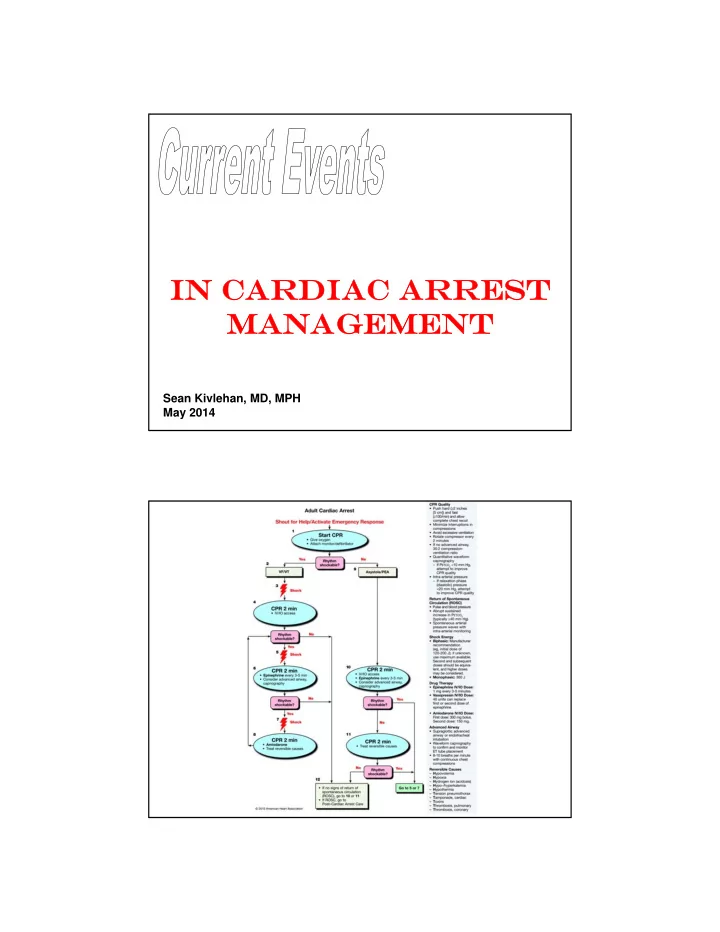
slide-2
SLIDE 2

Outline

  • 1. Capnography
  • 2. Compressions
  • 3. CPR Devices
  • 4. Hypothermia
  • 5. Access
  • 6. Medications
slide-3
SLIDE 3

Significantly Associated with ROSC:

– Witnessed Arrest (OR = 1.51) – Initial EtCO2 >10 (OR = 4.79)

Alternatively:

– Male, no bystander CPR, unwitnessed collapse, non-VF arrest, initial EtCO2 <10 – 97% predictive of no ROSC

Eckstein, 2011

Capnography & Termination Capnography

A guide to:

  • 1. Likelihood of ROSC

GOOD: Abrupt & sustained increased to 35-40 BAD: <10 is a poor predict

  • 1. Airway Confirmation
  • 2. CPR quality (Goal >20)
slide-4
SLIDE 4

Termination Rules

Morrison, Resuscitation 2009

20 minutes?

150 patients in Washington in the 90’s

  • EtCO2 @ 20 minutes

– Survivors: 32.8 – Non-survivors: 4.4

Levine, NEJM 1997

slide-5
SLIDE 5

2: COMPRESSIONS What they already knew: at they already knew:

Compressions affected ventilation If alone, only do compressions “Only the human hand is required”

slide-6
SLIDE 6

Compressions

Time (Seconds) Systolic Blood Pressure

slide-7
SLIDE 7

CCR

Continuous Chest Compression (CCC) CPR

Preferred by bystanders Equivalent or better resuscitation rates

Cardiocerebral CPR

– 200 uninterrupted chest compressions @100/ min – Rhythm analysis with a single shock if indicated – Immediately followed by 200 postshock chest compressions before any pulse check or rhythm reanalysis. – ETI delayed until after 3 cycles – IV epi administered as soon as possible during the protocol and again with each cycle

More Info: SHARE Program @ Univ. of Arizona Sarver Heart Center

Ewy, Resuscitation 2010; Bobrow, JAMA 2008

CCR vs CPR

Arm #1: Continuous (6 minutes) Arm #2: 30:2 (standard) CPR

  • Multicenter RCT
  • Started June 2011
  • Expected completion Oct 2014
slide-8
SLIDE 8

3: CPR DEVICES

Load Distributing Band CPR (AutoPulse) Mechanical Piston Device (LUCAS)

slide-9
SLIDE 9

Load Distributing Band CPR (AutoPulse)

2004-5 ASPIRE Trial, US multicenter RCT – Halted Early (Dangerous)

  • 4 hour survival same
  • Hospital discharge 5.8% vs 9.9%

“Results a re unexp ected a nd there is no obv ious exp la na tion”

– Hawthorne Effect for CPR & Learning curve for device – Delay to use? – Enrollment bias?

. Hallstrom, JAMA 2006

LUCAS in Cardiac Arrest (LINC Trial)

  • Multicenter RCT (2,589 patients)
  • Mechanical vs Conventional CPR
  • No difference in:

– 4 hour survival – 6 month survival – 6 month neurologic outcome

Rubertsson, JAMA 2014

slide-10
SLIDE 10

“ no alternative technique or device in routine use has consistently been show n to be superior to conventional CPR for out-of-hospital basic life support”

(2010 AHA Guidelines)

“ Widespread use of m echanical devices for chest com pressions during cardiac events is not supported by this review .”

(2014 Cochrane Review)

4: HYPOTHERMIA

slide-11
SLIDE 11

Hypothermia in 2002

Study #1

– 77 patients randomized to 33°C x12 hours – Favorable neuro outcome:

  • 49% chilled
  • 26% not

Study #2

– VF post arrest, 136 patients randomized to 32-34°C x24 hours – Favorable neuro outcome:

  • 55% chilled
  • 39% not

6 month mortality down 14% No difference in complication rate

Bernard, N Engl J Med 2002; Hypothermia after Cardiac Arrest Study Group, N Engl J Med 2002

Hypothermia Today

  • 33 vs 36 targeted temperature
  • 939 patients
  • No difference in survival
  • Overall survival better vs 2002

Nielsen, NEJM 2013

slide-12
SLIDE 12

5: ACCESS

IO as first line in arrest?

[182 arrest patients] 1st attempt success:

Tibial IO: 91% Humeral IO: 51% PIV: 43%

Time to initial success:

Tibial IO: 4.6 m in Humeral IO: 7.0 min PIV: 5.8 min

Reades, Ann Emerg Med 2011

slide-13
SLIDE 13

In Hospital?

[40 arrest patients] 1st attempt success:

IO: 8 5% Central Line: 60%

Time to initial success:

IO: 2 m in Central Line: 8 min

Leidel, Resuscitation 2012

6: MEDICATIONS

slide-14
SLIDE 14
slide-15
SLIDE 15

Norway 2003-2008

IV drugs vs no IV drugs

6 years, 851 patients ROSC: 32% vs 21%: BETTER Survival to discharge: NO CHANGE Favorable Neuro Outcome: NO CHANGE 1 year survival: NO CHANGE

Overall, no im provem ent

Olasveengen TM, Sunde K, Brunborg C, et al. Intravenous drug administration during

  • ut-of-hospital cardiac arrest: a randomized trial. JAMA. 2009;302(20):2222–2229

Western Australia 2006-2009

Epi vs Placebo

4 years, 534 patients ROSC 23.5% vs 8.4%: BETTER Survival to discharge 4.0% vs 1.9%: NO CHANGE

(OR 0.7-6.3)

No statistically significant im provem ent

Jacobs IG, Fimm JC, Jelinek GA, et al. Effect of adrenaline on survival in out-of-hospital cardiac arrest: A randomised double-blind placebo-controlled trial. Resuscitation 2011 Sep;82(9):1138-43

slide-16
SLIDE 16

Japan 2005-2008

Epi vs Nothing

4 years, 417,188 patients ROSC: 18% vs 5%: BETTER 1 month survival: NO CHANGE Good functional status: 1.4% vs 2.2%: WORSE

(OR 0.21 – 0.71)

Decreased chance of survival and good functional outcome at 1 month

Why?

  • Increased lactate, over-constriction of microcirculation,

metabolic debt overall

  • Promotes dysrhythmias, activates platelets

Hagihara, JAMA. 2012

S ummary S tatements

“ …there is no placebo-controlled study that show s that the routine use

  • f any vasopressor during hum an cardiac arrest increases survival to

hospital discharge.” “ There is no convincing evidence that the routine use of other drugs (atropine, am iodarone, lidocaine, procainam ide, bretylium , m agnesium , buffers, calcium , horm ones, or fibrinolytics) during hum an CPR increases survival to hospital discharge.” “ There w as no clear advantage of epinephrine…the efficacy of vasopressor use in OHCA rem ains unansw ered.”

Morrison, Circulation 2010; Lin, Resuscitation 2014

slide-17
SLIDE 17

ALPS

Amiodarone, Lidocaine, or Placebo S tudy

Refractory VT/ VF after 1 shock: Arm #1: Amiodarone Arm #2: Lidocaine Arm #3: Placebo Est Completed Enrollment: Sept 2015

  • Vasopressin
  • Epi
  • Methylprednisolone

40mg Saline Epi Saline

Mentzelopoulos, JAMA 2013

slide-18
SLIDE 18

Ontario PreHospital Advanced Life S upport (OPALS ) S tudy

Survival to Discharge Odds Ratios

  • 1. Bystander CPR: 3.7
  • 2. Rapid Defibrillation: 3.4
  • 3. Paramedics with ACLS: 1.1

Stiell, NEJM 2004

S UMMARY

  • 1. Capnography - helpful
  • 2. Compressions - work
  • 3. CPR Devices - equivocal
  • 4. Hypothermia – questionable
  • 5. Access – IO first
  • 6. Medications - dogma
slide-19
SLIDE 19

QUES TION

  • The medications
  • The need to cool
  • Everything
  • Remember, it wasn’t too long ago we were

rolling a victim over a barrel and doing rectal insufflation of smoke! sean.kivlehan@gmail.com