Deep-Sea Coral Amendment Public Hearings Michelle Bachman, NEFMC - - PowerPoint PPT Presentation

deep sea coral amendment public hearings
SMART_READER_LITE
LIVE PREVIEW

Deep-Sea Coral Amendment Public Hearings Michelle Bachman, NEFMC - - PowerPoint PPT Presentation

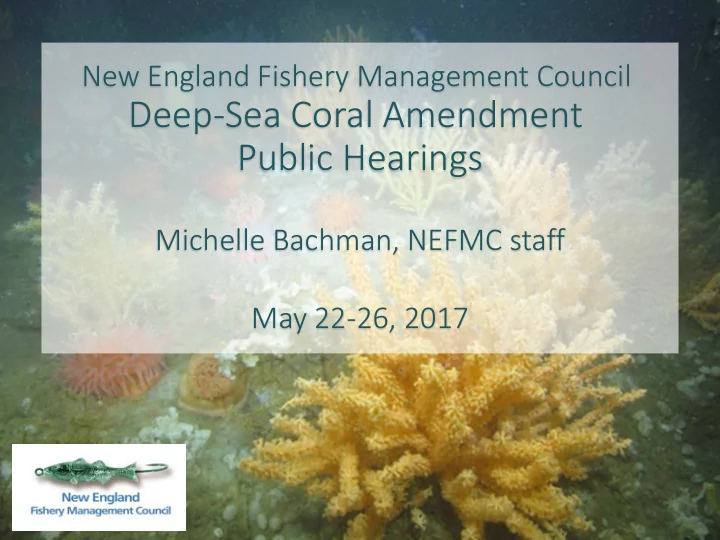
New England Fishery Management Council Deep-Sea Coral Amendment Public Hearings Michelle Bachman, NEFMC staff May 22-26, 2017 What is the Deep-Sea Coral Amendment? The coral amendment is a New England Fishery Management Council (NEFMC)


slide-1
SLIDE 1

New England Fishery Management Council

Deep-Sea Coral Amendment Public Hearings

Michelle Bachman, NEFMC staff May 22-26, 2017

slide-2
SLIDE 2

What is the Deep-Sea Coral Amendment?

  • The coral amendment is a New England Fishery Management

Council (NEFMC) action, developed in collaboration with NOAA Fisheries, the Mid-Atlantic Fishery Management Council, and the Atlantic States Marine Fisheries Commission

  • Overall purpose of the amendment is to protect deep-sea coral

habitats throughout the New England region from the negative impacts of fishing gears

  • Amendment considers a series of spatial management areas

throughout the region, with possible restrictions on bottom- tending fishing gears

  • Amendment would update all NEFMC fishery management

plans

slide-3
SLIDE 3

Management authority

  • When the Magnuson-Steven Fishery Conservation and

Management Act was reauthorized in 2007, a provision was added (§303(b)) that allows Councils to take discretionary action to protect deep-sea coral habitats

  • Allows the flexibility to decouple coral conservation measures from

Essential Fish Habitat or bycatch-related authorities in MSA

  • Important in the context of precautionary management as some corals
  • ccur in deep and remote waters beyond the distribution of managed

stocks and fisheries

  • In 2014, NOAA Fisheries drafted national guidance on

implementing the §303(b) discretionary provisions

  • Per the guidance, Councils may develop measures that apply to any

fishing, including fishing managed under other federal fishery management plans (e.g., those developed by another Council), or state- regulated fishing authorized in the EEZ (e.g., the lobster fishery)

slide-4
SLIDE 4

Amendment problem statement:

The Council is utilizing its discretionary authority under Section 303(b) in MSA to identify and implement measures that reduce, to the extent practicable, impacts of fishing gear on deep sea corals in New England. This amendment contains alternatives that aim to identify and protect concentrations of corals in select areas and restrict the expansion of fishing effort into areas where corals are likely to be present. Deep sea corals are fragile, slow-growing organisms that play an important role in the marine ecosystem and are vulnerable to various types of disturbance of the seafloor. At the same time, the importance and value of commercial fisheries that operate in

  • r near areas of deep sea coral habitat is recognized by the
  • Council. As such, measures in this amendment will be considered

in light of their benefit to corals as well as their costs to commercial fisheries.

slide-5
SLIDE 5

Amendment timeline

  • April 14: Habitat Committee reviews workshop outcomes

and recommends preferred alternatives

  • April 18: Council selects preferred alternatives
  • May 1-June 5: Public comment period
  • May 22-May 26: Public hearings
  • May 30: Committee reviews written and hearing comments,

recommends any updates to preferred alternatives

  • June 20-22: Council takes final action on coral amendment
  • Late summer/fall/early winter: Amendment submission and

rulemaking

  • 2018: Implementation (6-7 months from Council

submission)

slide-6
SLIDE 6

Public comment opportunities

Date and Time Location Monday, May 22 6:00-8:00 p.m. Montauk Playhouse Community Center 240 Edgemere Street, Montauk, NY 11954 Tuesday, May 23 1:00-3:00 p.m. University of Rhode Island Bay Campus, CorlessAuditorium 215 South Ferry Road, Narragansett, RI 02882 Tuesday, May 23 5:30-7:30 p.m. Fairfield Inn and Suites 185 MacArthur Drive, New Bedford, MA 02740 Wednesday, May 24 1:00-3:00 p.m.

  • Mass. Division Marine Fisheries,

Annisquam River Marine Fisheries Field Station 30 Emerson Ave., Gloucester, MA 01930 Wednesday, May 24 5:30-7:30 p.m. Sheraton Harborside 250 Market Street, Portsmouth, NH 03801 Thursday, May 25 5:00-7:00 p.m. Ellsworth High School 299 State Street, Ellsworth, ME 04605 Friday, May 26 1:00-2:30 p.m. Webinar https://attendee.gotowebinar.com/register/98257139389273345 Habitat Committee meeting to review comments and make recommendations to the Council: Tuesday, May 30, 10:00 a.m. – Four Points by Sheraton, Wakefield MA

slide-7
SLIDE 7

What are deep-sea corals?

  • Animals related to anemones

and jellyfish

  • Live in cold, deep-waters (at

least 25 fathoms/50 m, typically deeper)

  • Unlike tropical corals, are active

feeders

  • Some types, sea pens in

particular, are found in soft bottom, but many species need to attach to boulders and rocky ledges

  • These are the conservation focus of

the Council’s amendment

Upper image: A sea fan (Paramuricea) in Nygren Canyon Lower image: A large black coral and sea fans (Paramuricea) in Oceanographer Canyon Images courtesy of NOAA Okeanos Explorer Program, 2013 Northeast U.S. Canyons Expedition.

slide-8
SLIDE 8

Deep-sea corals of New England

  • Four major groups: stony corals,

soft corals, and black corals, and sea pens

  • Black corals occur along the

continental margin south of Georges Bank in very deep water, but not in the Gulf of Maine

  • Species richness is greater in the

canyon/slope region vs. the Gulf of Maine

  • Some species were documented

for the first time in New England during recent scientific expeditions (2013-2015)

  • New England corals are mostly

colonial, but not reef building

Sea pens Stony corals Soft corals Black corals

Types of corals that occur in the New England region

slide-9
SLIDE 9

Gulf of Maine soft coral species

Fan corals or gorgonians:

  • Paragorgia arborea or bubble gum coral
  • Primnoa resedaeformis or sea corn coral
  • Paramuricea placomus
  • Anthothela grandiflora
  • Gersemia rubifomis

Yellow and purple Paramuricea sp. collected during recent GOM coral surveys

Paragorgia arborea. Source: Bourbonnais et al. 2003 Primnoa resedaeformis. Source: Kenchington et al. 2009 Gersemia rubiformis.

Source: http://www.arcodiv.org/seabottom/cnidaria/Gersemia_rubiformis.html

slide-10
SLIDE 10

Why protect coral habitats?

  • Deep-sea corals provide

habitat for fishes and for

  • ther invertebrates
  • Many coral species are

physically fragile and susceptible to entanglement with fishing gear.

  • Their very slow growth

rates mean that recovery from damage takes many years

  • Thus, a precautionary

management approach is appropriate to prevent future impacts in areas that are currently unfished

Upper images: redfish in Jordan Basin Lower images: haddock in Jordan Basin; dogfish and cusk at Outer Schoodic Ridge

slide-11
SLIDE 11

Atlantic coast coral management

New England

  • Amendment we are discussing at

today’s hearing

  • Possible management areas in

canyon/slope/seamount region and in the Gulf of Maine

Mid-Atlantic

  • Effective January 2017
  • Management areas in

canyon/slope region extending

  • ut to edge of EEZ
  • 450m depth, shallower in canyon

heads

  • Areas closed to BTG, red crab

fishery exempt

  • Lobster fishery not considered in
  • r affected by amendment
slide-12
SLIDE 12

§ 4.2 Coral zones

Broad zones: large areas based on 300m, 400m, 500m, 600m, 900m depth contours extending to EEZ boundary. Preferred alternative has 600m minimum depth. Canyons: 20 areas Seamounts: Bear, Retriever, Physalia, Mytilus GOM: Mt. Desert Rock, Outer Schoodic Ridge, Lindenkohl Knoll, Jordan Basin

§ 4.3 Gear restrictions

Option 1: Prohibit fixed and mobile bottom-tending gears. Sub-option A: exempt red crab trap fishery Sub-option B: exempt other trap fisheries Option 2: Prohibit mobile bottom- tending gears only.

For both options, transiting across coral zones would be allowed: Vessels may transit the coral zones provided bottom-tending trawl nets are

  • ut of the water and stowed on the reel and any
  • ther fishing gear that is prohibited in these

areas is onboard, out of the water, and not

  • deployed. Fishing gear would not be required to

meet the definition of “not available for immediate use” in 50 CFR § 648.2.

slide-13
SLIDE 13

§ 4.2.1 Broad coral zones

Preferred alternative 600m minimum depth, closed to all BTG, with an exemption for the red crab trap fishery

slide-14
SLIDE 14

§4.2.2.1 Canyon zones, and §4.2.2.2 Seamount zones

Canyons: Alvin, Atlantis, Nantucket, Veatch, Hydrographer, Dogbody, Clipper, Sharpshooter, Welker, Heel Tapper, Oceanographer, Filebottom, Chebacco, Gilbert, Lydonia, Powell, Munson, Nygren, unnamed canyon, Heezen Seamounts: Bear, Mytilus, Physalia, Retriever Not preferred at this time

slide-15
SLIDE 15

§4.2.2.3.1 Mt. Desert Rock

  • Option 1 is a larger area (46.8

km2)

  • Option 2 (19.2 km2) more

closely targets areas of high slope and coral observations

  • Preferred alternative, but

Option 1 vs. 2 not yet

  • determined. Gear restriction

would be MBTG closure

Tow 11 Tow 11

slide-16
SLIDE 16

§4.2.2.3.2 Outer Schoodic Ridge

Zone targets areas

  • f high slope and

coral observations

Dive 11 Dive 14 Dive 11 Dive 14

  • Single

boundary

  • ption
  • Preferred

alternative, MBTG closure

slide-17
SLIDE 17

§4.2.2.3.3 Jordan Basin

  • Option 1 (175 km2)

groups all dive sites with corals into four management zones

  • Option 2 (66 km2) more

closely targets areas of high slope, when known, and coral

  • bservations, and

subdivides the 114 bump and central Jordan Basin areas

  • Not a preferred

alternative at this time, but if designated, preference is MBTG closure

Detailed view of seafloor terrain in 114 bump area

slide-18
SLIDE 18

Jordan Basin corals and coral-associates

slide-19
SLIDE 19

§ 4.2.2.3.4 Lindenkohl Knoll

  • Option 1 (113 km2) includes all

known coral habitats in a single zone

  • Option 2 (24.7 km2) has 3 sub-

areas and targets individual dive observations

  • Not a preferred alternative at

this time, but if designated, preference is MBTG closure

slide-20
SLIDE 20

Overlap with lobster management areas

Area 1/Inshore

  • Outer Schoodic Ridge

(Maine Lobster Zone A, 12+)

  • Mt. Desert Rock (Maine

Lobster Zone B, 3-12) Area 3/Offshore

  • Jordan Basin
  • Lindenkohl Knoll
  • Canyons and slope, all

broad zones

slide-21
SLIDE 21

§4.4 Special fishery programs

  • Alternative 1/No Action
  • Alternative 2: Special access program fishing
  • Alternative 3: Exploratory fishing
  • Alternative 4: Request letter of acknowledgement for research

activities (preferred)

§4.5 Framework adjustment alternatives

  • Alternative 1/No Action
  • Alternative 2: Add, revise, or remove coral zones (preferred)
  • Alternative 3: Change fishing restrictions in coral zones (preferred)
  • Alternative 4: Allow development or modification of special access
  • r exploratory fishing programs (preferred)

Other alternatives in the amendment

slide-22
SLIDE 22

Summary of preferred alternatives

  • Broad zone with 600m minimum depth, closed to all bottom-

tending gears, red crab trap fishery exempt

  • Any Gulf of Maine zones designated would be closed to all

mobile bottom-tending gears

  • Inshore zones at Mt. Desert Rock and Outer Schoodic preferred
  • No definitive recommendation on the offshore zones (Jordan

Basin and Lindenkohl)

  • Original vs. updated boundaries not specified
  • Request letters of acknowledgement from researchers

working in coral zones

  • Allow changes to coral zones, fishing restrictions in coral

zones, and development of special fishery programs for coral zones via framework adjustment

  • Include coral research priorities in amendment
slide-23
SLIDE 23

Estimating impacts to deep-sea corals

  • Assess occurrence of corals and likely coral habitats
  • Consider fishing activities and gears used
  • Considering these factors, and coral vulnerability, what conservation

benefits might be achieved by excluding fishing from the zone?

How do coral metrics compare across the different broad zones depths?

slide-24
SLIDE 24

What do we know about fishing gear impacts on corals?

  • Coral characteristics make them inherently vulnerable to

damage

  • Slow growth, branching structure, brittle/easily broken, limited

dispersal capabilities

  • Scientific studies have documented negative impacts of

fishing gears on corals in many parts of the world

  • Most studies address trawl interactions; less work on fixed gears
  • Coral bycatch does occur in New England
  • Since 2013, the Northeast Fishery Observer Program has collected

samples when bycatch occurs to verify coral identifications

  • Most interactions are in the Gulf of Maine (vs. the canyons/continental

slope)

  • While these data indicate that coral/gear interactions are occurring, we

can’t use them to estimate bycatch rates at the fleet level

slide-25
SLIDE 25

Estimating revenue in offshore coral zones

Jordan Basin, Lindenkohl Knoll, Canyons and slope

  • Analysis is based on vessel trip reports

(2010-2015)

  • Revenue by gear type and species
  • Number of trips and permits by gear type
  • Percent revenue by owner
  • Lobster revenue, trips, and permits are

scaled up by 26%

  • Alternate approach for lobster trap gear

in canyon/slope region relies on information from an ASMFC survey about depth fished to distribute revenues spatially

Vessel trip report data Depth intervals used to assign revenue from survey

slide-26
SLIDE 26

Estimating revenue in inshore coral zones

Outer Schoodic Ridge, Mt. Desert Rock

Maine DMR (via the Lobster TC) contributed data on fishing trips, permits fished, value, and landings by Lobster Management Zone, including the proportion attributed to federally permitted vessels Dealer and port data were used to estimate 2015 lobster revenue for Lobster Management Zones A, B, and C. Harvester reports from 2011-2014 were then used to ascribe that zone’s trips, landings, and revenue to three distances from shore (0-3, 3-12, 12+ nm).

slide-27
SLIDE 27

Estimating social/community impacts

  • Consider the general social impacts to fisheries of area

closures (ability to adapt, displaced effort, gear conflicts in

  • pen areas, long-term though uncertain benefits to fisheries if

ecosystem improves and resource productivity increases)

  • Consider how recent fishery revenues in a zone or group of

zones have been are distributed amongst communities

  • What are the demographic characteristics of those communities

and their dependence on fishing?

  • Need to ensure that community data are non-confidential when

reporting data by year/gear/port – at least three vessels selling to at least three dealers

  • Also consider non-use/existence value of corals
slide-28
SLIDE 28

Questions?

For more information, contact Michelle Bachman, mbachman@nefmc.org or 978-465-0492 x 120