Investigating artificial reef design for stage IV European lobsters - - PowerPoint PPT Presentation

investigating artificial reef design for stage iv
SMART_READER_LITE
LIVE PREVIEW

Investigating artificial reef design for stage IV European lobsters - - PowerPoint PPT Presentation

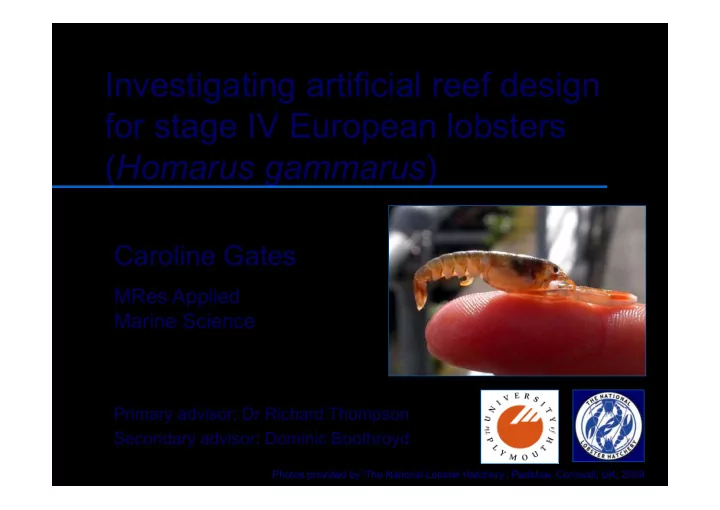
Investigating artificial reef design for stage IV European lobsters ( Homarus gammarus ) Caroline Gates MRes Applied Marine Science Primary advisor: Dr Richard Thompson Secondary advisor: Dominic Boothroyd Photos provided by The National


slide-1
SLIDE 1

Investigating artificial reef design for stage IV European lobsters (Homarus gammarus)

Primary advisor: Dr Richard Thompson Secondary advisor: Dominic Boothroyd

Caroline Gates

MRes Applied Marine Science

Photos provided by ‘The National Lobster Hatchery’, Padstow, Cornwall, UK, 2009

slide-2
SLIDE 2

Overview

Two sections:

  • 1. Overall aims of the project and

background literature

  • 2. Project design and hypotheses

(The National Lobster Hatchery, 2009)

slide-3
SLIDE 3

1. Aims of the project

  • Investigate whether stage IV hatchery reared

lobsters will occupy man made shelters

  • Determine if there are any body size to shelter

dimension relationships

  • Expand the current literature regarding stage IV

settlement choices

slide-4
SLIDE 4

Understanding a reefs target species’ ecological requirements

  • Homarids (Nephropidae) are solitary and can be

cannibalistic in group situations (Linnane et al., 2000)

  • Evidence that larger individuals move offshore

even though they are not shelter limited (Steneck,

2006)

  • Poole Bay, England (Jensen et al., 1994)

̶ PFA blocks created a substitute rocky area ̶ Long term site loyalty by larger lobsters

slide-5
SLIDE 5
  • H. gammarus life cycle

Courtship Moult into a stage IV, settle to the benthic environment Mature to adult size Eggs carried on the underside of the females tail Larvae released Pelagic larval phases

(The National Lobster Hatchery, 2009)

slide-6
SLIDE 6

Wild EBP Homarids

  • Early benthic phase (EBP) Homarus americanus

have been found in rocky areas similar to that which their adult counterparts inhabit

  • No EBP H. gammarus have been found despite

trans-European studies (Mercer et al., 2001) ̶ Rocky, artificial and areas experiencing freshwater input sampled ̶ Potential predator gut analysis

slide-7
SLIDE 7

Suggestions for apparent absence

  • f wild EBP H. gammarus
  • Substrates sampled

are not occupied by stage IVs (Mercer et al.,

2001)

  • Butler et al. (in Phillips,

2006) have suggested

a series of problems which settling lobsters have to

  • vercome

Larvae settlement

  • bstacles

Reproductive limits Cold regions/years Diverse predators/ competitors

(Adapted from Butler et al., in Phillips, 2006)

slide-8
SLIDE 8

Problems for reef design associated with the pelagic larval phases

  • Ocean currents and prevailing winds determine

movement, can result in a shadow effect (Wahle

and Incze, 1997)

  • Larval developmental period (Cobb et al., 1997)
  • Water temperature (Wahle and Fogarty, in Phillips, 2006)

and thermoclines (Butler et al., in Phillips, 2006)

  • Settlement cues

̶ Attraction to conspecifics (Boudreau et al., 1993) ̶ Deterred by predators (Boudreau et al., 1993)

slide-9
SLIDE 9

Homarid shelter experiments

  • They are thought to have ‘home’ shelters (Mehrtens

et al., 2005) and do not migrate long distances (Smith et al., 2001)

  • Consistently found between hard surfaces and

benthic substrate, rarely found surrounded by solid material (Miller et al., 2006)

  • Tight body size to shelter size ratio (Cobb, 1971)
  • Preference for 1:2 height to width ratio for

shelter dimensions (Cobb, 1971)

slide-10
SLIDE 10

EBP habitat choice experiments

  • Experimental evidence suggests that H.

gammarus choose pre-constructed shelters when given a choice of natural substrates (Linnane

et al., 2000; Jørstad et al., 2001)

  • Lobsters of this stage have been shown to use

artificial shelters made of plastic and clay (van der

Meeren, 2001)

slide-11
SLIDE 11

2. Hypotheses

  • The lobsters will be provided with either a set
  • f different sized circular or ellipse shelters
  • H1. Lobsters will inhabit the shelter which is

closest to their body size

  • The preferred options will then be used in a

choice experiment of shape H2.Lobsters will inhabit the ellipse shelter option

(The National Lobster Hatchery, 2009)

slide-12
SLIDE 12

Artificial reef blocks

  • Fired clay is chemically

inert

  • Two shapes:

̶ Cylindrical (1:1 ratio) ̶ Ellipse (1:2 ratio)

  • 1:2 height to width

ratio based on Cobb’s (1971) findings

  • 60mm deep to enable

lobsters to entirely retreat

slide-13
SLIDE 13

Nocturnal activity pattern

  • Homarids are known to be nocturnal
  • Light has been shown to be a major factor in

shelter choice (Cobb,1971; Johns and Mann, 1987)

  • Peaks in activity have been identified as just

after dark and before dawn (Smith et al., 1999; Mehrtens

et al., 2005)

  • Larvae are believed to settle around dusk as the

reduced light provides protection from potential predators (Childress and Jury, in Phillips, 2006; Butler et al., in

Phillips, 2006)

slide-14
SLIDE 14

Observation methodology

  • Natural night time will be extended to begin at

3.30pm and end at 9.00am

  • Artificial dawn and dusk will both be for 30

minutes

  • All recordings per light setting will be for 30

minutes using the scan sampling method (Martin and Bateson, 1993)

  • Observations will cease when a lobster moults to

stage V Night Dawn Day Day Dusk Night

slide-15
SLIDE 15

Introduction methodology

  • Measure lobster carapace length (CL) and total

length (TL) using digital microscope photography

  • Introduce to individual tanks 30 minutes before

the second ‘light’ sampling period

  • Record initial movements
  • Record time taken to enter its first shelter, if it

enters any

slide-16
SLIDE 16

Recording options when a lobster is in a shelter

Title of lobster position Description of lobster position 1 Lobster is entirely inside shelter one Partial 1 Lobster is less than entirely inside shelter one 2 Lobster is entirely inside shelter two Partial 2 Lobster is less than entirely inside shelter two 3 Lobster is entirely inside shelter three Partial 3 Lobster is less than entirely inside shelter three 4 Lobster is entirely inside shelter four Partial 4 Lobster is less than entirely inside shelter four

slide-17
SLIDE 17

Recording options when a lobster is not in a shelter

Title of lobster position Description of lobster position Near Lobster is within the ‘Near’ section of the tank Middle Lobster is within the ‘Middle’ section of the tank Outer Lobster is within the ‘Outer’ section of the tank Left Lobster is in the ‘Left’ hand side of the tank Right Lobster is in the ‘Right’ hand side of the tank Upper Lobster is in the ‘Upper’ section o the water Lower Lobster is in the ‘Lower’ section of the water

slide-18
SLIDE 18

Tank layout

  • Each individual tank will have grid lines on
  • The bath tanks maintain water temperature

Clay block Bath tank Individual tank

slide-19
SLIDE 19

Statistical analysis

  • Chi squared tests will identify how the data is

spread between shelter choices, although they will not determine which shelter was chosen

  • Histograms will be used to determine any
  • bvious preferences
  • A 3-way ANOVA may be applicable using shelter

size, lobster size, and shelter type as factors

slide-20
SLIDE 20

The next steps

  • Conduct experiments for hypotheses 1 and 2
  • Trial soft substrate addition experiment
  • This series of experiments will add to the limited

literature regarding stage IV H. gammarus settlement choices

  • Provide evidence for future artificial reef design

projects which focus on this elusive stage

slide-21
SLIDE 21

References

  • Boudreau, B., Bourget, E., Simard, Y. (1993) ‘Behavioral responses of competent

post-larvae to odor plumes.’ Marine Biology, 117, Iss 1, pp63-69.

  • Butler, M.J., Steneck, R.S., Herrnkind, W.F. (2006) ‘Juvenile and Adult Ecology.’ In

Phillips, B.F. (ed.) Lobsters Biology, Management, Aquaculture and Fisheries. Oxford: Blackwell Publishing Ltd.

  • Childress, M.J., Jury, S.H. (2006) ‘Behaviour.’ In Phillips, B.F. (ed.) Lobsters Biology,

Management, Aquaculture and Fisheries. Oxford: Blackwell Publishing Ltd.

  • Cobb, J.S., Booth, J.D., Clancy, M. (1997) ‘Recruitment strategies in lobsters and

crabs: a comparison.’ Marine and Freshwater Research, 48, pp 797-806.

  • Jensen, A.C., Collins, K.J., Free, E.K., Bannister, R.C.A. (1994) ‘Lobster (Homarus

gammarus) movement on an artificial reef: The potential use of artificial reefs for stock enhancement.’ Crustaceana, 67, Iss 2, pp198-213.

  • Johns, P.M., Mann, K.H. (1987) ‘An experimental investigation of juvenile lobster

habitat preference and mortality among habitats of varying structural complexity.’ Journal of Experimental Marine Biology and Ecology, 109, Iss 3, pp275-285.

  • Jørstad, K.E., Agnalt, A.L., Kristiansen, T.S., Nøstvold, E. (2001) ‘High survival and

growth of European lobster juveniles (Homarus gammarus) reared communally on natural-bottom substrate.’ Marine Freshwater Research, 52, pp1431-1438.
slide-22
SLIDE 22

References

  • Linnane, A., Mazzoni, D., Mercer, J.P. (2000a) ‘A long-term mesocosm study on the

settlement and survival of juvenile European lobster Homarus gammarus L. in four natural substrata.’ Journal of Experimental Marine Biology and Ecology, 249, pp 51- 64.

  • Martin, P. Bateson, P. (1993) Measuring behaviour: An introductory guide. 2nd
  • Edition. UK: Cambridge University Press.
  • Mehrtens, F., Stolpmann, M., Buchholz, F., Hagen, W., Saborowski, R. (2005)

‘Locomotory activity and exploration behaviour of juvenile European lobsters (Homarus gammarus) in the laboratory.’ Marine and Freshwater Behaviour and Physiology, 38, Iss 2, pp 105-116.

  • Mercer, J.P., Bannister, R.C.A., van der Meeren, G.I., Debuse, V., Mazzoni, D.,

Lovewell, S., Browne, R., Linnane, A., Ball, B. (2001) ‘An overview of the LEAR (Lobster Ecology and Recruitment) project: results of field and experimental studies

  • n the juvenile ecology of Homarus gammarus in cobble.’ Marine and Freshwater

Research, 52, pp 1291-1301.

  • Miller, R.J., Sharp, G.J., O’Brien, E.M. (2006) ‘Laboratory experiments on artificial

reefs for American lobsters.’ Journal of Crustacean Biology, 26, Iss 4, pp621-627.

  • Smith, I.P., Collins, K.J., Jensen, A.C. (1999) ‘Seasonal changes in the level and diel

pattern of activity in the European lobster Homarus gammarus.’ Marine Ecology Progress Series, 186, pp 255-264.

slide-23
SLIDE 23

References

  • Smith, I.P., Jensen, A.C., Collins, K.J., Mattey, E.L. (2001) ‘Movement of wild

European lobsters Homarus gammarus in natural habitat.’ Marine Ecology Progress Series, 222, pp 177-186.

  • Steneck, R.S. (2006) ‘Possible demographic consequences of intraspecific shelter

competition among American lobsters.’ Journal of Crustacean Biology, 26, Iss 4, pp628-638.

  • The National Lobster Hatchery (2009) Accessed: 08/03/2009. Available from:

http://www.nationallobsterhatchery.co.uk/index.html

  • van der Meeren, G.I. (2001) ‘Effects of experience wither shelter in hatchery-reared

juvenile European lobsters Homarus gammarus.’ Marine Freshwater Research, 52, pp 1487- 1493.

  • Wahle, R.A., Fogarty, M.J. (2006) ‘Growth and Development : Understanding and

Modelling Growth Variability in Lobsters.’ In Phillips, B.F. (ed). Lobsters Biology, Management, Aquaculture and Fisheries. Oxford: Blackwell Publishing Ltd.

  • Wahle, R.A., Incze, L.S. (1997) ‘Pre and post-settlement processes in recruitment of

the American lobster.’ Journal of Experimental Marine Biology and Ecology, 217, pp 179-207.