Artificial Reef Performance in Artificial Reef Performance in Lake - - PowerPoint PPT Presentation

artificial reef performance in artificial reef
SMART_READER_LITE
LIVE PREVIEW

Artificial Reef Performance in Artificial Reef Performance in Lake - - PowerPoint PPT Presentation

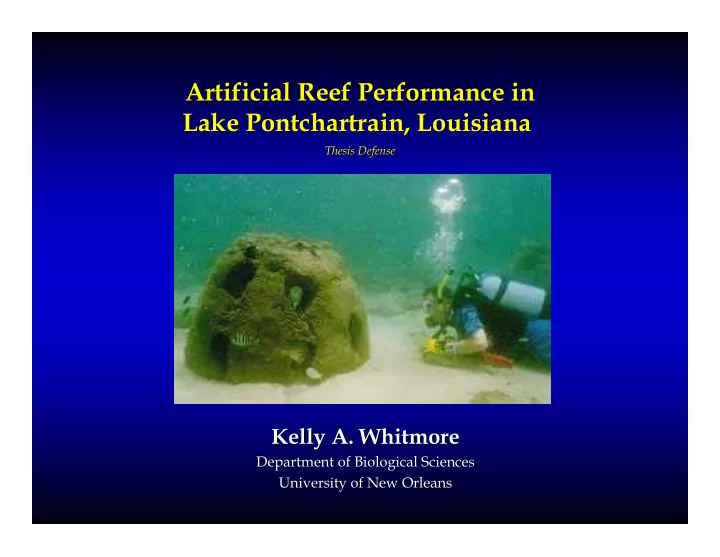
Artificial Reef Performance in Artificial Reef Performance in Lake Pontchartrain, Louisiana Lake Pontchartrain, Louisiana Thesis Defense Thesis Defense Kelly A. Whitmore Kelly A. Whitmore Department of Biological Sciences Department of


slide-1
SLIDE 1

Artificial Reef Performance in Artificial Reef Performance in Lake Pontchartrain, Louisiana Lake Pontchartrain, Louisiana

Thesis Defense Thesis Defense

Kelly A. Whitmore Kelly A. Whitmore

Department of Biological Sciences Department of Biological Sciences University of New Orleans University of New Orleans

slide-2
SLIDE 2

Artificial Reefs

  • What is an artificial reef?
  • Object of natural or human origin,

deployed on seafloor to influence aquatic species for biological or economic gain

– Enhance fisheries – Enhance tourism – Protect habitats – Restore coral reefs – Stabilize shorelines

  • Attraction vs. production
  • Attraction known
  • Production debatable
slide-3
SLIDE 3

Lake Pontchartrain

» 1,632 km2 estuary » Mean salinity 4 ppt, oligohaline » Average depth 3.7 m » Sediment bottom, no natural reefs

Artificial reefs developed to:

  • Enhance recreational fisheries and fishing
  • Promote awareness of improved water

quality and environmental conditions

  • Supplement hard substrate lost by shell

dredging

slide-4
SLIDE 4

Artificial Reef Artificial Reef Development Development

Louisiana Artificial Reef Program 1986

  • Convert offshore oil/gas platforms to artificial reefs
  • Oyster reef restoration, inshore

Lake Pontchartrain Artificial Reef Working Group

Organized in June 2000

  • NGOs, state and federal fisheries agencies, parishes, sportsmen’s
  • rganizations, commercial fishing associations
  • 2001: 1st reef by Lakefront airport, limestone rubble
  • 2003/2004: reef ball reefs – 3 south shore/ 1 north shore
slide-5
SLIDE 5

Material: Reef Balls

  • Concrete, perforated domes
  • Durable, stable
  • Non-toxic, pH adjusted
  • Faster invertebrate colonization
  • Heavy base
  • Two sizes:

– Bay: 0.9 m diameter, 340 kg – Pallet: 1.2 m diameter, 1000 kg

slide-6
SLIDE 6
slide-7
SLIDE 7

.

New Orleans IHNC LAKE PONTCHARTRAIN Bonnet Carre Spillway Mississippi R. C a u s e w a y B r i d g e N1 H1, H3, H4 Coordinates of Artificial Reef Sites H1 – N 30° 05.028’ W 090° 12.096’ H3 – N 30° 05.034’ W 090° 12.582’ H4 – N 30° 05.289’ W 090° 12.336’ N1 – N 30° 16.296’ W 090° 03.753’

0 10 20

Scale (km)

South shore reefs (H1, H3, H4) North shore reef (N1) ~200 balls each ~80 balls

slide-8
SLIDE 8

Lake Pontchartrain Artificial Reef Evaluation

Assess performance and efficacy of artificial reefs in low-salinity estuary

Management concerns:

  • Do reef balls move with strong storms?
  • Not a “natural habitat”, what fish and

invertebrate assemblages are present?

  • Will anglers/divers use the reefs?
  • Is the cost worth the benefit?
slide-9
SLIDE 9

Evaluation Components

Structural Integrity Water Quality Benthic Macroinvertebrate Colonization Fish Assemblage Recreational Activity

slide-10
SLIDE 10

Reef Structural Integrity

  • Purpose

– Storms could cause movement or sinking of balls, or scouring around balls – Compromise colonization and persistence of reef

  • Methods

– Monitored reef ball locations before and after 2004 hurricane season

  • Identified survey area and reef balls
  • Measured distances to balls

and markers

  • Measured depth of base in substrate
slide-11
SLIDE 11

Reef Structural Integrity

  • Results:

– Storms of 2004

  • Hurricane Ivan, 16 September
  • Tropical Storm Matthew, 10 October

– 37 hours of underwater survey effort

– No sinking, sliding, or scouring around balls detected – Reef balls are stable material for Lake Pontchartrain

slide-12
SLIDE 12

Water Quality

  • Purpose:

– Abiotic conditions influence fish and invertebrate assemblages – Vertical relief of reefs could offer protection from bottom hypoxia

  • Methods:

– Water quality sampled at all reef visits – Measured dissolved oxygen, temperature, and salinity

  • Results:

– Salinity ranged: 2.3 – 5.0 ppt – Temp ranged: 22- 32°C – DO ranged: 5.5 – 8.6 mg/L – Hypoxia not detected at reefs

slide-13
SLIDE 13

Benthic Macroinvertebrates

  • Purpose:

– Compare faunal composition

  • Over time
  • South shore reef to north shore reef
  • South shore reef to other artificial substrates
  • Methods:

– Sampled

  • Reefs
  • Oil platform pilings
  • Causeway pilings

– 10 x 10 cm replicate scrape samples – Stained, preserved, and sorted – Compared presence/absence

slide-14
SLIDE 14

Benthic Macroinvertebrates

10/28/04 5/04/05 8/05/05 5/17/05 5/17/05 8/21/05 Phylum Species H3 reef H3 reef H3 reef Causeway Oil Platform N1 reef

Porifera Spongilla alba Spongilla alba

X

  • X
  • S. alba gemmules

X X X X X X

Cnidaria Garveia franciscana

X X

  • X

X X

Cordylophora caspia Cordylophora caspia

X

  • Bryozoa

Victorella pavida

X

  • X

X X X

Conopeum sp.

X X

  • X

X X

Nematoda nematode worms

X X X X X X

Annelida Polydora websteri

X X X X X X

Neanthes succinea Neanthes succinea

  • X
  • X

Class Oligochaeta Class Oligochaeta

  • X
  • X

Mollusca Congeria leucophaeta Congeria leucophaeta

X X X

  • X

Ischadium recurvum

  • X

Arthropoda Balanus improvisus

  • X
  • X

X

  • B. subalbidus

X X

  • X

X

  • Corophium lacustre
  • X

X X X

  • Uromunna reynoldsi

Uromunna reynoldsi

X X

  • X

Melita sp.

  • X
  • X

X

  • Rhithropanopeus harrissii -

X

  • X

X X

Balanus sp.

slide-15
SLIDE 15

Bray-Curtis Similarity Index

Benthic macroinvertebrates

% similarity

slide-16
SLIDE 16

August 2005 May 2005

slide-17
SLIDE 17

Fish Assemblage

  • Purpose:

– Compare species composition and abundance of fishes

  • South shore reef
  • Nearby shell pad (no reef balls)
  • Mud-bottomed site
  • Methods:

– Visual surveys by SCUBA divers

  • Roving Diver Technique

– Paired divers, timed swim over survey areas – 2 - 10 minute surveys per pair per site per day » 2 m visibility, measured vertically and horizontal – Recorded all fish and mobile macroinvertebrates

slide-18
SLIDE 18

Visual Surveys

  • Results:

– 30 hrs of survey effort over 10 days in summer 2005

Fishes:

  • Number of species greater over

reef than shell and mud

  • Total abundance over reef

higher than shell pad and mud

Mobile Macroinvertebrates:

  • Abundance highest over reef

Archosargus probatocephalus Ictalurus furcatus

slide-19
SLIDE 19

Fishes Species Common Reef Shell Mud Anguillidae Anguilla rostrata american eel 2 Atherinidae Menidia beryllina Menidia beryllina tidewater silverside tidewater silverside 70 Batrachoididae Opsanus beta

  • yster toad fish

1 Blennidae Hypsoblennius iothonas Hypsoblennius iothonas freckled blenny freckled blenny 15 9 Bothidae Paralicthys lethostigma Southern flounder 4 2 Carangidae Carnax hippos jack Crevalle 4 Dasyatidae Dasyatis sabina Atlantic stingray 1 Gobisocidae Gobiesox strumosus skilletfish 2 8 Gobiidae Gobiosoma bosc Gobiosoma bosc naked goby naked goby 466 122 8 Ictaluridae Ictalurus furcatus blue catfish 3 Mugilidae Mugil cephalus striped mullet 6 Ophichthidae Myrophis punctatus speckled worm eel 1 Sciaenidae Micropogonias undulatus Atlantic croaker 1 Sciaenidae Aplodinotus grunniens freshwater drum 1 Soleidae Trinectes maculatus hogchoker 1 Sparidae Archosargus probatocephalus Archosargus probatocephalus sheepshead sheepshead 37 2 Sparidae Lagodon rhomboides pinfish 7 Invertebrates Species Common Reef Shell Mud Penaeidae Farfantepenaeus aztecus brown shrimp 2 Portunidae Callinectes sapidus Callinectes sapidus blue crab blue crab 63 39 2 Xanthidae Rhithropanopeus harrisii mud crab 2 1

slide-20
SLIDE 20

Fish Assemblages

Visual Surveys

100 200 300 400 500 600 # of individuals

Reef Shell Mud

Trinectes maculatus Aplodinotus grunniens Myrophis punctatus Menidia beryllina Micropogonias undulatus Dasyatis sabina Opsanus beta Gobiesox strumosus Anguilla rostrata Ictalurus furcatus Carnax hippos Paralicthys lethostigma Mugil cephalus Lagodon rhomboides Hypsoblennius iothonas Archosargus probatocephalus Gobiosoma bosc reef vs. shell: p=0.016 reef vs. mud: p<0.001 shell vs. mud: p=0.185

slide-21
SLIDE 21

10 20 30 40 50 60 70 # of individuals

Reef Shell Mud Rhithropanopeus harrisii Farfantepenaeus aztecus Callinectes sapidus

Mobile Macroinvertebrates

Visual Surveys

reef vs. shell: p=0.435 reef vs. mud: p<0.001 shell vs. mud: p=0.049

slide-22
SLIDE 22

Mobile Macroinvertebrates

Visual Surveys

  • Callinectes sapidus (blue crab)
  • Occupied cavities in and

under reef balls

  • Molted shells observed
  • Pairs in mating pose

– Reefs offer protection during vulnerable life stages

slide-23
SLIDE 23

Recreational Activity

  • Purpose:

– Determine if public is aware of and using reefs – What species are being caught

  • Methods:

– Vessel observations at reefs – Interviews at local fishing rodeos – Online recreational fishing and diving survey:

  • Lake Pontchartrain Basin Foundation

http://saveourlake.org

Oct 2004 - present

  • Louisiana Fishing and Hunting

http://rodnreel.com

June – Aug 2005

slide-24
SLIDE 24

Recreational Fishing & Diving Survey

  • Results:

– 21 respondents (2 in 2004 / 19 in 2005)

  • 16 visited south shore; 3 north shore; 2 limestone

– Target species

  • Speckled trout, redfish, flounder

– Catch

  • 8/21 speckled trout (mean 21/ range 10-35)
  • Flounder, white trout, sheepshead, catfish, croaker

– Disposition

  • 16/21 reefs enhanced fishing
  • 5 reef enhanced diving (4/5 reported both)
  • 12 fished more / 4 dived more
slide-25
SLIDE 25

Conclusions

  • Reef balls are stable reef material in the lake
  • Artificial reefs support more fish and

macroinvertebrates than surrounding habitat

  • Recreational users are aware of reefs, feel they

have enhanced fishing/diving opportunities

slide-26
SLIDE 26

Future Work

  • Predation experiments/trophic level interactions
  • Expand hypoxia monitoring in Lake

Pontchartrain

  • Identify innovative techniques for sampling

reefs/ structural habitat

  • Cost worth the benefit?
slide-27
SLIDE 27

Acknowledgements

  • Lake Pontchartrain Basin Foundation

Lake Pontchartrain Basin Foundation

  • J. Bennett Johnston Science Foundation
  • J. Bennett Johnston Science Foundation
  • Dr. James Grady
  • Dr. James Grady
  • Dr. Michael Poirrier
  • Dr. Michael Poirrier
  • Dr. John Lopez
  • Dr. John Lopez
  • Field and lab assistance:

Field and lab assistance:

Beth Spalding, Ashley Walker, Chip Crews, Zoe Rodriguez del Rey, Beth Spalding, Ashley Walker, Chip Crews, Zoe Rodriguez del Rey, Willie Whitmore, Ryan Poirrier, Carol Willie Whitmore, Ryan Poirrier, Carol Franze Franze, Kenny Blanke, Chad , Kenny Blanke, Chad Ellinwood, Les Ellinwood, Les Dautrive Dautrive, and Mark Schexnayder , and Mark Schexnayder

  • Collaboration:

Collaboration:

Audubon Aquarium of the Americas Audubon Aquarium of the Americas Hammerhead Dive Club of Mandeville Hammerhead Dive Club of Mandeville