Data Review and Proposed Actions Schuylkill Technology Center PA - - PDF document

data review and proposed actions schuylkill technology
SMART_READER_LITE
LIVE PREVIEW

Data Review and Proposed Actions Schuylkill Technology Center PA - - PDF document

4.2018 School Climate Leadership Initiative Final Action Plan: Data Review and Proposed Actions Schuylkill Technology Center PA School Climate Survey Data Review: The STC School Climate Leadership Initiative (SCLI) Team conducted the PA School


slide-1
SLIDE 1

4.2018

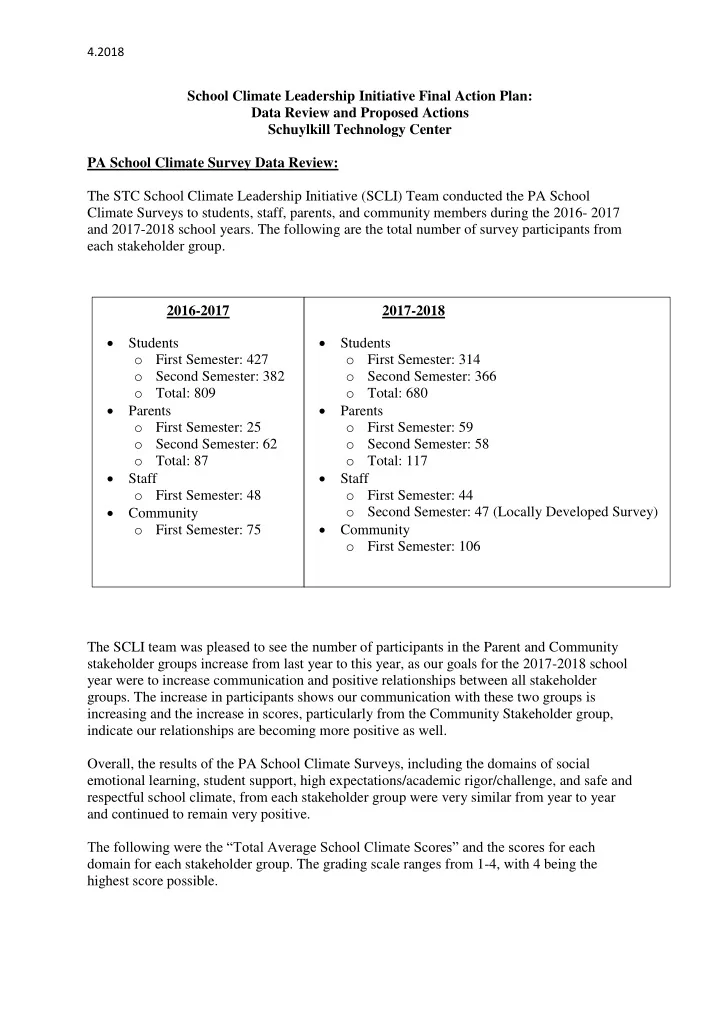
School Climate Leadership Initiative Final Action Plan: Data Review and Proposed Actions Schuylkill Technology Center PA School Climate Survey Data Review: The STC School Climate Leadership Initiative (SCLI) Team conducted the PA School Climate Surveys to students, staff, parents, and community members during the 2016- 2017 and 2017-2018 school years. The following are the total number of survey participants from each stakeholder group. The SCLI team was pleased to see the number of participants in the Parent and Community stakeholder groups increase from last year to this year, as our goals for the 2017-2018 school year were to increase communication and positive relationships between all stakeholder

  • groups. The increase in participants shows our communication with these two groups is

increasing and the increase in scores, particularly from the Community Stakeholder group, indicate our relationships are becoming more positive as well. Overall, the results of the PA School Climate Surveys, including the domains of social emotional learning, student support, high expectations/academic rigor/challenge, and safe and respectful school climate, from each stakeholder group were very similar from year to year and continued to remain very positive. The following were the “Total Average School Climate Scores” and the scores for each domain for each stakeholder group. The grading scale ranges from 1-4, with 4 being the highest score possible. 2016-2017  Students

  • First Semester: 427
  • Second Semester: 382
  • Total: 809

 Parents

  • First Semester: 25
  • Second Semester: 62
  • Total: 87

 Staff

  • First Semester: 48

 Community

  • First Semester: 75

2017-2018  Students

  • First Semester: 314
  • Second Semester: 366
  • Total: 680

 Parents

  • First Semester: 59
  • Second Semester: 58
  • Total: 117

 Staff

  • First Semester: 44
  • Second Semester: 47 (Locally Developed Survey)

 Community

  • First Semester: 106
slide-2
SLIDE 2

4.2018

Students

PA School Climate Survey Data: Students (Semester 1) 2016-2017 2017-2018

  • a. Total Average School Climate Score

2.93 2.92

  • b. Social Emotional Learning Average Domain Score

2.80 2.79

  • c. Student Support Average Domain Score

3.06 3.09

  • d. High Expectations/Academic/Challenge Average Domain

Score 2.68 2.65

  • e. Safe School Climate Average Domain Score

3.14 3.11 PA School Climate Survey Data: Students (Semester 2) 2016-2017 2017-2018

  • a. Total Average School Climate Score

2.97 2.91

  • b. Social Emotional Learning Average Domain Score

2.84 2.80

  • c. Student Support Average Domain Score

3.13 3.08

  • d. High Expectations/Academic/Challenge Average Domain

Score 2.67 2.64

  • e. Safe School Climate Average Domain Score

3.17 3.07

Parents

PA School Climate Survey Data: Parents (Semester 1) 2016-2017 2017-2018

  • a. Total Average School Climate Score

3.26 3.40

  • b. Social Emotional Learning Average Domain Score

3.24 3.25

  • c. Student Support Average Domain Score

3.33 3.45

  • d. High Expectations/Academic/Challenge Average Domain

Score 3.25 3.38

  • e. Safe School Climate Average Domain Score

3.23 3.43 PA School Climate Survey Data: Parents (Semester 2) 2016-2017 2017-2018

  • a. Total Average School Climate Score

3.45 3.33

  • b. Social Emotional Learning Average Domain Score

3.38 3.30

  • c. Student Support Average Domain Score

3.43 3.36

  • d. High Expectations/Academic/Challenge Average Domain

Score 3.48 3.30

  • e. Safe School Climate Average Domain Score

3.48 3.33

Staff

PA School Climate Survey Data: Staff 2016-2017 2017-2018

  • a. Total Average School Climate Score

2.96 3.04

  • b. Social Emotional Learning Average Domain Score

3.61 2.56

  • c. Student Support Average Domain Score

2.65 3.35

  • d. High Expectations/Academic/Challenge Average Domain

Score 2.88 3.24

  • e. Safe School Climate Average Domain Score

3.28 3.14

slide-3
SLIDE 3

4.2018

Community

PA School Climate Survey Data: Community 2016-2017 2017-2018

  • a. Total Average School Climate Score

2.92 3.04

  • b. Social Emotional Learning Average Domain Score

2.96 3.04

  • c. Student Support Average Domain Score

2.74 3.14

  • d. High Expectations/Academic/Challenge Average Domain

Score 2.91 3.02

  • e. Safe School Climate Average Domain Score

3.10 3.01 PA School Climate SCLI Team Readiness Survey Data Review: As part of the School Climate Initiative, the School Climate Leadership Initiative (SCLI) Team must complete the team Readiness Survey at the beginning and end of each school

  • year. This self-study tool allows the team to answer the questions “where are we now?” and

“where do we need to focus our attention to improve school climate?” This information is crucial to the School Climate Initiative as it tells us whether or not our faculty is truly ready to undertake change in our school. It is also essential to determining whether or not growth is taking place internally. The following are the results of the School Climate Leadership Initiative (SCLI) Team Readiness Surveys from October 2016 and November 2017. The survey rubric is also included for your reference. Readiness Survey Rubric: Note: The bars represent the mean (average) score of each domain.

Index Range Description Nothing in Place (1.0-1.9) Schools with an index in this range need intensive support to set in motion an effective school climate improvement process. Getting Started (2.0-2.9) Schools with an index in this range need targeted-to-intensive support to improve readiness to support a successful school climate improvement process. Partially in Place (3.0-3.9) Schools with an index in this range need some targeted support to improve readiness to embark on an effective school climate and to create favorable conditions for learning and healthy development. Mostly in Place (4.0-4.9) Schools with an index in this range are ready to embark on a successful school climate improvement process. There are areas that can be further developed. Fully in Place (5.0) Schools with an index in this range are immediately ready to embark on a successful school climate improvement process. Naturally, there is always room for improvement and further development.

slide-4
SLIDE 4

4.2018

Schuylkill Technology Center: SCLI Team Readiness Results: October 2016: Schuylkill Technology Center: SCLI Team Readiness Results: November 2017:

Figure 1: Mean Domain Scores

5.00 4.50 4.00 2.36 2.18 2.00 1.89 1.94 1.83 1.52 1.50 Trust & Collaboration Learning Communities

Figure 1: Mean Domain Scores

4.00 3.01 3.00 2.85 2.84 2.70 2.72 2.50 2.41 2.00 1.50 Trust & Collaboration Learning Communities

slide-5
SLIDE 5

4.2018

Data Conclusion: After reviewing the data, the STC School Climate Leadership (SCLI) Team has determined that

  • ur efforts to create a more positive school climate and culture have been successful so far. The

increased scores on the readiness survey indicate the SCLI team feels confident in our ability to make positive changes and that our efforts thus far have prompted growth. The PA School Climate Survey data suggests all stakeholder groups have a positive view of the Schuylkill Technology Center. The data has remained similar from last year to this year, or in the case of the Community Stakeholder group, increased, which is our ultimate goal for all stakeholder groups. The SCLI team anticipates our numbers to grow next year due to the initiatives we have put in place during the 2017-2018 school year. The team will continue to collect and monitor data as

  • ur initiative continues to expand.

School Climate Successes: The School Climate Leadership Initiative (SCLI) Team has developed and implemented many initiatives over the last two years. We have been very fortunate that many of these initiatives have been greatly successful! The following is a list of some of those initiatives:  2017-2018 PDE Safe Schools Targeted Program Grant Recipient- $11, 250.00  2017-2018 PDE School Climate Leadership Grant Recipient- $4,314.00  School Rush- Home-School Communication System  STC Online School Store  Online Bully Box and SAP Referral System  In-Service: ALICE, Drug and Alcohol, Social/Emotional Learning  Student Social/Emotional Learning Training  Student Ambassador Program  Breakfast With Santa  STC Tech Trot 5K/Fun Run  Knoebels Family Appreciation Day  Spring Fling Semi-Formal  50th Day and End-of-Year Celebrations  Social Media Communications/Promotions- FB and Twitter Pages  Connecting Communities of Courage Conference- California  National School Climate Center- Lessons from the Field Study Participant

slide-6
SLIDE 6

4.2018

National School Climate Center (NSCC) Lessons From the Field Study: The Schuylkill Technology Center was chosen as 1 of 6 schools from across the nation to participate in the Lessons from the Field project. STC is also the only Career and Technical Education Center involved in the study. The study includes 3 phases: Background Research, Site Visit, and Data Validation. The Schuylkill Technology Center’s School Climate Initiative also received a $3,000.00 stipend to be used for future School Climate projects.  Site Visits will be conducted: South Campus- Thursday, April 26, 2018 North Campus- Friday, April 27, 2018  Site Visits will include: (per building) Administrative and Staff Interviews Classroom Observations and Walk-Throughs Staff Focus Group Student Focus Group The SCLI team is looking forward to the opportunity to share our successes and challenges with the NSCC team and get feedback about how to continue setting the standard for school climate improvement. Action Steps The data from each stakeholder group highlighted two specific areas of concern which were used to develop the mid-year action plan. The objectives of the mid-year action plans are as follows:

  • 1. To continue analyzing data sources for all stakeholder groups to better inform the SCLI

team about what initiatives could be the most beneficial for all stakeholders.

  • 2. To continue implementing and assessing our current School Climate initiatives and

altering them so they are as successful as possible. The School Climate Leadership Team (SCLT) developed an action plan outlining the steps necessary to improve these two areas of need identified. The SCLT is continuing to analyze more data sources and is researching programs, initiatives, and best practices for possible future implementation to continue nurturing positive relationships and increase communication between STC administration, faculty, and staff and all stakeholders.

slide-7
SLIDE 7

4.2018

Proposed Ideas to Meet Identified Needs The SCLI team is currently in the process of creating our end-of-year action plan, which will become the framework for the 2018-2019 School Climate Initiative. There have been many suggestions and ideas discussed during the SCLI Team meetings about potential supports, programs, and technology that could be implemented at the Schuylkill Technology Center. Some

  • f these resources would require ongoing financial support, while others involve systemic

change; initiatives proposed at this time for administrative consideration include:

  • 1. Implementing Restorative Practices

The most noticeable concern for both staff and students from the PA School Climate Survey data continues to be the need for the development of social and emotional skills and strategies. To better implement the concepts of Social Emotional Learning we have been working to incorporate this school year, our SCLI team members believe the next step is adding restorative practices as a norm at STC. Restorative practice is an emerging social science that studies how to strengthen relationships between individuals as well as social connections within communities. As relationships and communications are the basis for our school climate initiative, we feel utilizing this norm will make our efforts stronger and even more successful.

  • 2. Creation of Peer Support Groups

Through the School Climate Initiative, our SCLI team members have realized that many

  • f our students are struggling with similar issues. Whether it is losing someone close to

them, being a victim of bullying, facing family financial situations at home, etc., many of

  • ur students are dealing with issues outside of school that can and many times do affect

their school experience. Creating Peer Support Groups was the suggestion of our Student

  • Ambassadors. The students believe being able to talk through their experiences with
  • ther students will help them cope with the difficulties they face and give them new

suggestions about how others manage similar issues.

  • 3. Utilization of ClassMate Parents Portal

To continue expanding the lines of communication between STC and parents, the SCLI team members and administration believe utilizing the ClassMate Parent Portal will be a great opportunity. The ClassMate Parent Portal is a secure site that allows only authorized parent contacts to easily access important student information. The Parent Portal enables parents to communicate directly with the child's teacher via email to discuss or inquire about their child's progress. They can also set up alerts via email which will allow them to receive notices for specific attendance, grade and discipline

  • conditions. Regular communication between parents and the child's teacher(s) is an

important part of every child's educational success. The ClassMate Parent Portal will be an additional expense. Pricing is currently being researched through the IT department.

slide-8
SLIDE 8

4.2018

  • 4. Implementation of the Remembering Adam “Pledge Together” Initiative

The Remembering Adam “Pledge Together” initiative will be introduced as a part of the Positive Norms Campaign. The goal of this program is to encourage students to live a healthy, drug-free lifestyle. Through this voluntary drug screening program, students receive encouragement, guidance, and positive reinforcement to be drug free. Students entering the workforce in most of our career pathways will be expected to pass a drug screening before obtaining employment in their fields. This program will allow students to gain the knowledge and skills they need to maintain a healthy, drug-free lifestyle now as well as when they are adults in the workforce. This program is completely free for the first year of implementation. All subsequent years will require funding which is calculated based on the number of students participating in the program from year to year. Based on last year’s enrollment, the president of Remembering Adam, Inc., Deborah Fowler, projected the program could be run at both the North and South Campuses for less than $1,000.00 total per year.

  • 5. Implementation of Positive Norms Campaign/PBIS

The School Climate Leadership team plans to continue to research and discuss the possibility of implementing PBIS in the future. As part of the research, the team will continue to developing and implement a Positive Norms Campaign as a foundation for a larger, more involved PBIS initiative. This campaign will aim to increase positive student and faculty relations and to create a more positive overall school climate. The data from this initiative will be used in the discussion and consideration of the implementation of a more intensive PBIS initiative in the future.

  • 6. Research Counseling for Careers

A connection to the goals of the Counseling for Careers initiative will be researched to determine the possibility of working with the SREB initiative to develop a mentor

  • program. Lynn Anderson of SREB offered to conduct trainings via webinar for our SCLI

team and instructors to help build and implement a faculty-staff mentor program. Part of this program may also focus on enhancing college and career exploration for students. The SCLT projects to implement at the start of the 2019-2020 school year. End-of-Year Action Plan The final action plan to be implemented in 2018-2019 will be submitted to the Pennsylvania Department of Education (PDE) in May 2018.