D R Y T O R T U G A S Randy & Kim Kalisik O V E R V I E W - - PowerPoint PPT Presentation

d r y t o r t u g a s
SMART_READER_LITE
LIVE PREVIEW

D R Y T O R T U G A S Randy & Kim Kalisik O V E R V I E W - - PowerPoint PPT Presentation

C R U I S I N G T O T H E D R Y T O R T U G A S Randy & Kim Kalisik O V E R V I E W INTRODUCTION About us and about Blue Turtle, our trawler ABOUT THE DRY TORTUGAS History, facts, things to do, and park rules


slide-1
SLIDE 1

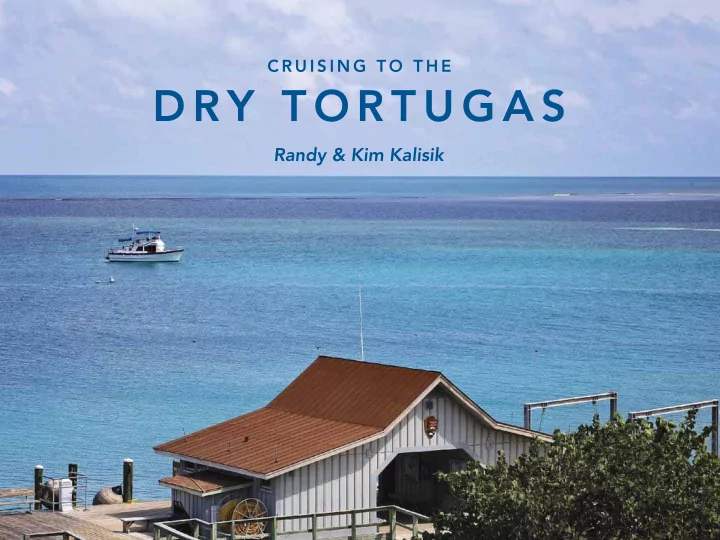
D R Y T O R T U G A S

C R U I S I N G T O T H E

Randy & Kim Kalisik
slide-2
SLIDE 2
  • INTRODUCTION


About us and about Blue Turtle,

  • ur trawler
  • ABOUT THE DRY TORTUGAS


History, facts, things to do, and park rules

  • PRE-TRIP


Provisioning and pre-trip checklist

  • GETTING THERE


Cruising considerations and navigating there

  • ARRIVING


Anchoring, checking in (boat permits/fees) and sooty terns

  • SNORKELING & DIVING


Equipment check, snorkel & dive sites and getting the most out of it

  • FISHING


Park & state regulations, fishing spots and type of fish caught

O V E R V I E W

slide-3
SLIDE 3

IN TRO D UC TIO N

slide-4
SLIDE 4

A BO UT US

  • Full time live aboard for 7 years on Fort

Myers Beach with our son, Corey and dog, Sophie

  • Both work full time - Kim owns a web

design business, Randy is a manufacturer’s rep for industrial products

  • Cruising around southwest Florida, the

Keys and Dry Tortugas

  • Very active in fishing, diving, snorkeling,

wake boarding and other water sports

  • Randy is a U.S.C.G. Licensed Master

Captain

  • Blog about living aboard and cruising at

www.blueturtletrawler.com

slide-5
SLIDE 5

A BO UT BLUE TURTLE

  • 1974 40’ DeFever Passagemaker Trawler
  • Single screw (185hp Perkins) with bow

and stern thrusters

  • Cruising speed 6.5 - 7.5 knots
  • 2 gallons per hour fuel consumption
  • Full displacement hull
  • 200 gallons water capacity
  • 500 gallon fuel capacity
  • 40 gallon holding tank
  • 9 foot dinghy with 15 hp motor
slide-6
SLIDE 6
slide-7
SLIDE 7

ABO UT TH E D RY TO RTUG AS

slide-8
SLIDE 8

W H Y C RUISE TO TH E D RY TO RTUG A S?

  • It’s one of the least visited parks in the U.S.

National Park Service

  • Uncrowded, isolated and unspoiled preserve

lacking any commercialism

  • Intriguing history and abundant wildlife
  • Reefs are in great shape and perfect for

snorkeling and diving

THINGS TO DO:

  • Explore Fort Jefferson
  • Camping
  • Fishing
  • Kayaking/paddle sports
  • Swimming, snorkeling

and diving

  • Wildlife viewing / bird

watching

  • Explore Loggerhead

Key

  • Watch the sun rise and

set on the Gulf of Mexico

  • Stargazing - No light

pollution

slide-9
SLIDE 9
slide-10
SLIDE 10
slide-11
SLIDE 11

LO C A TIO N

  • Small group of islands located 70 miles west of Key West and 90

miles north of Cuba at the northwest entrance to the Florida Straits

slide-12
SLIDE 12

7 ISLA N D S TO TA L

  • Loggerhead Key, Garden Key, Bush Key, Long Key, Hospital Key, Middle Key, and

East Key

  • Garden Key and Loggerhead Key can be visited year-round
  • Bush Key is seasonally closed during the sooty tern nesting season
  • Originally, there were 11 islands; 4 of them were reclaimed by the sea by the 1930’s
slide-13
SLIDE 13
slide-14
SLIDE 14

A BO UT TH E PA RK

  • Called “ Dry” Tortugas

because of the absence of fresh water on the island

  • Designated as a National

Monument in 1935 and became a National Park in 1992. Dry Tortugas Park is over 64,000 acres, but only 1% is dry land

  • One of the least visited parks

in the U.S. National Park System with just over 70,000 visits in 2016

slide-15
SLIDE 15
  • Accessible only by sea plane, ferry (out of Key West) or private vessel
  • Ferry visitors are at the fort from 10:30 am - 3pm
slide-16
SLIDE 16
  • Tortugas coral reefs are the end of the third largest reef in the world, the

Florida Reef system - ending within a few miles of the Gulf Stream where the Gulf of Mexico, Atlantic Ocean, and the Caribbean Sea collide

slide-17
SLIDE 17
  • Tropical bird breeding grounds - Over 299 species including the Sooty

Tern, Brown Noddy, Frigate birds, Cormorants, Pelicans and more.

slide-18
SLIDE 18
  • Since the Dry Tortugas islands are closer to Cuba than Miami, Cuban

migrants attempt to land here on homemade boats called “ chugs”

Credit: Jennifer Macaulay via Flickr

slide-19
SLIDE 19

PA RK RULES

  • Pets are allowed on Garden Key

but not inside the fort

  • Operation of drones is prohibited

within the park

  • Jet skis are prohibited in the park
  • Kayaks, canoes and small dinghys

may be beached in designated areas

  • Collecting of lobsters and

Spearfishing is prohibited

  • Fishing is permitted on Garden

Key in specified areas and outside the Research Natural Area (refer to park map)

  • Pack in, pack out park – all

campers, visitors and boaters must take out what they brought in

slide-20
SLIDE 20

TO TA L ISO LA TIO N

  • No available fresh water – i.e. “ Dry” Tortugas
  • No restaurants or shops of any kind; only lodging

facilities is a primitive camp ground

  • No cell or WiFi service – Park Ranger office posts

printed 3-day weather forecasts

  • Park recommends campers bring two gallons of water

per person per day as well as extra 2 days of food

slide-21
SLIDE 21
slide-22
SLIDE 22

H ISTO RY

  • Named Las Tortugas (The Turtles) in 1513 by

Spanish explorer Ponce de León

  • Later labeled “ Dry Tortugas” on mariner

charts to indicate it offered no fresh water

  • Became a major shipping channel in the

1800s connecting the Atlantic Ocean waters with the Gulf of Mexico

  • Known as a “ ship trap” because of the

shallow waters, swift currents and hurricanes causing numerous wrecks (250 documented)

  • “ Wrecking” - the salvage operation industry

quickly grew and became the main industry that contributed to the building of Key West

  • U.S. realized that if they occupied and

fortified this area, the Dry Tortugas could be the “ advance post” for the defense of the Gulf Coast

  • Construction began on Fort Jefferson in

1846

slide-23
SLIDE 23

G A RD EN KEY A N D FO RT J EFFERSO N

  • Garden Key is the second largest island, about 14 acres in size
  • Home to Fort Jefferson, park headquarters, visitor center,

campgrounds and great snorkeling areas

slide-24
SLIDE 24
  • Fort Jefferson was the largest and most sophisticated of the “ Third System” coastal

forts that were being built following the War of 1812

  • It was designed as a six-sided, four-tiered building, capable of mounting 420 guns
  • Even though construction spanned over 30 years, the fort was never finished and shot

was never fired

slide-25
SLIDE 25
  • It is considered the largest brick masonry structure in the Western

Hemisphere

  • Made up of 16 Million bricks and has over 2,000 brick arches
slide-26
SLIDE 26
  • Two different types of brick were used in construction: Northern red clay brick (top)

which didn’t hold up well in the humid subtropical environment and southern brick from near Pensacola, FL which was harder and more durable (bottom)

slide-27
SLIDE 27

Though never finished, Fort Jefferson served many purposes through the years:

  • During the Civil War, it

remained in Union hands and was used in their campaign to blockade Southern shipping

  • Military prison mainly for

Union deserters but also for famous civilian prisoner Dr. Samuel Mudd, who had been convicted for conspiracy in the death of President Lincoln.

  • After being abandoned by

the Army, it was later used as a a quarantine station for Marine Hospital Service and coaling station for war ships

slide-28
SLIDE 28
  • 6 Rodman cannons and 4 Parrott rifled cannons in the fort are some of the

rarest examples of 19th Century seacoast artillery in existence.

slide-29
SLIDE 29
  • Unlike other forts in the states, Fort Jefferson has little in the way of railings

and enclosures. Watch your footing when walking on the top perimeter.

slide-30
SLIDE 30
slide-31
SLIDE 31

Traverse Magazine

slide-32
SLIDE 32
slide-33
SLIDE 33

Powder Magazine Hot Shot Furnace

slide-34
SLIDE 34

LO G G ERH EA D KEY

  • Located 3 miles from Garden Key, it is the largest of the Dry Tortugas islands.
  • Amazing snorkeling and diving at nearby reefs and wreck - Little Africa and

Windjammer Wreck

slide-35
SLIDE 35
  • The Dry Tortugas

Light was constructed in 1856 to replace the lighthouse

  • n top of Fort

Jefferson which proved to be too short, too dim, and too far away from other reefs.

  • Both lighthouses

were the only lights on the Gulf coast throughout the American Civil War

slide-36
SLIDE 36
slide-37
SLIDE 37
slide-38
SLIDE 38
  • Cutting-edge marine laboratory located there that conducted some of the

the most significant scientific research of the Dry Tortugas from 1905 to 1939

  • One of the scientific contributions include the first underwater black and

white and color photography.

slide-39
SLIDE 39
slide-40
SLIDE 40
slide-41
SLIDE 41

P RE - TRIP

slide-42
SLIDE 42

PRO VISIO N IN G

  • The Park recommends 2 gallons of water per

person per day and an extra 2 days of food in case

  • f bad weather
  • If you have adequate freezer and storage space,

stock up on non-perishable foods (Canned goods, frozen meat, dry goods like rice and pasta)

  • To save space and fit more food, remove items

from boxes and large cartons and repack in plastic

  • If you have a small fridge, keep beverages in a

separate cooler for the first couple days and move them into the refrigerator as space is made available

  • Water-conservation tips: washing dishes in salt

water followed by fresh water rinse; using salt water and a bucket to rinse your decks

  • Carry extra water by purchasing jerry cans or

bladders to fill with fresh water as well as using solar showers

slide-43
SLIDE 43

PRE- TRIP C H EC KLIST

  • Check running lights (if cruising at night)
  • Have bottom and running gear dove and

cleaned

  • Check engine maintenance
  • Bring spare fuel filters and impellers
  • Bring extra oil, transmission oil and

coolant

  • Fill fuel and water
  • Pump holding tank
  • Check diving and snorkeling equipment

Keep in mind that there are no stores to buy food, water, spare parts, etc.

slide-44
SLIDE 44

G E TTIN G TH E RE

slide-45
SLIDE 45

C RUISIN G C O N SID ERA TIO N S

  • Located in the Gulf of

Mexico at the end of the Florida Keys, about 70 miles west of Key West

  • Check the long term

weather forecast for winds, hurricanes, or fronts to make sure you have an

  • ptimal weather window
  • Summer has afternoon thunderstorms and more

predictable weather patterns

  • Winter has cold fronts which can bring high wind

and seas

slide-46
SLIDE 46
  • Departing or returning to Key West - cruise on north or

south side of islands depending on wind and swell direction

slide-47
SLIDE 47

Marquesas Key & Rebecca Shoal

slide-48
SLIDE 48

C RUISIN G SC EN A RIO S

  • Our trip from Fort Myers to the Dry Tortugas was 120 miles and took 18 hours
  • Cruising 1-day vs. 3-days (depending on your location)
  • We anchored out in a pass the night before to make it easier and quicker to

leave in the early a.m.

slide-49
SLIDE 49

A RRIVIN G

slide-50
SLIDE 50

A N C H O RIN G

  • Vessels anchor at the

Tortugas Anchorage or Bird Key Anchorage

  • Anchorage is 20-30’ deep and

coarse sandy bottom. Scope 5-7 times depth.

  • We have an anchor designed

for a 50’ boat and 100 feet of chain.

  • It’s common seeing boats

drag anchor

  • Keep 16 on at night as rangers

hail when a boat is adrift

slide-51
SLIDE 51
slide-52
SLIDE 52

C H EC KIN G IN

  • Use the designated area for

leaving your dinghy on shore

  • The entrance fee for the

park is $10.00 per visitor. This fee covers entrance to the park for 7 days. You may stay a maximum of 14 days at one time.

  • A free-of-charge boat

permit must be obtained and can be acquired from park rangers on site or contact VHF Marine Radio Channel 16

slide-53
SLIDE 53

A N O TE A BO UT SO O TY TERN S

  • About 80,000 Sooty Terns nest

annually on Bush Key near the anchorage

  • Bush Key is closed seasonally

to the public because of the nesting ground (February - September)

  • The birds can present a messy

problem for boaters anchoring in the area with their droppings

  • We have used an osprey kite

the last couple of years and it seemed to keep them away quite well

slide-54
SLIDE 54

S N O RKE LIN G A N D D IVIN G

slide-55
SLIDE 55

EQ UIPM EN T C H EC K

  • Test snorkel and dive

gear in a pool to make sure everything works

  • Bring spare equipment if

you have it — things break and there are no local dive shops to visit for repairs

  • Bring enough dive tanks

for your trip since there’s no where to get air fills

slide-56
SLIDE 56

SN O RKELIN G SITES

  • Garden Key
  • Little Africa
  • Windjammer Wreck
  • Brick Wreck
slide-57
SLIDE 57
slide-58
SLIDE 58

GARDEN KEY

  • The closest snorkeling spot is around the fort moat wall and coal dock ruins. You can night

snorkel around the mote as well.

slide-59
SLIDE 59
slide-60
SLIDE 60
slide-61
SLIDE 61

LITTLE AFRICA

  • Located on the west side of Loggerhead Key is a huge shallow reef perfect for snorkeling.
slide-62
SLIDE 62
slide-63
SLIDE 63

3 WAYS TO GET TO LITTLE AFRICA

  • 1. Dinghy to dinghy access area on calm day and walk across the island
  • 2. Grab mooring ball on east side and ding to shore and walk across
  • 3. Grab mooring ball on west side of island and snorkel to area
slide-64
SLIDE 64
slide-65
SLIDE 65

WINDJAMMER WRECK

  • Located less than a mile southwest of Loggerhead Key
  • In 1907 a 261 ft., 3-masted vessel named Avanti struck the Loggerhead reef after a navigational

error and sank

  • Wreck lies in 18-21 feet of water and makes a great snorkel or dive. Watch the current, it can be

swift at times.

slide-66
SLIDE 66

A VA N TI

W IN D J A M M E R W RE C K

slide-67
SLIDE 67
slide-68
SLIDE 68
slide-69
SLIDE 69
slide-70
SLIDE 70

BRICK WRECK

  • Sometime between 1857 and 1861 a flat bottom steamboat carrying bricks for the fort

ran aground

  • Lies in 4-6 feet of water. There is a very strong current there
  • No mooring ball, must anchor
slide-71
SLIDE 71

D IVIN G SITES

  • Off Ramp
  • The Maze
  • Davis Rock
  • Texas Rock
slide-72
SLIDE 72

OFF RAMP

  • Isolated reef outcroppings with staghorn coral on the western side
  • Depths 25 feet and shallower
slide-73
SLIDE 73

THE MAZE

  • Coral caverns, swim-through pinnacles and straight up vertical relief
  • Depths 20-60 feet
slide-74
SLIDE 74

DAVIS ROCK

  • Large crevices run through the middle of this pinnacle reef
  • Depths 20-45 feet
slide-75
SLIDE 75

TEXAS ROCK

  • Large crevices, caves, swim-through, cracks, pinnacles and lots of

vertical relief

  • Depths 20-60 feet
slide-76
SLIDE 76

GETTING THE MOST OUT OF SCUBA DIVING AND CONSERVING AIR

  • We dove only half tanks in order to conserve air and get to see more spots
  • We would dive a half tank in the a.m. and then stop at Little Africa on the way back to

snorkel for a long as we wanted

  • Little Africa is one of the best snorkel spots we’ve seen. It is 3 miles from anchorage and on

a calm day is a very easy dinghy trip (on plane). Make sure to bring a hand-held VHF radio.

slide-77
SLIDE 77

F IS H IN G

slide-78
SLIDE 78

FISH IN G

  • Fishing is permitted within 1 mile
  • f Garden Key
  • 1 mile is marked by yellow buoys
  • Spearfishing is not permitted

anywhere in the park boundaries

  • Follow Florida Gulf of Mexico

fishing regulations

  • We fished by dinghy and it was

helpful to have a snorkel ready

  • Yellowtail snapper, mutton

snapper, grouper, hogfish, bonefish, tarpon, shark

  • We caught snapper with a jig
slide-79
SLIDE 79
  • From Garden Key, you can only fish on the ferry dock
  • From the ferry dock we saw tarpon and mangrove snapper
slide-80
SLIDE 80
slide-81
SLIDE 81
slide-82
SLIDE 82

TO RTUG A S BA N K

  • Located about

11 miles from Garden Key

  • Spearfishing is

allowed since it lies outside of the park boundaries

  • If you catch a

fish, you should call it in to the ranger station before entering park boundaries

slide-83
SLIDE 83
  • The reef is marked by several mooring balls
  • Depths are 40’ to 110’ deep
slide-84
SLIDE 84

Q & A

FOR BLOG POSTS AND LINKS ABOUT THE DRY TORTUGAS, VISIT: www.blueturtletrawler.com/dry-tortugas PASSAGEMAKER ARTICLE:

Tortugas Bound! Exploring Florida's last piece of wilderness www.passagemaker.com/destinations/ tortugas-bound Presented by:
 Randy and Kim Kalisik

slide-85
SLIDE 85

Q & A

FOR BLOG POSTS AND LINKS ABOUT THE DRY TORTUGAS, VISIT: www.blueturtletrawler.com/dry-tortugas PASSAGEMAKER ARTICLE:

Tortugas Bound! Exploring Florida's last piece of wilderness www.passagemaker.com/destinations/ tortugas-bound Presented by:
 Randy and Kim Kalisik