SLIDE 1
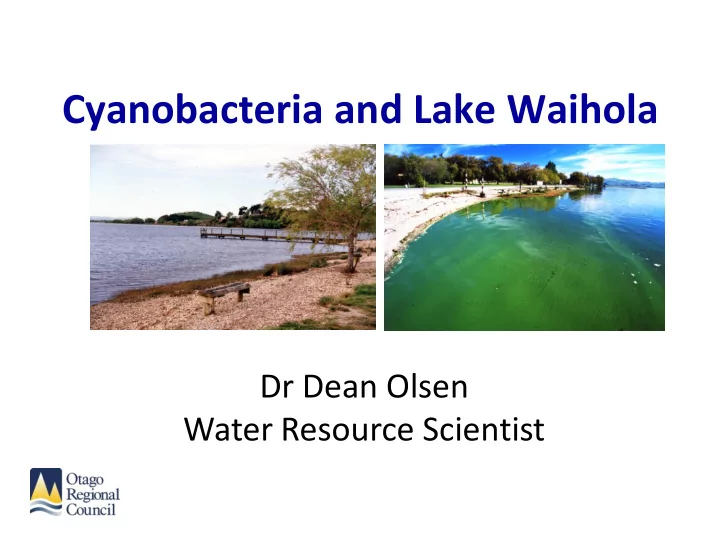
Cyanobacteria and Lake Waihola
Dr Dean Olsen Water Resource Scientist
SLIDE 2 What are cyanobacteria?
- Blue-green algae
- Photosynthetic bacteria
- Found in almost all
terrestrial and aquatic habitats
SLIDE 3 Freshwater cyanobacteria
- Planktonic or benthic
- Can form dense blooms
→water quality issues →Toxins (possible)
- Drinking water
- Swimming
- Animals
- Fish
- Shallow, eutrophic lakes (but not
necessarily)
SLIDE 4 Blooms & scums
- Not a new issue in NZ & widespread
Pridmore & Etheredge 1987
- Planktonic cyanobacteria detected in
127 NZ lakes
- Conspicuous blooms/scums reported
from 33 NZ lakes (including Waihola) Wood et al. (2006)
- 37 lakes (incl. Waihola) screened for
toxins
- Microcystins most abundant class of
cyanotoxin in NZ
SLIDE 5
Dr Susie Wood Cyanobacteria guru
SLIDE 6 Wind
Very thick scum!
How scums form
SLIDE 7
Lake Rotorua, Kaikour
SLIDE 8 Lake Waihola
- Cyanobacteria blooms have occurred
previously
- E.g. summer 2001/2002
- Anabaena lemmermannii
- Microcystin 1.7 µg/L
- Drinking water MAV (provisional) :
1 µg/L
- Nutrient levels not likely
to be limiting algal growth
Anabaena planktonica
SLIDE 9
Karori Reservoir, Wellington
Not limited to Waihola...
SLIDE 10 Cylindrospermopsis sp. Anabaena sp. Microcystis sp.
Karori Res.
SLIDE 11 Lake Horowhenua - Levin
Microcystis sp.
SLIDE 12
SLIDE 13
Cyanotoxins
SLIDE 14
Three broad classes: Hepatotoxins = damage liver Microcystin eg: Microcystis, Anabaena Nodularin eg: Nodularia Cylindrospermopsin eg: Cylindrospermopsis Neurotoxins = affect nervous system Anatoxin-a eg: Aphanizomenon, Anabaena Saxitoxin eg: Lyngba, Anabaena Dermatotoxins = skin irritants Lyngbyatoxin-a eg: Lyngba, Anabaena Aplysiatoxins Lipopolysaccharides eg: most spp.
Cyanotoxins
SLIDE 15 H H H H H OCH3 NH O HN O N NH NH O O O COOH H H H H COOH H
Y X
H H H H H OCH3 NH O HN O N NH NH O O O COOH H H H H COOH H
Y X
- Globally the most frequently found
cyanotoxin
- Some cases of human deaths from
drinking contaminated water
- Inhibitors of protein phosphatases
enzymes
- Liver tumor promoters
- WHO guideline value for DW of
1µg/L (MC-LR)
Microcystis aeruginosa
Microcystins
SLIDE 16 Anatoxin-a & Homoanatoxin-a
- Not identified from Waihola
- Neurotoxin
- Rapid death from respiratory arrest
- Numerous dog deaths in NZ
- Esp. Benthic cyanobacteria in rivers
H N CH3 O
SLIDE 17 Dermatotoxins
- Severe dermatitis
- Burning or itching skin
- Red eyes & lips
- Asthma symptoms
- Sore throat
- Dizziness
SLIDE 18 Safety considerations
- Significant health consequences from
drinking contaminated water
- Humans
- Animals (esp. dogs & horses)
- Swimming or showering/bathing
- Dogs
- Contaminated irrigation water can
deposit toxins & cells on crops
SLIDE 19 Take-home messages
- Blooms are likely to develop from time to
time
- Settled, warm weather
- Precautions during blooms:
- Don’t drink lake water (boiling won’t
remove toxins
- Including stock water
- Minimise contact with water
- Keep dogs out of water
- Don’t irrigate using lake water during
SLIDE 20 Bloom detected Sample(s) collected
Low biomass
No further action
High biomass
Warning signs and ongoing sampling
- No routine monitoring for cyanobacteria in
Otago
- Rely on public and/or ORC staff to report
SLIDE 21 Thanks!
- A massive thanks to Susie Wood
(Cawthron Institute) who provided much of the material for this presentation