Identification of Cyanobacteria and Potential for Future Blooms - - PowerPoint PPT Presentation

identification of cyanobacteria and
SMART_READER_LITE
LIVE PREVIEW

Identification of Cyanobacteria and Potential for Future Blooms - - PowerPoint PPT Presentation

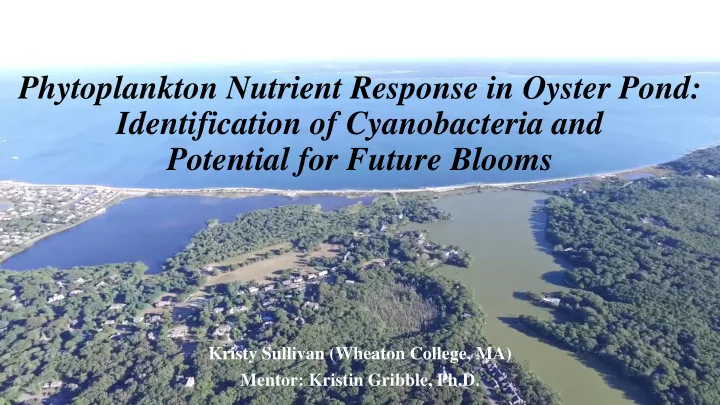
Phytoplankton Nutrient Response in Oyster Pond: Identification of Cyanobacteria and Potential for Future Blooms Kristy Sullivan (Wheaton College, MA) Mentor: Kristin Gribble, Ph.D . Are cyanobacteria present in the water and/or overwintering in


slide-1
SLIDE 1

Phytoplankton Nutrient Response in Oyster Pond: Identification of Cyanobacteria and Potential for Future Blooms

Kristy Sullivan (Wheaton College, MA) Mentor: Kristin Gribble, Ph.D.

slide-2
SLIDE 2

Are cyanobacteria present in the water and/or

  • verwintering in the sediment?

What nutrient conditions could stimulate a bloom next summer?

slide-3
SLIDE 3
  • Oyster Pond water profiles
  • Water incubations (Control, P, N,

N & P)

  • Sediment incubations (Control,

P, N, N & P)

  • Fluorescence
  • Cyanobacteria counts
  • Microscopy
  • PCR & sequencing
slide-4
SLIDE 4

Microcystis

slide-5
SLIDE 5

Aphanocapsa

slide-6
SLIDE 6

3000 bp 1000 bp 500 bp

A? A M A M

  • Microcystin synthetase gene B

(350 bp)

  • Part of 10 gene cluster

involved in biosynthesis of microcystin

  • 16S rRNA gene (700 bp)

Neg

350 700

slide-7
SLIDE 7

Filamentous Cyanobacteria Non- Filamentous Other bacteria

slide-8
SLIDE 8

1000 2000 3000 4000 5000 6000 Average # Colonies mL-1

Microcystis colonies in Sediment

Initial Control P N N & P

slide-9
SLIDE 9
  • 500

500 1000 1500 2000 2500 3000 3500 4000 4500 Water Sediment Water Microcystis cells mL-1

Microcystis cell counts

Control P N N & P

slide-10
SLIDE 10

20,000 40,000 60,000 80,000 100,000 120,000 Water Sediment Water Aphanocapsa cells mL-1

Aphanocapsa cell counts

Control P N N & P

slide-11
SLIDE 11

0.00 1.00 2.00 3.00 4.00 5.00 6.00 7.00 8.00 9.00 1 2 3 4 5 6 7 8 Fluorescence (µg L-1) Days

Average Fluorescence Water Incubation #2

Control P N N & P

slide-12
SLIDE 12

2 4 6 8 10 12 14 16 18 2 4 6 8 10 12 Fluorescence (µg L-1) Days

Average Fluorescence Sediment Incubation

Control Avg P Avg N Avg N & P Avg Sed C Water

slide-13
SLIDE 13

2 4 6 8 10 12 14 16 18 2 4 6 8 10 12 14 Fluorescence (µg L-1) Days

Average Fluorescence Sediment Incubations, Replicates 1 & 2

Sed Control Sed P Sed N Sed N & P Neg Sed Control

slide-14
SLIDE 14

Conclusions

  • If salinity stays <2 ppt,

there could be another bloom

  • Microcystis is present in

the sediment

  • Microcystis and

Aphanocapsa produce microcystin

0.2 0.4 0.6 0.8 1 1.2 1.4 1.6 1.8 2 8/18 9/7 9/27 10/17 11/6 11/26 12/16

Average Salinity (ppt) OP1 OP2 OP3 Weir

slide-15
SLIDE 15

Special thanks to…

Kristin Gribble Ken Foreman Rich McHorney SES TAs Wendi Buesseler Bill Kerfoot Jim McIlvain Louis Kerr