CURRENT STATUS AND FUTURE DEVELOPMENT OF DRY PORTS IN MONGOLIA - - PowerPoint PPT Presentation

current status and future development of dry ports in
SMART_READER_LITE
LIVE PREVIEW

CURRENT STATUS AND FUTURE DEVELOPMENT OF DRY PORTS IN MONGOLIA - - PowerPoint PPT Presentation

CURRENT STATUS AND FUTURE DEVELOPMENT OF DRY PORTS IN MONGOLIA P.SOLONGO MONGOLIA ASIAN WAY LLC FEDERATION OF MONGOLIAN FREIGHT FORWARDERS BOARD OF DIRECTORS KAZAHSTAN, ALMATY 2018-05-30 CONTENT 1. Current status of dry ports /


slide-1
SLIDE 1

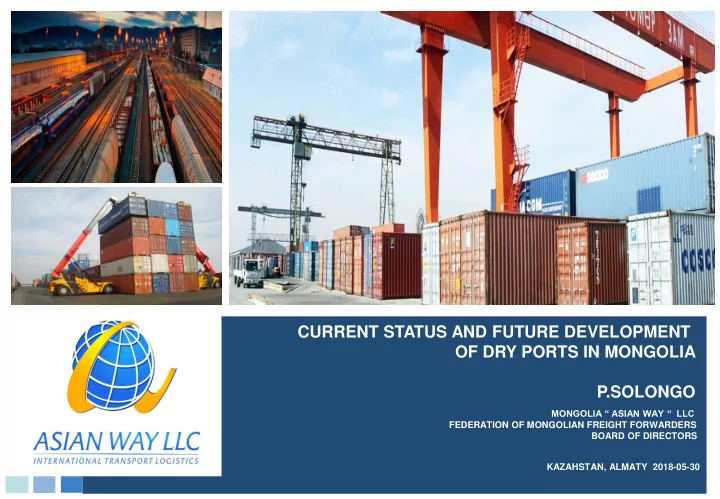
CURRENT STATUS AND FUTURE DEVELOPMENT OF DRY PORTS IN MONGOLIA P.SOLONGO

MONGOLIA “ ASIAN WAY “ LLC FEDERATION OF MONGOLIAN FREIGHT FORWARDERS BOARD OF DIRECTORS KAZAHSTAN, ALMATY 2018-05-30
slide-2
SLIDE 2

2

CONTENT

  • 1. Current status of dry ports / terminals/ in

Mongolia

  • 2. Policies, projects and programs implemented on

the development of dry ports

  • 3. Future development of dry ports in Mongolia
slide-3
SLIDE 3

Government Actions

  • Ratification of the Intergovernmental Agreement of Dry Ports

– It was completed on 05 February 2016 by the Parliament of Mongolia.

  • Establishment of Working Group

– The Working Group was established on 23 May 2018 under the Order No. 104 by the Prime Minister of Mongolia. It will be in charge of:

  • Improvement of Dry Port Legal Environment
  • Enhancement of Investment Issues
  • Development of Cooperation with International Organizations
  • Ensure the mutual beneficial relations of PPP
  • Adoption of the Regional Framework for the Planning, Design, Development and Operation
  • f Dry Ports of International Importance

– It was adopted during the 74th Session of the UNESCAP held in Bangkok 11-16 May 2018. – It notes the importance of well-managed dry ports, particularly those located at a significant distance from seaports, in reducing transportation costs and total transit time, in particular for the Asia-Pacific landlocked countries.

3

slide-4
SLIDE 4

Location of Dry Port

4

Capital City City Asian Highway Route Railway line gauge 1520mm Location of Existing Dry Port Location of Potential Dry Port

  • 5 Locations

1 2 3

Sourse: UNSCAP, Integrated Map of AH, TAR & Dry Ports of International Importance

4 5

  • 1. Zamiin-Uud
  • 2. Ulaanabaatar
  • 3. Altanbulag

Existing Planned

  • 4. Sainshand
  • 5. Choibalsan
slide-5
SLIDE 5

Zamiin-Uud port

5

  • Zamiin-Uud port is not only the international gateway which is located to the

south of the country, i.e. at the significant point of Mongolian transportation infrastructure, but it is also the biggest and strategically important port in terms

  • f trade and logistics on the southern border with PRC.
  • Main transport corridors such as CAREC’s 4b, AH-3 passes through Zamiin-Uud.
  • It is the final port of 1520mm gauge railway that connects Europe and Asia. 80%
  • f total transshipments are transported by railway.
  • Total 5 terminals for loading, unloading and transshipping currently operates at

Zamiin-Uud with an average of 3 mln. tons load handling and which are categorized as: terminal for transshipment from vehicles to wagons, terminal for transshipping imported cements, terminal for transshipping liquid fuels, terminal for transshipping containers which was built in 1995 by the financial grant of Japanese Government.

  • The number of passengers, goods and vehicles entering the Zamiin-Uud port is

increasing year by year and the shipment flow is rapidly growing. The majority of vehicles entering the port are the multimodal transportation of shipments by the vehicles to the railway terminal for transshipping.

slide-6
SLIDE 6

Cargoes handled by Zamiin-Uud terminals in 2015

6

Rail terminal Road terminal Liquid fuel terminal Multimodal transport terminal-2

850,0 mln.ton 800,0 mln.ton 30,0 mln.ton 1200 mln.ton

slide-7
SLIDE 7

Improvement of the capacity of Zamiin-Uud port

  • With a view to increase the transit transportation through Mongolia, to improve its

effectiveness, to increase the port capacity of the country with a railway gauge difference, to develop intermodal transportation system, Government of Mongolia and Asian Development Bank (ADB) will jointly finance construction of new logistic hub-transportation terminal with a capacity of 6 mln. tons of load handling per year and which will be put into operation in 2018.

  • Terminal is a complex facility, which is covering area of total 128 hectares and consists of

heavy-duty concrete bridge construction intersecting with railways both broad-gauge and narrow gauge as well as entry and exit railways to the logistic hub at 2 levels, auto route, infrastructure, facilities and engineering networks.

  • Terminal’s working hours are 24/7, with 2950m long railways for loading and unloading each

for broad-gauge and narrow-gauge, loading front of 55 wagons or 800m long, equipped with 2 gantry cranes each with a capacity of 50tn and other equipment. After its full operation, capacity of load handling will be 620 wagons per day, as well as it will have Customs warehouse with a total area of 2436 sq.m.

  • It has a capacity to receive and handle 12 trains from China per day.

7

slide-8
SLIDE 8

Planning of New Terminal in Zamyn-Uud port

8

Одоо байгаа бодит зураг

slide-9
SLIDE 9

Terminals of Ulaanbaatar

  • The capital of Mongolia, Ulaanbaatar is the city with the highest population and density, and

the main hub for foreign, domestic and transit trade and transportation.

  • Ulaanbaatar has total 9 internationally-known operating terminals. These terminals provide

2PL services, i.e. receipt of import and export goods and providing basic standard services such as freight forwarding and load handling of transporting shipment to the final point. Terminals provide one-stop services such as customs, specialized inspection, laboratory, banking etc. As well as provides customs broker, temporary and guaranteed warehouse services.

  • Small terminals causes many difficulties such as creating demand for intermediate

transportation, increasing road traffics, slowing down traffic speed and causing road

  • destruction. For instance, most goods are transferred from terminals to the second-stage

warehouses and distributed from there to retail storages and stores. Many producers and retailers build own warehouses and storages which leads to the fact that there are “areas with containers and non-purpose storages” around many commercial streets and trade

  • centers. Many problems arise from it such as complaints about the quality and standards of

the goods that are transported in non-purpose vehicles, stored in non-standard warehouses have become an usual thing.

9

slide-10
SLIDE 10

Terminals of Ulaanbaatar

  • Every year, around 70 thousand containers of goods are imported to our country from our

neighbors, and 90% of which are unloaded in the capital city of Ulaanbaatar. Moreover, transportation of containers between our neighbors, Russia and China is expected to grow.

  • 85% of total export and import goods of Mongolia is concentrated in Ulaanbaatar city and

transported by railway. And as a result, load handling of Ulaanbaatar railway station is increasing year by year, and some years it is increased by 40%, which recently causes difficulties in delivering shipment on time and ensuring its integrity.

  • The fact that these warehouses are spread out all over the Ulaanbaatar causes damage to

the auto road conditions, as well as traffic jam which leads to delay in delivery of the goods and other road-related difficulties within the city. At current level of transportation growth there is a need to centralize load handling to one of the locations far away from the capital’s downtown.

  • Within the next 5 years it is planned to build an international terminal in the suburbs of

Ulaanbaatar city with a capacity to handle 300-500 thousand TEU containers and 10 mln. tn.

  • f loads per year which is 4 times more than the total capacity of the existing 9 terminals.

10

slide-11
SLIDE 11

UB terminal location /now/

11

  • Approx, 2.5 Mln ton

Freight handling per year

  • Approx, 100’000 TEU

per year

Capacity Now

  • 1.8 Mln ton Freight per

year

  • 75’000 TEU per year
slide-12
SLIDE 12

UB terminal location /now/

12

slide-13
SLIDE 13

UB terminal /planned/

  • It is reflected in the Mongolia’s Sustainable Development Vision-2030, State policy on railway

transportation, State policy on civil aviation in Mongolia up to the year 2020 and in the Government action plan; – Build logistic hubs – Build a new railway line “Bogd Khan” around the Ulaanbaatar city with a view to export mineral products, increase transit transportation and reduce traffic jam in the capital city – Highway route Altanbulag-Ulaanbaatar-Zamiin-Uud (AB-UB-ZU) – Build a new international airport

  • And among these construction works it is planned to build logistic hubs-international terminal with a

capacity to handle 300-500 thousand TEU containers and 10 mln. tn. of loads per year.

  • 13

өн х и й Яармагий нө ер

Эмээл т Өлзий т Туул- Шувуу фабрик а т Монгол наадам Аргалант

  • Яарм

аг Зуун мод Аэро ситихот Б и о к

т ө

о

л

м

ө

б

в

1

л

и

ө

н

г ө

Sourse:

1. Ministry of Road and Transport Development of Mongolia 2. Civil Aviation Authoritory of Mongolia 3. Mongolian Russian Joint company Ulaanbaatar Railway /UBTZ/

slide-14
SLIDE 14

Altanbulag port

  • Altanbulag port is strategically important in terms of trade and logistics and the biggest port
  • n the northern border with Russia.
  • Main transport corridors such as CAREC’s 4b, AH-3 passes through Altanbulag.
  • Imported goods to Mongolia from Russia and EU passes through Altanbulag port which

equals to 20% of total commodity goods imported to Mongolia.

  • There are 2 terminals at Altanbulag port for loading export, import and re-export shipments

and containers with a capacity of 600 thousand tn. load and 15’000 TEU containers handling per year.

  • “Altanbulag” free zone with total area of 50 hectares is operating near the port with a view to
  • perate transnational transit supplies, production of goods and its export to the international

markets on trade conditions of Mongolia as well as connected with auto and railway routes, equipped with transshipping equipment, warehouses and one-stop service.

14

slide-15
SLIDE 15

Altanbulag port

15

  • 95% of total oil products’

consumption of Mongolia imported through Altanbulag port.

  • Load handling of grains, wood and

wooden material export and re- export transportation.

  • It is operating since 2014.
  • 3.5 mln. USD investment was

made as of 2017.

  • 5 mln. USD worth of trade

turnover.

  • It is still under development.

Railway Terminal Free zone

slide-16
SLIDE 16

Mongolian potential Dry Port – Sainshand

16

Units are envisioned to be built in the complex:

  • Cement Plant
  • Coke Plant
  • Iron Pellets Plant
  • HBI / DRI Plant
  • Coal Gasification Plant
  • Oil Refinery
  • Copper Smelter
  • Power Plant
  • Intersection point of the existing railway

and auto road with the main horizontal Trans-Mongolian axis which is planned to be built.

  • Intersecting with AB-UB-ZU highway

route.

  • Industrial park is planned to be

constructed.

slide-17
SLIDE 17

Mongolian potential Dry Port – Choibalsan

17

  • Length of existing railway-238 km.

– Existing terminal for export and import loading with a capacity of loading front of 6 wagons and equipped with 1 gantry crane of 20tn.

  • Export loading of nonferrous metal and grains.
  • Import of oil products, wood and wooden materials,

flour, rice and other food products.

  • The capital of Dornod province, Choibalsan is the city

with highest population among the cities of Eastern region, with well-developed infrastructure and manufacturing of textile and food products.

  • Well-developed mining and agricultural manufacturing.
  • Horizontal axis will be connected to Choibalsan.
  • Heads of State of Mongolia, Russia and China inked the

Program to build economic corridor linking the 3 countries on June 23, 2016.

  • Eastern corridor which is included in this Program as

it follows:

  • (Borzya – Solovievsk – Ereentsav –

Choibalsan – Hoot – Bichigt - Xilin gol (Zuun khatavch) – Ulaankhad – Chaoyang - Jinzhou/Panjin)

New railway routes Hoot-Bichigt and Hoot-Numrug which are planned for construction will be linked more closely to the ports of PRC.

slide-18
SLIDE 18

Terminals’ facing issues

  • Upgrade of technology and equipment.
  • Renew and equip terminals with modern technology that meets standards

and requirements of customs and other inspection authorities.

  • Remove terminal of dangerous and hazardous shipment out of the capital

city.

  • Automate and upgrade the commercial cargo screening.
  • Build new terminals due to the growth of shipment transportation.
  • Build automated warehouse for special purposes that meets modern

standards, upgrade and newly equip existing one.

  • Automate working places.
  • Switch to electronic processing of transportation related documents, i.e.

switch to paperless technology.

  • TA on Planning, Design and Development

18

slide-19
SLIDE 19

THANK YOU

19