
SLIDE 1
Update on EPA’s Ports Initiative
1
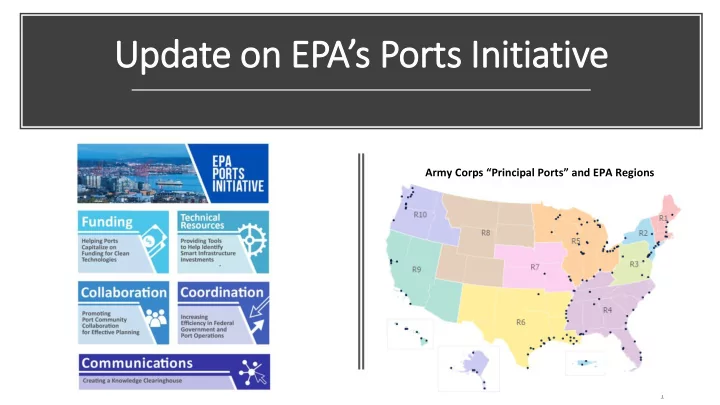
Army Corps “Principal Ports” and EPA Regions
Update on EPAs Ports Initiative Army Corps Principal Ports and EPA - - PowerPoint PPT Presentation
Update on EPAs Ports Initiative Army Corps Principal Ports and EPA Regions 1 Overview of EPAs Ports Initiative Through EPA tools and assistance in the five program areas, we are accelerating adoption of: Clean air planning
1
Army Corps “Principal Ports” and EPA Regions
Through EPA tools and assistance in the five program areas, we are accelerating adoption of:
inventories, clean air plans, community engagement) that inform strategic clean air investments
Act (DERA) Grants
movement projects.
air plans, community engagement.
government funding opportunities
www.epa.gov/ports-initiative/funding-
communities
Update to port inventory guidance (published in 2009) to reflect new methods and emissions factors Public review draft target date: Dec 2019 Assessment of fuel cell applications at ports Best practices for metrics and indicators that ports can use to measure, evaluate and set goals to improve air quality and community engagement Factsheets on operational strategies that can reduce emissions and increase efficiency such as vessel speed reduction and gate management
EPA’s Ports Initiative website and newsletter sign-up:
www.epa.gov/ports-initiative
Army Corps “Principal Ports” and EPA Regions Keep in touch:
talkaboutports@epa.gov Sarah Froman: (202) 343-9652, Froman.Sarah@epa.gov Jennifer Keller: (202) 343-9541; keller.jennifer@epa.gov
6
Funding
Helping Ports Capitalize on Funding for Clean Technologies
Technical Resources
Providing Tools to Help Identify Smart Infrastructure Investments
Collaboration
Promoting Port-Community Collaboration for Effective Planning
Coordination
Increasing Efficiency in Federal Government and Port Operations
Communications
Creating a Knowledge Clearinghouse
2019 U.S. Environmental Protection Agency
process
to improve conditions
to expand their knowledge about freight transport and port facilities
engagement
concerns are outside of port’s control; communities don’t understand port
develop solutions for environmental, health and related community-driven concerns associated with port-related activities
equip/empower communities for effective decision-making engagement with port-related entities
where we convened stakeholder dialogues, delivered technical assistance, and tested three draft tools.
Seattle, WA; and Providence, RI
resource materials from pilots (e.g. case studies, training modules).
Port of Savannah Tour
10 Draft Community Action Roadmap: Empowering Near-Port Communities An implementation companion for the Ports Primer for Communities that provides a step-by-step process for building capacity and preparing community stakeholders
Draft Environmental Justice (EJ) Primer for Ports: The Good Neighbor Guide to Building Partnerships and Social Equity with Communities Designed to inform the port industry sector of the perspectives, priorities, and challenges often unique to communities with EJ concerns. In addition to orienting the port sector about EJ considerations this resource is structured to provide step-by-step guidance to improve the effectiveness of port and community engagement in addressing concerns of impacted residential communities.
Draft Ports Primer for Communities: An Overview of Ports Planning and Operations to Support Community Participation An interactive tool and reference document that characterizes the port industry sector including environmental and community health impacts associated with port activities.
Collaboratively-developed Capacity Building Tools
2019 U.S. Environmental Protection Agency
2019 U.S. Environmental Protection Agency 11
Draft Ports Primer for Communities: An Overview of Ports Planning and Operations to Support Community Participation
An interactive tool and reference document that characterizes the port industry sector including environmental and community health impacts associated with port activities Draft Ports Primer for Communities (PDF) https://www.epa.gov/community-port-collaboration-and-capacity-building/draft-ports- primer-communities (webpages)
2019 U.S. Environmental Protection Agency 12
Draft Ports Primer for Communities draft
2019 U.S. Environmental Protection Agency 13
Draft
Community Action Roadmap:
Empowering Near-port Communities
An implementation companion for the Ports Primer that provides a step-by-step process for building capacity and preparing community stakeholders to engage nearby port facilities and influence decision-making on issues of community interest
DRAFT
Draft Community Action Roadmap (PDF)
Prioritize Goals and Concerns.
Identify and prioritize goals and concerns that are motivating community leaders to engage with the Port.Identify Levers for Change.
Identify port governance structure and key regulatory agencies. Identify upcoming planning processes, decision documents and other opportunities for community influence.Build Relationships.
Identify key community stakeholders and resource partners. Conduct outreach and buildDevelop an Action Plan.
Evaluate methods of engagement and select the most effective approach (may select more than one).Make Your Case.
Gather information that supports community concerns and goals. Implement selected strategy.
Build Momentum for Change.
Evaluate the results of community efforts, and share these with the public. Celebrate6 5 3 4 1 2
3
Draft
Community Action Roadmap sample page
2019 U.S. Environmental Protection Agency 14
2019 U.S. Environmental Protection Agency 15
Draft Environmental Justice Primer for Ports:
The Good Neighbor Guide to Building Partnerships and Social Equity with Communities Designed to inform the port industry sector of the perspectives, priorities, and challenges often unique to communities with EJ concerns. In addition to orienting the port sector about EJ considerations this resource is structured to provide step-by-step guidance to improve the effectiveness
concerns of impacted residential communities. Draft Environmental Justice Primer for Ports (PDF)
Good Neighbor Guide Steps
U.S. Environmental Protection Agency 16
compensation to community partners for engagement activities
hiring decision
the Port of Seattle Commissioners established support for the Duwamish Valley Community Equity Program.
maintenance practices; strengthened partnerships and established communication channels with nearby residents in New Orleans
regularly to collaboratively determine objectives and prioritize investments to improve environmental performance and community conditions in Providence.
Updated Capacity Building Toolkit, process guidance, training modules and additional resource materials are being prepared for web accessibility EPA continuing support for implementation of stakeholder-determined plans resulting from pilot activities
Community Monitoring Workshop – Savannah
EPA building/expanding internal capacity for supporting additional stakeholder engagement activities for near-port communities, ports, and
entities EPA exploring
the equity conversation among a variety of institutions,
businesses
EPA Regions 9 & 10: AK, AZ, CA, HI, ID, NV, OR, WA, Pacific Islands & 419 Native Tribes
19
20
1) Public-private partnerships to reduce diesel emissions 2) Support technology advancements and deployments to increase efficiency and economic growth 3) Provide technical assistance and EPA grant funding to deploy cleaner vehicles and equipment
Picture: Pre-1980 school bus exhaust
AQMD, $719,500
$1,601,523
Program, $576,419