Town Hall Meetings Wednesday, July 26, 1pm, Bakersfield - - PowerPoint PPT Presentation

town hall meetings
SMART_READER_LITE
LIVE PREVIEW

Town Hall Meetings Wednesday, July 26, 1pm, Bakersfield - - PowerPoint PPT Presentation

San Joaquin Valley Unified Air Pollution Control District Town Hall Meetings Wednesday, July 26, 1pm, Bakersfield Wednesday, July 26, 7pm, Delano Thursday, July 27, 1pm, Fresno Thursday, July 27, 7pm, Huron Friday, July


slide-1
SLIDE 1

1

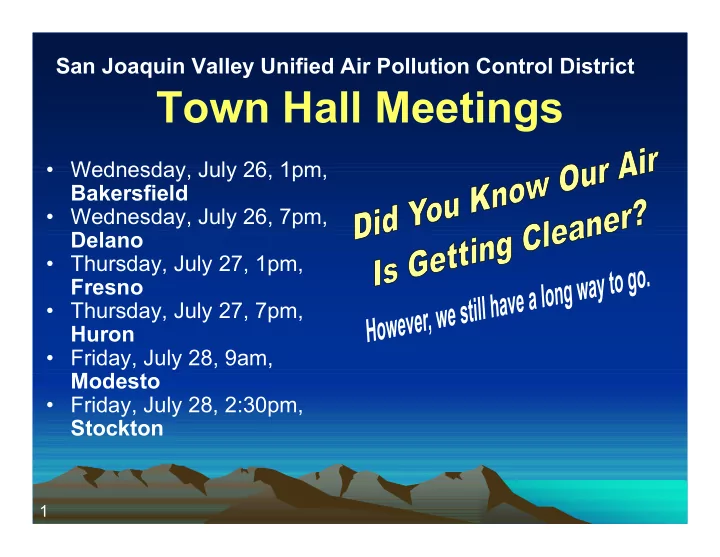
Town Hall Meetings

San Joaquin Valley Unified Air Pollution Control District

  • Wednesday, July 26, 1pm,

Bakersfield

  • Wednesday, July 26, 7pm,

Delano

  • Thursday, July 27, 1pm,

Fresno

  • Thursday, July 27, 7pm,

Huron

  • Friday, July 28, 9am,

Modesto

  • Friday, July 28, 2:30pm,

Stockton

slide-2
SLIDE 2

Introduction: Introduction: Pollutants in the Valley Pollutants in the Valley Health, Economic, and Health, Economic, and Environmental Effects Environmental Effects Health Health-

  • based Standards

based Standards

slide-3
SLIDE 3

3

Pollutants in the Valley Pollutants in the Valley

  • Particulate Matter (PM)

–Wintertime problem –May be emitted as dust and soot –May form in the atmosphere from other compounds –PM10 and PM2.5

slide-4
SLIDE 4

4

Pollutants in the Valley Pollutants in the Valley

  • Ozone

–Summertime problem –Smog –Not emitted directly –Forms when emissions from human activities react in sunlight –1-hour and 8-hour averages

slide-5
SLIDE 5

5

Health Impacts Health Impacts

  • Ozone health effects and symptoms:

– Chest pain – Coughing – Throat irritation – Congestion – Reduced lung function – Inflamed lung linings – Lung tissue scarring – Wheezing – Painful breathing – Higher hospital admissions – More emergency room visits

slide-6
SLIDE 6

6

Economic Impacts Economic Impacts

  • Hall’s study, The Health and Related

Economic Benefits of Attaining Healthful Air in the SJV

– Analyzed the benefits of attaining both the PM2.5 and 8-hour ozone standards – Could save the Valley more than $3 billion per year in health care costs and lost school and work days

  • Findings & assumptions are debatable,

but the study emphasizes that not attaining the federal standards affects health and therefore the economy

slide-7
SLIDE 7

7

Environmental Impacts Environmental Impacts

  • Ozone’s environmental impacts

– Makes plants more susceptible to disease, insects, and harsh weather – Damages leaves of trees and other plants, damaging the appearance of cities, forests, parks, and recreational areas – Reduces agricultural yields for economically important crops

slide-8
SLIDE 8

8

Economic Impacts Economic Impacts

  • Ozone levels are highest in the summer, when

crops are growing

  • A 2003 University of Illinois study found that a

20% rise in ozone exposure resulted in a 20% drop in crop yield for soy beans.

  • Damage to crop plants in the United States

may exceed several billion dollars per year, (e.g. Heck et al., 1983; Adams et al., 1988)

slide-9
SLIDE 9

9

Federal Standards Federal Standards

  • EPA sets federal ambient air quality standards
  • Ambient standards protect public health,

including the health of "sensitive" populations.

  • The CAA requires periodic review (every 5

years) of standards based on best science, including laboratory, clinical, and community health studies.

  • Standard setting process involves extensive

peer review & opportunity for public comment.

  • Standards are not set in consideration of cost or

feasibility of attainment.

slide-10
SLIDE 10

10

Federal Standards Federal Standards

  • States and Districts put together plans
  • utlining the rules and programs that will

be undertaken to reduce air pollution.

  • Attainment of federal standards

protects public health

slide-11
SLIDE 11

Current State of Valley Current State of Valley Air Quality: Air Quality: Emissions Reductions Emissions Reductions Measured Ozone & PM levels Measured Ozone & PM levels

slide-12
SLIDE 12

12

State of Air Quality State of Air Quality

Emissions Inventory Emissions Inventory

  • Ozone and PM2.5 precursor emissions have

been substantially reduced in the SJV

Reductions, 1990-2005

10% Directly Emitted PM2.5 13% Directly Emitted PM10 40% ROG Emissions Reductions 41% NOx Emissions Reductions

slide-13
SLIDE 13

13

Reductions through Regulations Reductions through Regulations

  • The District has toughest rules in the state
  • Over 500 rules & amendments since 1992

– Fireplaces – Voluntarily expanded Smog Check II testing – Wine production and storage – Conservation Management Practices (farms) – Indirect Source Review (development) – Confined Animal Feeding Operations – Engines, boilers, turbines, glass-melting furnaces

slide-14
SLIDE 14

14

Ozone Ozone Monitoring Monitoring

Oildale Edison Bakersfield Maricopa Arvin Shafter Ash Mtn. Lookout Pt. Lower Kaweah Visalia Hanford Parlier Fresno Clovis Turlock Merced Tracy Stockton Modesto Madera Oildale Edison Bakersfield Maricopa Arvin Shafter Ash Mtn. Lookout Pt. Lower Kaweah Visalia Hanford Parlier Fresno Clovis Turlock Merced Tracy Stockton Modesto Madera Oildale Edison Bakersfield Maricopa Arvin Shafter Ash Mtn. Lookout Pt. Lower Kaweah Visalia Hanford Parlier Fresno Clovis Turlock Merced Tracy Stockton Modesto Madera

slide-15
SLIDE 15

15

State of Air Quality State of Air Quality

  • Valley ozone has improved from 1990
  • Number of days with high levels, 3-year

averages:

18 58 1-hour standard 105 126 8-hour standard 2005 1990

slide-16
SLIDE 16

16

State of Air Quality State of Air Quality

  • Particulate Matter

–PM10 attainment –Annual average PM2.5 levels have improved since monitoring began in 1999

33% 87% PM2.5 annual average, percent over standard 12 35-38 PM2.5 days over standard 2005 1999

slide-17
SLIDE 17

17

State of Air Quality State of Air Quality

Problem Pollutants Problem Pollutants

  • 8-hour ozone

– The Valley has one of the most severe

  • zone problems in the country.

– Compared to Los Angeles, the Valley has lower peak ozone levels, yet more days with unhealthy levels. – Large number of days with ozone above the level of the standard – Peak readings are slow in declining

  • PM2.5

– Most sites still exceed annual PM2.5 standard

slide-18
SLIDE 18

Challenges: Challenges: Legal Timelines Legal Timelines Natural Conditions Natural Conditions Carrying Capacity Carrying Capacity Jurisdiction Jurisdiction

slide-19
SLIDE 19

19

Federal Requirements Federal Requirements

By start of 2012 ozone season Compliance date: achieve all emissions reductions needed June 15, 2013 Attainment date June 15, 2007 Attainment demonstration, RFP, and NSR SIP submission to EPA Deadline for Serious Areas Requirement

slide-20
SLIDE 20

20

The District’s topography and climate create ideal conditions for serious air pollution.

Natural environment & air quality Natural environment & air quality

slide-21
SLIDE 21

21

Effects of natural environment Effects of natural environment

  • Valley’s ozone air

quality problem worse than SF and about same as LA

  • But SJV emissions

per unit area (emissions density) much less than SF

  • r LA
  • Natural factors

enhance ozone air pollution in SJV

0.1 0.2 0.3 0.4 0.5 0.6 1990 2005 2020

San Joaquin Valley Bay Area South Coast ROG + NOx tons/day per square mile

slide-22
SLIDE 22

22

Carrying Capacity Carrying Capacity

  • Ozone “carrying capacity” is the

maximum amount of NOx and VOC emissions that would allow for attainment of the ozone standard.

  • Preliminary ARB modeling indicates that

the Valley may need to reduce projected NOx and VOC emissions by 60%

slide-23
SLIDE 23

23

Carrying Capacity & Future Carrying Capacity & Future Reductions Reductions

  • 60% reduction of NOx and VOC

emissions would be beyond reductions being achieved by current regulations.

  • Population growth can offset emissions

reductions.

4.8 million 4.0 million 3.2 million 2020 2010 2000

slide-24
SLIDE 24

24

Jurisdictional Puzzle Jurisdictional Puzzle

NOx Emissions/Jurisdiction State and Federal 69% District 31%

VOC Emissions/Jurisdiction State and Federal 48% District 52%

slide-25
SLIDE 25

25

200 400 600 800 1000

2005 Emissions Inventory 2015 2015 w/o 2015 w/o 2015 w/o 2015 w/o 2015 w/o

Tons Per Day

NOx ROG

60% Reduction in Emissions: 60% Reduction in Emissions: How Difficult? How Difficult?

“Carrying Capacity”

Mobile Sources Stationary Sources Light Duty Vehicles Diesel Trucks Agriculture Emissions Inventory

slide-26
SLIDE 26

26

60% Reduction in Emissions: 60% Reduction in Emissions: How Difficult? How Difficult?

Total ROG & NOx with Carrying Capacity

0.0 100.0 200.0 300.0 400.0 500.0 600.0

2005 2015

year

tons per day

State & Federal sources Carrying Capacity

slide-27
SLIDE 27

Strategies Strategies

slide-28
SLIDE 28

28

How Do We Get There? How Do We Get There? Strategy Issues Strategy Issues

  • How many reductions do we really need?
  • Will strategies that were effective for 1-hour
  • zone work for 8-hour ozone?
  • How can we integrate the PM and Ozone

strategies?

  • Can we refine our strategies to conserve

resources?

– Seasonal / episodic controls? – Sub-regional controls? – What pollutants? – Other innovative/new approaches?

slide-29
SLIDE 29

29

Four Four-

  • faceted Control Strategy

faceted Control Strategy

  • 1. Regulatory component - traditional

“command-and-control”

  • 2. Incentive-based strategies
  • 3. Alternative compliance - allow sources to

achieve equivalent reductions from alternative sources

  • 4. Local, State, and Federal sources &

partnerships - Local, State, and Federal agencies must each reduce emissions from the sources under their jurisdiction

slide-30
SLIDE 30

Discussion Discussion

slide-31
SLIDE 31
slide-32
SLIDE 32

32

Air Pollution Control in Air Pollution Control in California, 1971 Annual Report California, 1971 Annual Report

  • “It is apparent that by 1980, motor

vehicles will not be the major source of hydrocarbons and oxides of nitrogen, and greater emphasis will have to be placed on emissions from nonvehicular sources.” -- page 34.

  • Sections titled “EVALUATION OF LOW

EMISSION VEHICLES” and “NATURAL GAS AND LPG FUELED VEHICLES”

slide-33
SLIDE 33

33

Changes in Mobile Source NOx Emissions

50 100 150 200 250 300 350 400 450 500 1990 1999 2000 2010 Tons per Day 1994 Plan Extreme Plan Current Draft