Current Policies, Laws, Regulations and Standards Governing the - - PowerPoint PPT Presentation

current policies laws regulations
SMART_READER_LITE
LIVE PREVIEW

Current Policies, Laws, Regulations and Standards Governing the - - PowerPoint PPT Presentation

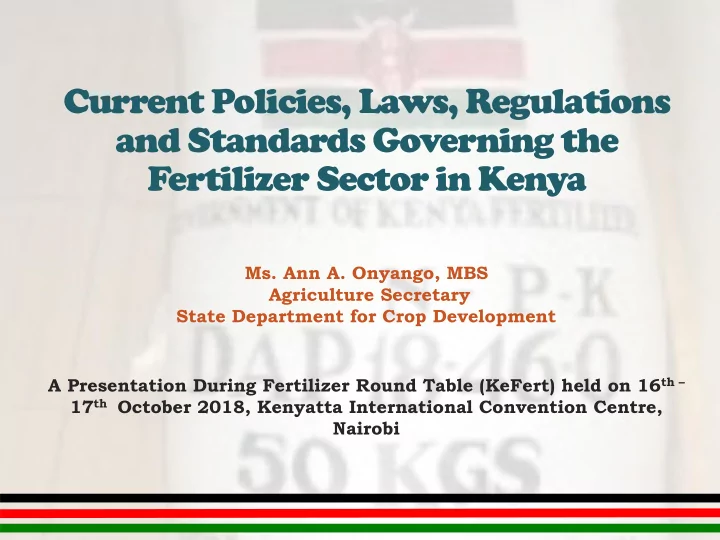
Current Policies, Laws, Regulations and Standards Governing the Fertilizer Sector in Kenya Ms. Ann A. Onyango, MBS Agriculture Secretary State Department for Crop Development A Presentation During Fertilizer Round Table (KeFert) held on 16 th


slide-1
SLIDE 1

Current Policies, Laws, Regulations and Standards Governing the Fertilizer Sector in Kenya

  • Ms. Ann A. Onyango, MBS

Agriculture Secretary State Department for Crop Development A Presentation During Fertilizer Round Table (KeFert) held on 16th – 17th October 2018, Kenyatta International Convention Centre, Nairobi

slide-2
SLIDE 2

Background

  • Kenya imports all her fertilizer requirements.
  • As at December 2017, the apparent consumption of

fertilizers in Kenya was 800,000 MT of 68 fertilizer types.

  • Currently the industry is fully liberalized and is mainly

driven by the private sector, which imports most of the fertilizers.

  • Limited amounts are manufactured locally (10,000MT
  • f SSP).
slide-3
SLIDE 3

Legal Framework

  • Fertilizer and Animal Foodstuffs Act, CAP 345- has been in

force since 1967 and amended in 2015 to create a Fertilizer and Animal Feedstuffs Board of Kenya

  • Standards Act (CAP 496) which is implemented by the Ministry
  • f Industrialization specifically used by KEBS in implementation
  • f standards for commodities including fertilizer
  • KEPHIS Act, 2011- Allows Kenya Plant health Inspectorate

Services (KEPHIS) to establish laboratories for the purpose of monitoring the quality and levels of toxic residues in agro inputs, irrigation water, plants, soils and produce.

  • Anti Counterfeit Act– Police have been using this Act to

prosecute those involved in subsidy fertilizer malpractices

slide-4
SLIDE 4

Fertilizer in Policy Documents

  • Importance of fertilizers and other farm inputs in food

production are enlisted in: i. Vision 2030 – the three tier fertilizer cost reduction strategy (Bulk procurement, Blending and Local fertilizer manufacture) ii. Agriculture Sector Development Strategy (ASDS) iii. Ministry of Agriculture Strategic Plan

  • iv. Government Big Four Development Agenda

v. National Agricultural Soil Management Policy- Draft

slide-5
SLIDE 5

Current Draft Policies

National Agricultural Soil Management Policy

Being developed to address the following thematic areas: i. Sustainable agricultural land management ii. Soil management and environmental

  • iii. Technology

development, dissemination and utilization

  • iv. Fertilizer development and investments
slide-6
SLIDE 6

The Big Four Agenda

Issues on fertilizer captured in the Big 4 execution plan in the Ministry:

  • Use locally blended fertilizer on a 50/50
  • Redesign subsidy model to maximize impact by

focusing on specific farmer needs (flexible voucher and incentive based model)

  • Basis and implement liming e.g. maize.
  • Locally Blended Fertilizer – 50% and Lime of 250,000

Acres targeting Trans Nzoia

  • Enact legislation to make soil liming mandatory -2018
slide-7
SLIDE 7

Fertilizer Standards

  • The Fertilizer and Soil Amendments

Committee of Kenya Bureau of Standards (KEBS) develop standards for fertilizers in use in Kenya

  • The committee comprises of representatives

from the fertilizer industry, the Ministry of Agriculture, universities, KARLO, KEPHIS and the Government Chemist

  • All fertilizers used in the country have

standards

  • The standards are reviewed every 5 years
  • The committee meets every month
slide-8
SLIDE 8

Features of the Fertilizers and Animal Foodstuffs (Amendment) Act, 2015

  • Amendment of section 2 of Cap 345 (the Fertilizers

and Animal Foodstuffs Act) was done In October 2015

  • The commencement date for the amended Act was

26th October 2015.

  • Provides for establishing the Fertilizer and Animal

Foodstuffs Board of Kenya

slide-9
SLIDE 9

Fertilizer And Animal Foodstuffs (Amendment) Act, 2015……..

Functions of the Board: a) Regulate the fertilizers and animal foodstuffs industry in Kenya including the production, manufacture, packaging, importation and marketing of fertilizers and animal foodstuffs; b) Regulate the importation of raw materials for the manufacture of animal foodstuffs; c) Promote the manufacture of fertilizers and animal foodstuffs;

slide-10
SLIDE 10

d) Advise the national and county governments on:

i. The procurement, importation and efficient and timely distribution of subsidized fertilizers and animal foodstuffs; ii. Establishment of retail outlets of fertilizers and animal foodstuffs in the counties; and iii. Development of policies related to the manufacture and distribution of fertilizer and animal foodstuffs;

Fertilizer And Animal Foodstuffs (Amendment) Act, 2015……..

slide-11
SLIDE 11

e) Inspect and test fertilizers and animal foodstuffs to ensure their quality and safety; f) License manufacturers, distributors and retailers of fertilizers and animal foodstuffs on the recommendation of the Director of Agriculture and the Director of Veterinary Services; g) Promote, in collaboration with stakeholders in the agriculture industry, research on fertilizer and animal foodstuffs; h) Ensure that fertilizers and animal food stuffs imported, manufactured or distributed in Kenya meet the standards of quality and safety as prescribed by law.

Fertilizer And Animal Foodstuffs (Amendment) Act, 2015…….

slide-12
SLIDE 12

Challenges in Fertilizer Development and Investment

  • Inadequate raw materials for local manufacture of fertilizers
  • The Fertilizer and Animal foodstuffs Act (amendment) 2015

does not address the biological and organic fertilizers

  • Inadequate capacity for fertilizer quality assurance analysis

which includes laboratories, equipment and personnel

  • Inadequate capacity in terms of infrastructure and personnel

for soil analysis

  • High cost of fertilizer associated infrastructure and skills
slide-13
SLIDE 13

Conclusion

  • The

policies, laws, regulations and standards recognize the critical role that is played by private sector organizations in fertilizer development

  • The formation of the Kenya Fertilizer Platform is

critical to facilitate timely resolution of emerging issues on integrated soil management

slide-14
SLIDE 14

Thank You