Better Environmental Outcomes from Hydrocarbon Spills using RemScan - - PowerPoint PPT Presentation

better environmental outcomes from
SMART_READER_LITE
LIVE PREVIEW

Better Environmental Outcomes from Hydrocarbon Spills using RemScan - - PowerPoint PPT Presentation

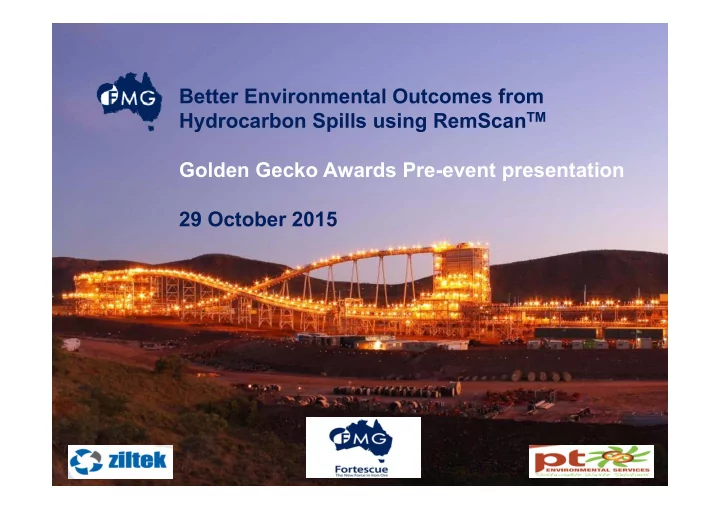
Better Environmental Outcomes from Hydrocarbon Spills using RemScan TM Golden Gecko Awards Pre-event presentation 29 October 2015 Fortescue Overview. Founded in 2003 First Ore in 2008 Shipped over 550mt 165mt production rate


slide-1
SLIDE 1

Better Environmental Outcomes from Hydrocarbon Spills using RemScanTM Golden Gecko Awards Pre-event presentation 29 October 2015

slide-2
SLIDE 2

Fortescue Overview.

slide-3
SLIDE 3
  • Founded in 2003
  • First Ore in 2008
  • Shipped over 550mt
  • 165mt production rate
  • Integrated Mine, Rail and Port Operations
  • Focus on Safety, Environmental

management, cost reduction and product quality .

slide-4
SLIDE 4

Port Overview

slide-5
SLIDE 5

Rail- Overview

  • Heaviest haul railway in the world
  • Rakes up to 250 cars, 2.7km long and 32,000 tonnes.
  • 15 locomotives
  • 600+ km of Rail
slide-6
SLIDE 6

Mine- Overview

  • Two Hub, 4 mine operations
  • Wet and Dry hematite processing
  • Surface mining and truck and shovel
slide-7
SLIDE 7
  • Mining results in both planned an unplanned impacts upon the

environment.

  • Fortescue has a clear focus on minimising these impacts.
  • Planned impacts includes the clearing and development of land for mining

and infrastructure.

  • Unplanned impacts includes accidents and incidents resulting from these

planned activities.

  • FY15 – 1299 Environmental incidents were recorded across all operations.
  • 838 involved chemicals or hydrocarbons ranging from 0.5 – 1000L+.
  • Chemicals and Hydrocarbons are the predominant category of unplanned

events and as such, innovative solutions were investigated and class leading practices were implemented to minimise associated impacts on the environment.

Minimising and managing the impact of our operations

slide-8
SLIDE 8

Why we need to care for and manage our Environment

slide-9
SLIDE 9

Fortescue and PTES have developed a progressive and innovative relationship working together to take Fortescue waste management to best practice, delivering Recycling of total volumes to landfill to greater than 85% Fortescue acknowledges PTES for bringing forward initiatives in line with the Fortescue waste management and Bio remediation goals and is appreciative of the collaborative working relationship that provides benefits and solutions to effective and Best Practice Waste Management

slide-10
SLIDE 10

Cloudbreak Bio remediation Remscan Implementation

slide-11
SLIDE 11

Fortescue identified that best practice wasn’t happening in the bio pads. Volume and placement management needed review – it was a time for change.

2012 Bio Remediation area

slide-12
SLIDE 12

A new approach – best practice implementation

Bio Pads under construction

slide-13
SLIDE 13

Bio remediation area today – well managed and environmentally responsible

2015 – Bio Remediation area Cloudbreak Mine

slide-14
SLIDE 14
  • Immediate clean up of spill
  • Excavate in layers
  • Sample each layer
  • Map sample locations (hot spots)
  • Monitor TPH until below EIL

THE REMSCAN ADVANTAGE

slide-15
SLIDE 15

Sample mapping for collection of soil samples

Onsite management capabilities to effectively manage contaminated soils

Remscan

slide-16
SLIDE 16

Monitoring Results – TPH in remediated soil over 6 mths

slide-17
SLIDE 17

Solomon Implementation

slide-18
SLIDE 18

Hydrocarbon Incidents at Solomon

13 10 8 13 15 23 14 26 21 34 41 37 33 24 35 13 20 37

5 10 15 20 25 30 35 40 45

  • No. of Hydrocarbon Spills
  • More than 80% of recorded incidents due to hydraulic hose

failures on Heavy Mining Equipment causing loss of hydraulic oils

  • Spill volumes typically between 0 to 200 L, with minor

amount of spills between 200 – 1500 L

  • Recovery of hydrocarbon contaminated variable based off

visual assessment and results of NATA-accredited lab analyses

slide-19
SLIDE 19

Hydrocarbon Incident Management – before RemScanTM

  • Incidents reported via Fortescue Business Management System (BMS)
  • Clean up dependent on visual observations of Operators / Fitters / Mechanics of

spill area, using spill absorbent material and / or removal by use of earthmoving equipment

  • Subsequent inspection of areas where large spills (> 100 L) had occurred by

Environmental staff often observed remnant contamination

  • Where samples taken by site environmental function to determine hydrocarbon

contamination status – results not received for seven (7) days unless additional costs paid for quicker turnaround of analyses (i.e. 24 hours).

  • Main issue was inability to immediately determine lateral and vertical extent of

hydrocarbon contamination of soils and sediments as part of ongoing monitoring and spill response process.

slide-20
SLIDE 20

Hydrocarbon Incident Management – After RemScanTM

  • Wash pad sediment – able to test it after removal to identify appropriate disposal

location (biofarm or waste rock dump)

  • Used to monitor the biofarm monthly not quarterly

– Currently showing levels too high to consider releasing material. – Costs saved in not sending samples to NATA-accredited laboratory unnecessarily

  • Large spill from grader

– Able to pinpoint and circle clean up required saving time and material to biofarm

  • Demobilising contractors where suspected or known hydrocarbon contamination

is in-situ in areas under their control due to their activities

– Able to identify down to a very small area the contamination present thereby only excavating contaminated material for treatment in the biofarm

slide-21
SLIDE 21

RemScan™: Technical Overview

Dr Grant Webster Chief Scientific Officer

slide-22
SLIDE 22

History of Technology

CSIRO was using infrared (IR) light to measure soil properties for agriculture Ziltek funded collaboration to test if IR light could measure total petroleum hydrocarbons (TPH) in soil Success on a laboratory instrument led to commercialisation in a field instrument

slide-23
SLIDE 23

Demand for Real-Time Data

  • Closing sites screening tool for

petroleum hydrocarbons detection

  • More data, increased confidence
  • Real-time, smarter decisions
  • Accelerated project closure, less cost
slide-24
SLIDE 24

What is RemScan?

  • Handheld infrared instrument for the direct

measurement of TPH in soil

  • User simply pulls the trigger for a ~15 second

readout of TPH (C10 - C36/40) in mg/kg

  • No consumables or chemicals required
slide-25
SLIDE 25

The RemScan™ Advantage

slide-26
SLIDE 26

20000 40000 60000 80000 100000 120000 20000 40000 60000 80000 100000 120000

RemScan TPH Concentration (mg/kg) Laboratory TPH Concentration (mg/kg)

RemScan vs Laboratory TPH (C10‐C36) Concentration Good agreement with laboratory TPH results

slide-27
SLIDE 27

Summary of Benefits

  • Environmental risk reduction – better

spill response management

  • Better monitoring of site

bioremediation area – production of results to determine contaminated site status of open / inactive cells (site calibration)

  • Able to provide advice in the field to

clean-up crews regarding lateral / vertical extent of hydrocarbon contaminated soil / material

  • Reduced carbon footprint
  • Transportability / portability
  • Implementation of the Ziltek RemScanTM has

ultimately allowed Fortescue to:

  • Provide better advice on spill clean-up requirements;
  • Better identification of material for on-site

bioremediation; and

  • Provide immediate “on the ground” management of

hydrocarbon issues

  • Manage and maintain Bio Remediation cells for
  • ptimal performance
slide-28
SLIDE 28

Questions?

slide-29
SLIDE 29

Sign up to alerts online

www.fmgl.com.au