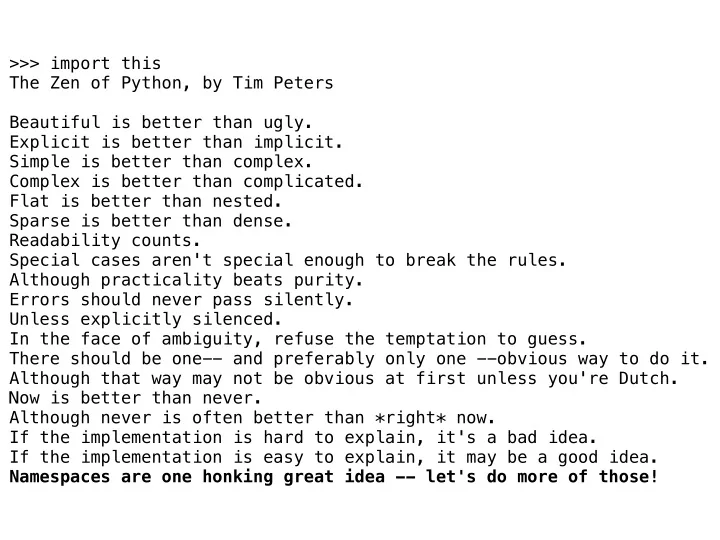
>>> import this The Zen of Python, by Tim Peters Beautiful - - PowerPoint PPT Presentation

import this the zen of python by tim peters beautiful is
SMART_READER_LITE
LIVE PREVIEW

>>> import this The Zen of Python, by Tim Peters Beautiful - - PowerPoint PPT Presentation

>>> import this The Zen of Python, by Tim Peters Beautiful is better than ugly. Explicit is better than implicit. Simple is better than complex. Complex is better than complicated. Flat is better than nested. Sparse is better than


slide-1
SLIDE 1

>>> import this The Zen of Python, by Tim Peters Beautiful is better than ugly. Explicit is better than implicit. Simple is better than complex. Complex is better than complicated. Flat is better than nested. Sparse is better than dense. Readability counts. Special cases aren't special enough to break the rules. Although practicality beats purity. Errors should never pass silently. Unless explicitly silenced. In the face of ambiguity, refuse the temptation to guess. There should be one-- and preferably only one --obvious way to do it. Although that way may not be obvious at first unless you're Dutch. Now is better than never. Although never is often better than *right* now. If the implementation is hard to explain, it's a bad idea. If the implementation is easy to explain, it may be a good idea. Namespaces are one honking great idea -- let's do more of those!

slide-2
SLIDE 2

How Python works: Namespaces

slide-3
SLIDE 3

Some vocabulary

We’ll use the terms “value” and “object” interchangeably. We’ll use the terms “name” and “variable” interchangeably. A binding is a runtime pair: name ↦ value. A namespace is a runtime collection of bindings. At runtime, an assignment binds a name to a value. At runtime, a reference looks up a name’s value. A name’s scope is the region of text in which that name is valid.

slide-4
SLIDE 4

x, y = 'a', 'b' def f1(): x = 1 print(x, y) def f2(y): x = 2 print(x, y) f1() f2(3) print(type(x), type(y)) print(x, y)

1 2 3 4 5 6 7 8 9 10 11 12 13 14

slide-5
SLIDE 5

builtin

global / file / module / session

1 2 3 4 5 6 7 8 9 10 11 12 13 14

scopes


(determined by program code) f1 f2

x, y = 'a', 'b' def f1(): x = 1 print(x, y) def f2(y): x = 2 print(x, y) f1() f2(3) print(type(x), type(y)) print(x, y)

slide-6
SLIDE 6

builtin

global / file / module / session

1 2 3 4 5 6 7 8 9 10 11 12 13 14

scopes


(determined by program code) f1 f2

namespaces


(a snapshot of program execution) built-in global

type

(and others)

1 2

x, y = 'a', 'b' def f1(): x = 1 print(x, y) def f2(y): x = 2 print(x, y) f1() f2(3) print(type(x), type(y)) print(x, y)

slide-7
SLIDE 7

builtin

global / file / module / session

1 2 3 4 5 6 7 8 9 10 11 12 13 14

scopes


(determined by program code) f1 f2

namespaces


(a snapshot of program execution) built-in global

type

(and others)

x y 'a' 'b'

1 2

x, y = 'a', 'b' def f1(): x = 1 print(x, y) def f2(y): x = 2 print(x, y) f1() f2(3) print(type(x), type(y)) print(x, y)

slide-8
SLIDE 8

builtin

global / file / module / session

1 2 3 4 5 6 7 8 9 10 11 12 13 14

scopes


(determined by program code) f1 f2

namespaces


(a snapshot of program execution) built-in global

type

(and others)

x y f1 'a' 'b'

1 2

x, y = 'a', 'b' def f1(): x = 1 print(x, y) def f2(y): x = 2 print(x, y) f1() f2(3) print(type(x), type(y)) print(x, y)

slide-9
SLIDE 9

builtin

global / file / module / session

1 2 3 4 5 6 7 8 9 10 11 12 13 14

scopes


(determined by program code) f1 f2

namespaces


(a snapshot of program execution) built-in global

type

(and others)

x y f1 f2 'a' 'b'

1 2

x, y = 'a', 'b' def f1(): x = 1 print(x, y) def f2(y): x = 2 print(x, y) f1() f2(3) print(type(x), type(y)) print(x, y)

slide-10
SLIDE 10

builtin

global / file / module / session

1 2 3 4 5 6 7 8 9 10 11 12 13 14

scopes


(determined by program code) f1 f2

namespaces


(a snapshot of program execution) built-in global

type

(and others)

x y f1 f2 'a' 'b'

local

f1, called @ line 11

1 2

x, y = 'a', 'b' def f1(): x = 1 print(x, y) def f2(y): x = 2 print(x, y) f1() f2(3) print(type(x), type(y)) print(x, y)

slide-11
SLIDE 11

builtin

global / file / module / session

1 2 3 4 5 6 7 8 9 10 11 12 13 14

scopes


(determined by program code) f1 f2

namespaces


(a snapshot of program execution) built-in global

type

(and others)

x y f1 f2 'a' 'b'

local

f1, called @ line 11 x 1

1 2

x, y = 'a', 'b' def f1(): x = 1 print(x, y) def f2(y): x = 2 print(x, y) f1() f2(3) print(type(x), type(y)) print(x, y)

slide-12
SLIDE 12

builtin

global / file / module / session

1 2 3 4 5 6 7 8 9 10 11 12 13 14

scopes


(determined by program code) f1 f2

namespaces


(a snapshot of program execution) built-in global

type

(and others)

x y f1 f2 'a' 'b'

1 2

x, y = 'a', 'b' def f1(): x = 1 print(x, y) def f2(y): x = 2 print(x, y) f1() f2(3) print(type(x), type(y)) print(x, y)

slide-13
SLIDE 13

builtin

global / file / module / session

1 2 3 4 5 6 7 8 9 10 11 12 13 14

scopes


(determined by program code) f1 f2

namespaces


(a snapshot of program execution) built-in global

type

(and others)

x y f1 f2 'a' 'b'

1 2

local

f2, called @ line 12 y 3

x, y = 'a', 'b' def f1(): x = 1 print(x, y) def f2(y): x = 2 print(x, y) f1() f2(3) print(type(x), type(y)) print(x, y)

slide-14
SLIDE 14

builtin

global / file / module / session

1 2 3 4 5 6 7 8 9 10 11 12 13 14

scopes


(determined by program code) f1 f2

namespaces


(a snapshot of program execution) built-in global

type

(and others)

x y f1 f2 'a' 'b'

1 2

local

f2, called @ line 12 y 3 x 2

x, y = 'a', 'b' def f1(): x = 1 print(x, y) def f2(y): x = 2 print(x, y) f1() f2(3) print(type(x), type(y)) print(x, y)

slide-15
SLIDE 15

builtin

global / file / module / session

1 2 3 4 5 6 7 8 9 10 11 12 13 14

scopes


(determined by program code) f1 f2

namespaces


(a snapshot of program execution) built-in global

type

(and others)

x y f1 f2 'a' 'b'

1 2

x, y = 'a', 'b' def f1(): x = 1 print(x, y) def f2(y): x = 2 print(x, y) f1() f2(3) print(type(x), type(y)) print(x, y)

slide-16
SLIDE 16

builtin

global / file / module / session

1 2 3 4 5 6 7 8 9 10 11 12 13 14

scopes


(determined by program code) f1 f2

namespaces


(a snapshot of program execution) built-in global

type

(and others)

x y f1 f2 'a' 'b'

1 2

x, y = 'a', 'b' def f1(): x = 1 print(x, y) def f2(y): x = 2 print(x, y) f1() f2(3) print(type(x), type(y)) print(x, y)

slide-17
SLIDE 17

builtin

global / file / module / session

1 2 3 4 5 6 7 8 9 10 11 12 13 14

scopes


(determined by program code) f1 f2

x, y = 'a', 'b' def f1(): x = 1 print(x, y) def f2(y): x = 2 print(x, y) f1() f2(3) print(type(x), type(y)) print(x, y)

slide-18
SLIDE 18

Firstname Lastname

Let’s practice!

  • T. 10 / 30

(Your response)

def fact(n): if (n == 0): return 1 return n * fact(n-1) n = 4 result = fact(n / 2)

1 2 3 4 5 6 7

slide-19
SLIDE 19

Modules are 
 just more namespaces.

slide-20
SLIDE 20

builtin

global / file / module / session

1 2

scopes


(determined by program code)

import functions functions.f1()

1 2 3 4 5 6 7 8 9 10 11 12 13 14

x, y = 'a', 'b' def f1(): x = 1 print(x, y) def f2(y): x = 2 print(x, y) f1() f2(3) print(type(x), type(y)) print(x, y) functions.py

slide-21
SLIDE 21

builtin

global / file / module / session

1 2

scopes


(determined by program code)

import functions functions.f1()

namespaces


(a snapshot of program execution) built-in global

type functions

1 2

functions

slide-22
SLIDE 22

https://commons.wikimedia.org/wiki/File:Illustration_of_a_duck-billed_platypus._Wellcome_L0075037.jpg

slide-23
SLIDE 23

Slicing a sequence

seq[start : end : step]

[0, 1, 2, 3, 4, 5, 6, 7, 8, 9]

1

think: [start, end)

  • 10
  • 9

8 9

  • 2
  • 1

>>> values = [0, 1, 2, 3, 4, 5, 6, 7, 8, 9] >>> values[3:] [3, 4, 5, 6, 7, 8, 9] >>> values[3:5] [3, 4] >>> values[-1] 9 >>> values[::2] [0, 2, 4, 6, 8]

  • ptional
slide-24
SLIDE 24

Functional programming in Python

slide-25
SLIDE 25

0,1,2,3,4,5,6,7,8,9 0,2,4,6,8 100,200,300,400,500,600,700,800,900 10,17,24,31,38,45,52,59,66,73,80,87,94

data.txt

Reading from fjles

  • pen('data.txt').readlines()

['0,1,2,3,4,5,6,7,8,9\n', '0,2,4,6,8\n', '100,200,300,400,500,600,700,800,900\n', '10,17,24,31,38,45,52,59,66,73,80,87,94\n']

  • pen('data.txt').read()

'0,1,2,3,4,5,6,7,8,9\n0,2,4,6,8\n100,200,300,400,500,600,700,800 ,900\n10,17,24,31,38,45,52,59,66,73,80,87,94\n'

slide-26
SLIDE 26

are syntactic sugar for functional programming concepts (e.g., map)

List comprehensions

lines = open('data.txt').readlines() data = [] for line in lines: data.append(line[:-1]) data = list(map(lambda line: line[:-1], lines)) data = [line[:-1] for line in lines]

loop
 (imperative programming) map
 (functional programming) list comprehension
 (functional programming)

slide-27
SLIDE 27

are syntactic sugar for functional programming concepts (e.g., filter)

List comprehensions

positiveValues = [] for value in values: if value > 0: positiveValues.append(value)

data = list(filter(lambda value: value > 0, values))

data = [value for value in values if value > 0]

loop
 (imperative programming) filter
 (functional programming) list comprehension
 (functional programming)

slide-28
SLIDE 28

Good programming practice

Use list comprehensions.

List comprehensions are usually clearer (to Python programmers) than map / filter or single loops that build up lists.

slide-29
SLIDE 29

Python environment: VSCode + iPython

https://www.cs.hmc.edu/twiki/bin/view/CS5/Orientation

slide-30
SLIDE 30

Python sounds good!

http://tinyurl.com/hmc-python-sounds Help with the terminal: http://tinyurl.com/hmc-ipython-terminal Try to get as far as: replace_some We’ll stop at 10:45.