
SLIDE 1
Statutes, Regulations, Executive Orders & Policies
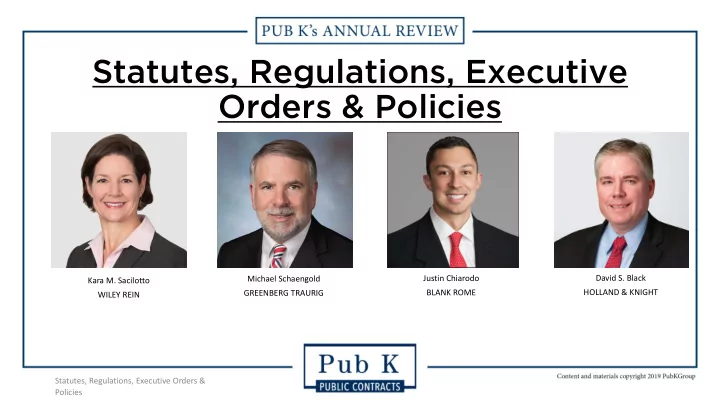
Kara M. Sacilotto WILEY REIN Michael Schaengold GREENBERG TRAURIG David S. Black HOLLAND & KNIGHT Justin Chiarodo BLANK ROME Statutes, Regulations, Executive Orders & Policies
Statutes, Regulations, Executive Orders & Policies David S. - - PowerPoint PPT Presentation
Statutes, Regulations, Executive Orders & Policies David S. Black Michael Schaengold Justin Chiarodo Kara M. Sacilotto HOLLAND & KNIGHT GREENBERG TRAURIG BLANK ROME WILEY REIN Statutes, Regulations, Executive Orders & Policies
Kara M. Sacilotto WILEY REIN Michael Schaengold GREENBERG TRAURIG David S. Black HOLLAND & KNIGHT Justin Chiarodo BLANK ROME Statutes, Regulations, Executive Orders & Policies
Statutes, Regulations, Executive Orders & Policies
21, 2018)
Statutes, Regulations, Executive Orders & Policies
met by calculating average annual receipts for 5 years rather than 3 years
contracts, which are based on employee count
business programs because of spikes in revenue
under a 3 year calculation, the business would be small; contrary to its apparent intent, Act may not help all businesses to stay small for a longer period
Statutes, Regulations, Executive Orders & Policies
result, the formula change arguably should have immediate effect
Extension Act is not presently effective and is therefore not applicable to present contracts,
have declined to overturn this decision
held a March 26, 2019 hearing, “Cleared for Take-off? Implementation of the Small Business Runway Extension Act”
Statutes, Regulations, Executive Orders & Policies
Act, “to address the delay in implementation of the Small Business Runway Extension Act.” In mid-July 2019, the legislation passed the House and was referred to the Senate Committee on Small Business and Entrepreneurship, where it remains pending
implementing this Act
Statutes, Regulations, Executive Orders & Policies
remove certain “sources” or “covered articles” from the supply chain
cyberattacks and espionage by China and Russia
Statutes, Regulations, Executive Orders & Policies
(Chair), GSA, DHS, ODNI, DOJ/FBI, DOD/NSA and Commerce/NIST.
risks in covered article procurements;
mitigation activities associated with supply chain risk;
Statutes, Regulations, Executive Orders & Policies
procurement actions”
systems”
that provides 30 days to submit information in opposition to the recommendation
security reasons
Statutes, Regulations, Executive Orders & Policies
agency head may exclude source from a single “covered procurement” or a class of “covered procurements”
chain risk related “qualification requirements” (for testing or quality assurance) in the acquisition or use of covered articles; (B) excluding a source from a covered article procurement if the source “fails to achieve an acceptable rating” for a supply chain risk evaluation factor; (C) determining a source is not responsible based on supply chain risk considerations; or (D) deciding “to withhold consent for a contractor to subcontract with a particular source or to direct a contractor to exclude a particular source from consideration for a subcontract”
covered procurement action taken, unless urgent national security interests exist
Statutes, Regulations, Executive Orders & Policies
procurement actions
Statutes, Regulations, Executive Orders & Policies
2023
final rule due on Dec. 21, 2020
focus on the “covered procurement actions”
Statutes, Regulations, Executive Orders & Policies
President’s budget, each agency must include:
‘closed, unimplemented’” that has been pending for at least 1 year; and
agency that has been pending for at least 1 year, and for which no final action has been taken.
Statutes, Regulations, Executive Orders & Policies
implementation status” of the above-referenced GAO and OIG public recommendations. The report shall include:
failed to act upon, “a detailed justification for the decision,” or where “the agency has decided to adopt [the recommendation], a timeline for full implementation;” and
not recommended has been taken, an explanation of the reasons why,” or where the agency has decided to adopt an unimplemented recommendation, a timeline for implementation.
Statutes, Regulations, Executive Orders & Policies
determining whether to implement the public recommendation,” the agency is exempt from compliance with the report issuance requirements in (A) and (B), above
lack of implementation in an agency’s budget request, agencies will be held more accountable for unimplemented recommendations and Congress and the public can more readily scrutinize an agency’s funding request in light of unfulfilled efficiency improvements that may yield cost savings.”
recommendations and improve agency accountability for tracking and resolving them
Statutes, Regulations, Executive Orders & Policies
agency head, he/she “shall submit a written statement on action taken or planned on the recommendation”
Congressional Committees. This additional time will enable agencies to “plan substantive action in response to GAO’s recommendations and will result in responses that are more useful to Congressional Committees and GAO in following up on agencies’ implementation
Statutes, Regulations, Executive Orders & Policies
Subpart 22.17, Combating Trafficking in Persons
to local educational agencies” “to establish, expand, and support programs”:
trafficking;” and
victims” of such trafficking
Statutes, Regulations, Executive Orders & Policies
contract for” “air transportation with a domestic carrier requires that the carrier submit to” GSA Administrator, Transportation Secretary, TSA Administrator, Labor Secretary, and Customs & Border Protection Commissioner “an annual report” concerning: (i) “the number of personnel trained in the detection and reporting of potential human trafficking;” (ii) “the number of notifications of potential human trafficking victims received from staff or other passengers;” and (iii) “whether the air carrier notified the National Human Trafficking Hotline or law enforcement at the relevant airport of the potential human trafficking victim for each such notification of potential human trafficking, and if so, when the notification was made.”
Statutes, Regulations, Executive Orders & Policies
the Trafficking Victims Protection Act of 2000 by adding subsection (k), “Agency Action To Prevent Funding Of Human Trafficking”
Director annually “to each submit a report to the GSA Administrator” that describes agency and contractor actions to ensure compliance with the various laws and regulations relating to prohibiting, preventing, investigating and penalizing human trafficking, including training and education related thereto, and information on investigations into contractors/subcontractors that may have violated such laws and regulations and any remedial or law enforcement actions taken
Statutes, Regulations, Executive Orders & Policies
Institute “shall include at least 1 course, lasting at least 30 minutes, regarding the law and regulations relating to human trafficking and contracting with the Federal Government.”
Statutes, Regulations, Executive Orders & Policies
the President, but an agreed upon Conference Report issued late on Dec. 9
more elsewhere
relevant Fiscal Year
Statutes, Regulations, Executive Orders & Policies
sought recommendations on how to reduce the timeline between NDAA statutory enactment and issuance of regulations in the DFARS and to “ensure that previously enacted statutory provisions are not disregarded in regulation.”
(more than 4 months late) on March 1, 2019: GAO-19-489, DEFENSE ACQUISITIONS: DOD NEEDS
TO IMPROVE HOW IT COMMUNICATES THE STATUS OF REGULATION CHANGES
Statutes, Regulations, Executive Orders & Policies
provisions, including through formal rulemaking for certain DFARS; in an interim DFARS; in a DFARS class deviation; in the DFARS Procedures, Guidance, and Information; or in acquisition guidance (e.g., a DOD Instruction)
the implementation status of acquisition-related NDAA provisions. This is available at https://www.acq.osd.mil/dpap/dars/index.html
Statutes, Regulations, Executive Orders & Policies
(some taking 2 to 4 years or more to be implemented)
were unimplemented
are not met
required to be completed within 180 days of the NDAA’s passage
Statutes, Regulations, Executive Orders & Policies
Statutes, Regulations, Executive Orders & Policies
the requirement to report counterfeit electronic parts in a contractor’s supply chain. The requirement, which previously applied to defense contractors, now applies to all contractors and requires them to report to the Government-Industry Data Exchange Program (GIDEP) any counterfeit/potentially counterfeit parts used in “complex items with critical applications” and nonconforming parts that do not meet contract specifications.
method for calculating annual average receipts used to prescribe size standards for all SBA receipt-based size standards, and for other agencies’ proposed receipts-based size standards, from a 3-year to a 5-year averaging period. Proposed rule discussed in written materials); (2) 84
RISE Act, and address other small business subcontracting issues); (3) 84 Fed. Reg. 65222, Nov. 26, 2019 Final Rule (comprehensive revision to HUBZone Program)
Statutes, Regulations, Executive Orders & Policies
methodology white paper explaining how it establishes, reviews, or revises small business size standards.
implement a statutory requirement to certify Women-Owned Small Business Concerns (WOSB) and Economically Disadvantaged Women-Owned Small Business Concerns (EDWOSB) participating in the Women-Owned Small Business Contract Program.
implement Section 852 of the FY 2019 NDAA which provides for accelerated payments to small business contractors and subcontractors by accelerating payments to their prime contractors.
Statutes, Regulations, Executive Orders & Policies
implement Section 1614 of the FY 2014 NDAA, as implemented by the SBA in its final rule published in 2016.
support the SBA’s policy of including overseas contracts in agency small business contracting goals.
Statutes, Regulations, Executive Orders & Policies
information from the public to assist in developing DFARS revisions to implement FY 2019 NDAA § 865, which repeals several years of congressional adjustments to the statutory presumption of development at private expense for commercial items.
implement FY 2017 NDAA §§ 871-872 to address how contracting officers may require offerors to submit relevant information to support market research for price analysis for the acquisition of commercial items.
the FAR to change the definition of ‘‘commercial item’’ at FAR 2.101 so that the regulatory definition conforms to statutory changes made to the definition by FY 2018 NDAA § 847.
Statutes, Regulations, Executive Orders & Policies
implement sections of the FY 2017 and 2018 NDAAs that established limitations and prohibitions
implement a section of the FY 2019 NDAA which specified the criteria that must be met to include LPTA source selection criteria in a solicitation and required procurements predominantly for the acquisition of certain services and supplies to avoid the use of LPTA source selection criteria, to the maximum extent practicable.
Statutes, Regulations, Executive Orders & Policies
amending the DFARS to implement sections of the FY 2017 and 2018 NDAAs. These NDAA provisions impose prohibitions regarding acquisition of certain foreign commercial satellite services; expand the definition of ‘‘covered foreign country’’ to include Russia; and prohibit purchase of items originating China that meet the definition of goods and services controlled as munitions items when moved to the Commerce Control List of the Export Administration Regulations.
the FAR to implement Section 889(a)(1)(A) of the FY 2019 NDAA. This interim rule prohibits agencies from procuring or obtaining, or extending or renewing a contract to procure or obtain, any equipment, system, or service that uses covered telecommunications equipment or services as a substantial or essential component of any system, or as a critical technology as part of any system, on or after August 13, 2019.
Statutes, Regulations, Executive Orders & Policies
Compliance Programs is proposing regulations to clarify the scope and application of the religious exemption contained in section 204(c) of Executive Order 11246, as amended.
salary level necessary to exempt executive, administrative, professional, outside sales, and computer employees from the Fair Labor Standards Act’s minimum wage and overtime pay requirements.
Statutes, Regulations, Executive Orders & Policies
to implement sections of the FY 2017 NDAA to expand special emergency procurement authorities for acquisitions of supplies or services that facilitate defense against or recovery from cyber-attack, provide certain international disaster assistance, or support response to an emergency or major disaster under the Robert T. Stafford Disaster Relief and Emergency Assistance Act.
establish a higher DoD contractor purchasing system review dollar threshold ($50 million).
Statutes, Regulations, Executive Orders & Policies
FAR to provide guidance to DoD, NASA, and the Coast Guard, consistent with Section 882 of the FY 2017 NDAA. Section 822 excludes from the standard for adequate price competition the situation in which there was an expectation of competition, but only one offer is received.
the VAAR to implement the Federal Circuit’s mandate in PDS Consultants, Inc., v. United States, 907 F.3d 1345 (Fed. Cir. 2018).
Statutes, Regulations, Executive Orders & Policies
implement a section of the FY 2017 NDAA that addresses the requirement for additional cost or pricing data when only one offer is received in response to a competitive solicitation. This supplements the FAR rule published in 84 Fed. Reg. 27494.
811 of the FY 2017 NDAA and Section 815 of the FY 2018 NDAA regarding undefinitized contractual actions.
Statutes, Regulations, Executive Orders & Policies
to implement a section of the FY 2016 NDAA regarding other transaction agreements that modifies DoD’s authority to carry out certain prototype other transactions and the criteria required to exempt from competition certain follow-on productions contracts to a participant in the transaction.
FAR to implement a section of the FY 2018 NDAA to increase the threshold for requiring certified cost or pricing data from $750,000 to $2 million for contracts entered into after June 30, 2018.
Statutes, Regulations, Executive Orders & Policies
Statutes, Regulations, Executive Orders & Policies
Projects (January 31, 2019)
Services Supply Chain (May 15, 2019)
Materials (July 15, 2019)
Statutes, Regulations, Executive Orders & Policies
(February 11, 2019)
Statutes, Regulations, Executive Orders & Policies
capabilities of contractors who handle CUI
body
RFPs in fall 2020
Statutes, Regulations, Executive Orders & Policies
Documents (October 9, 2019)
Statutes, Regulations, Executive Orders & Policies
in Civil Administrative Enforcement and Adjudication (October 9, 2019)
Statutes, Regulations, Executive Orders & Policies
Statutes, Regulations, Executive Orders & Policies
Statutes, Regulations, Executive Orders & Policies
Statutes, Regulations, Executive Orders & Policies
Statutes, Regulations, Executive Orders & Policies
Statutes, Regulations, Executive Orders & Policies