
SLIDE 1
CSE 473: Artificial Intelligence
Advanced Applic's: Natural Language Processing
Steve Tanimoto --- University of Washington
[Some of these slides were created by Dan Klein and Pieter Abbeel for CS188 Intro to AI at UC Berkeley.
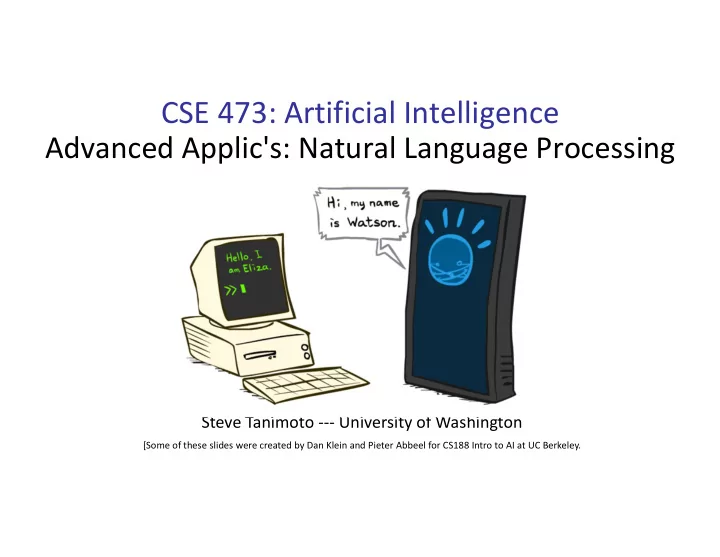
CSE 473: Artificial Intelligence Advanced Applic's: Natural Language - - PowerPoint PPT Presentation
CSE 473: Artificial Intelligence Advanced Applic's: Natural Language Processing Steve Tanimoto --- University of Washington [Some of these slides were created by Dan Klein and Pieter Abbeel for CS188 Intro to AI at UC Berkeley. What is NLP?
Steve Tanimoto --- University of Washington
[Some of these slides were created by Dan Klein and Pieter Abbeel for CS188 Intro to AI at UC Berkeley.
answering…
ROOT S 375/420 S NP VP . 320/392 NP PRP 127/539 VP VBD ADJP 32/401 …..
Hurricane Emily howled toward Mexico 's Caribbean coast on Sunday packing 135 mph winds and torrential rain and causing panic in Cancun, where frightened tourists squeezed into musty shelters.
[Demo: Berkeley NLP Group Parser http://tomato.banatao.berkeley.edu:8080/parser/parser.html]
database
“Do you often think of __”?
[Demo: http://nlp-addiction.com/eliza]
to potential answers
(e.g. Wikipedia, etc.), exploits redundancy
13
17
21
[ISI MT system output]
*important for AI
A multiset is a collection like a set, but which allows duplicates (any number of copies) of elements. { a, b, c} is a set. (It is also a multiset.) { a, a, b, c, c, c } is not a set, but it is a multiset. { c, a, b, a, c, c } is the same multiset. (Order doesn’t matter). A multiset is also called a bag.
words words bag in of repeat a may
Let document D = “The big fox jumped over the big fence.” The bag representation is: { big, big, fence, fox, jumped, over, the, the } For notational consistency, we use alphabetical order. Also, we omit punctuation and normalize the case. The ordering information in the document is lost. But this is OK for some applications.
In information retrieval and some other types of document analysis, we often begin by deleting words that don’t carry much meaning or that are so common that they do little to distinguish one document from another. Such words are called stopwords. Examples: (articles) a, an, the; (quantifiers) any, some, only, many, all, no;
(pronouns) I, you, it, he, she, they, me, him, her, them, his, hers, their, theirs, my, mine, your, our, yours, ours, this, that, these, those, who, whom, which; (prepositions) above, at, behind, below, beside, for, in, into, of, on, onto, over, under; (verbs) am, are, be, been, is, were, go, gone, went, had, have, do, did, can, could, will, would, might, may, must; (conjunctions) and, but, if, then, not, neither, nor, either, or; (other) yes, perhaps, first, last, there, where, when.
In order to detect similarities among words, it often helps to perform stemming. We typically stem a word by removing its suffixes, leaving the basic word, or “uninflecting” the word
A counterpart to stopwords is the reference vocabulary. These are the words that ARE allowed in document representations. These are all stemmed, and are not stopwords. There might be several hundred or even thousands of terms in a reference vocabulary for real document processing.
Assume we have a reference vocabulary of words that might appear in our documents. {apple, big, cat, dog, fence, fox, jumped, over, the, zoo} We represent our bag { big, big, fence, fox, jumped, over, the, the } by giving a vector (list) of occurrence counts of each reference term in the document: [0, 2, 0, 0, 1, 1, 1, 1, 2, 0]
If there are n terms in the reference vocabulary, then each document is represented by a point in an n-dimensional space.
Create links from terms to documents or document parts (a) concordance (b) table of contents (c) book index (d) index for a search engine (e) database index for a relation (table)
A concordance for a document is a sort of dictionary that lists, for each word that occurs in the document the sentences or lines in which it
“document”: A concordance for a document is a sort of dictionary that lists, for each word that occurs in the document the “occurs”: that lists, for each word that occurs in the document the sentences or lines in which it occurs.
Typical problems:
different versions of the same document. (applications: search engine hit filtering, plagiarism detection).
placed into the same category as a model document. (essay grading, automatic response generation, etc.)
Document 1: “All Blues. First the key to last night's notes.” Document 2: “How to get your message across. Restate your key points first and last. “ Reference vocabulary: { across, blue, first, key, last, message, night, note, point, restate, zebra }
Document 1 reduced: blue first key last night note Document 2 reduced: message across restate key point first last Document 1 vector representation: [0, 1, 1, 1, 1, 0, 1, 1, 0, 0, 0] Document 2 vector representation: [1, 0, 1, 1, 1, 1, 0, 0, 1, 1, 0]
Dot product (same as “inner product”) [0, 1, 1, 1, 1, 0, 1, 1, 0, 0, 0] [1, 0, 1, 1, 1, 1, 0, 0, 1, 1, 0] = 0 1 + 1 0 + 1 1 + 1 1 + 1 1 + 0 1 + 1 0 + 1 0 + 0 1 + 0 1 + 0 0 = 3 Normalized: cos = (v1 v2) / ( || v1 || || v2 || ) || v || = cos = 3 6 7 0.4629. 62.4 deg.
cos = 0 means that the document vectors are orthogonal and the documents have no reference vocabulary
cos = 1 means that the documents are either identical or the vectors point in the same direction in the n-dim space. That is, the documents share the same distribution of
A problem with the cosine similarity function: Unless both documents use the same term for something, the similarity is not recognized. “Computer learning environments have a great future.” “Educational technology offers wonderful potential.” cosine similarity is 0.
With Latent Semantic Analysis, the vector for each document is first transformed into a vector in another space
the same element or set of elements. After that, the cosine similarity between the new vectors will be greater, if the documents share RELATED terms.
The semantic space for LSA is obtained from a set of documents given in advance. The space is created using matrix factorization via the Singular Value Decomposition (SVD) method. This is computationally costly, but modern computers are powerful enough to do it. For more details, see Chapter 16 of Introduction to Python for Artificial Intelligence.
Given term-document matrix A, having t rows and d columns, find TSD such that: A = TSD T is a t by t orthonormal matrix D is a d by d orthonormal matrix S is an m by m diagonal matrix, where m is the rank of A.
import LinearAlgebra as LA (TSD) = LA.singular_value_decomposition(A)
Given TSD, form a reduced (and generalized) product Tr Sr Dr by deleting the rows and columns of S that contain the smallest diagonal values. Then eliminate the last columns of T to get Tr and eliminate the last rows of D to get Dr. Ar = Tr Sr Dr To compare two documents in the latent semantic space, first map the documents into the space and then compute their cosine similarity. doc1 = Dr doc1 ; doc1 = Dr doc1 ; cossim (doc1 , doc2 )
d1 = "the brown weasel followed the fox and stole the eggs" d2 = "behind the fence the thief fled with half a dozen“ d3 = "artificial limbs can offer full mobility" Documents used to create a semantic space: "the lazy brown fox jumped over the fence" "the thief jumped the lazy fence and fled" "artificial intelligence is full of surprises" cossim(d1, d2) = 0 Without LSA, d1 and d2 seem dissimilar. cossim(d1, d2) = 1 With LSA, they are completely similar. cossim(d1, d3) = cossim(d1, d3) = 0 But LSA does not make d3 any more similar to the others.