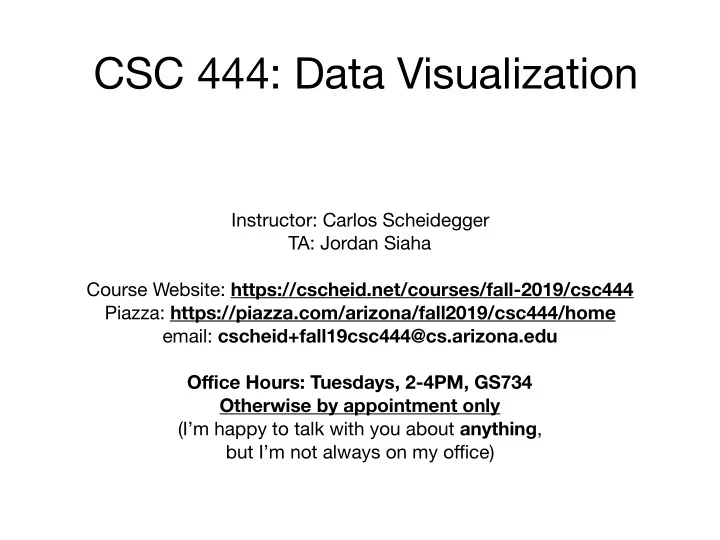
CSC 444: Data Visualization Instructor: Carlos Scheidegger TA: Jordan - - PowerPoint PPT Presentation

csc 444 data visualization
SMART_READER_LITE
LIVE PREVIEW

CSC 444: Data Visualization Instructor: Carlos Scheidegger TA: Jordan - - PowerPoint PPT Presentation

CSC 444: Data Visualization Instructor: Carlos Scheidegger TA: Jordan Siaha Course Website: https://cscheid.net/courses/fall-2019/csc444 Piazza: https://piazza.com/arizona/fall2019/csc444/home email: cscheid+fall19csc444@cs.arizona.edu O ffi ce


slide-1
SLIDE 1

CSC 444: Data Visualization

Instructor: Carlos Scheidegger TA: Jordan Siaha Course Website: https://cscheid.net/courses/fall-2019/csc444 Piazza: https://piazza.com/arizona/fall2019/csc444/home email: cscheid+fall19csc444@cs.arizona.edu Office Hours: Tuesdays, 2-4PM, GS734 Otherwise by appointment only (I’m happy to talk with you about anything, but I’m not always on my office)

slide-2
SLIDE 2

Before we start

  • Let’s read the syllabus: https://cscheid.net/

courses/fall-2019/csc444/syllabus.html

  • Many small programming assignments (50%), one

midterm exam (20%), one final exam (30%)

  • First assignment has been posted!
  • https://cscheid.net/courses/fall-2019/csc444/

assignment_1.html

slide-3
SLIDE 3

Before we start

  • Mental Health and Wellness
  • There are many resources available to you at UA
  • Do not hesitate to contact CAPS or advising@cs.

if you are struggling or want to talk someone

slide-4
SLIDE 4

Vis is both ubiquitous and subtle

  • Frank Anscombe,

“Graphs in Statistical Analysis”

slide-5
SLIDE 5

Activity: let’s try to make sense of this data

  • Think about what you’d try, 1 minute
  • Gather in small groups, talk
  • Share with everyone
slide-6
SLIDE 6
slide-7
SLIDE 7

What did we try?

  • https://cscheid.net/courses/fall-2019/csc444/

lectures/lecture1/anscombe/

slide-8
SLIDE 8

Something interesting just happened: isn’t this a visualization too?!

slide-9
SLIDE 9

The way in which data is presented changes how we consume it, drastically.

slide-10
SLIDE 10

You will learn how—and how not—to build interactive data visualizations

slide-11
SLIDE 11

Three main themes

  • Mechanics: how do I build a visualization?
  • Javascript, CSS, HTML, d3
  • Principles: why should I build it in this way?
  • mathematical and perceptual arguments
  • Techniques: how do I turn principles and mechanics

into an actual visualization?

  • algorithms, software libraries
slide-12
SLIDE 12

Assessment

  • One small assignment per week, 50% weight
  • ~2-5 hours per assignment
  • One closed-book midterm, 20% weight
  • hour-long
  • One closed-book final, comprehensive exam, 30% weight
  • Class participation, 5% weight
  • piazza counts
slide-13
SLIDE 13

Grading

  • Performance grade:
  • ≥90%: A, ≥80%: B, ≥70%: C, ≥60%: D, <50%: F
slide-14
SLIDE 14

Plagiarism and Academic Conduct Policy

  • Unless I state otherwise, you are allowed to use any open source

library you want in your projects, provided that you give it credit.

  • Assignments will be small
  • If you pass off someone else’s work as yours, that’s plagiarism.
  • The penalty for plagiarism always includes a referral to the

college, and ranges from an automatic zero in the assignment to an automatic F in the course to expulsion from the university.

  • Don’t do it.
  • Don’t do it.
slide-15
SLIDE 15

Textbook

  • No required textbook, but you won’t regret buying

Munzner’s “Visualization Analysis and Design”

  • Available in digital form

from UA library as well

  • All required reading

material will be given in lecture notes, webpages, and research papers

http://www.amazon.com/Visualization-Analysis-Design-AK-Peters/dp/1466508914

slide-16
SLIDE 16

Textbook

  • You will also probably make good use of Scott

Murray’s “Interactive Visualization for the Web”

  • Available through O’Reilly Safari on campus (see

course website for details)

slide-17
SLIDE 17

Important Vis Books

  • William Cleveland, The Elements of Graphing Data,

Visualizing Data

  • John W. Tukey, Exploratory Data Analysis
  • Jacques Bertin, Semiology of Graphics
  • Edward Tufte, The Visual Display of Quantitative Information,

Visual Explanations, Envisioning Information

  • Colin Ware, Information Visualization
  • Come take a look at them during office hours if you’re curious;

they’re not cheap :(

slide-18
SLIDE 18

Mechanics

  • Writing programs: we will use the web technology

stack

  • Javascript, SVG, CSS, HTML, d3
slide-19
SLIDE 19

http://bit.ly/1swfb5p http://i.imgur.com/wR3ZxfB.jpg

slide-20
SLIDE 20

Stick with it, though!

http://bl.ocks.org/mbostock

slide-21
SLIDE 21

It’s easy to talk to a server It’s ubiquitous

apple.com arstechnica.com nanocubes.net

Good reasons to choose the web stack: It’s fast!

slide-22
SLIDE 22
slide-23
SLIDE 23

Principles

Building a visualization is fundamentally about

  • tradeoffs. Principles help us understand these

tradeoffs, and make informed decisions

slide-24
SLIDE 24

Pre-attentive Processing

Examples from Christopher Healey’s excellent resource http://www.csc.ncsu.edu/faculty/healey/PP/ Demo: https://cscheid.net/courses/fal18/csc444/lectures/ lecture1/boundary/

slide-25
SLIDE 25

Change Blindness

(photosensitive epilepsy? please look away.)

slide-26
SLIDE 26

http://www.csc.ncsu.edu/faculty/healey/PP/

slide-27
SLIDE 27

Respect the math in the data

Not everything you can do with data makes sense

slide-28
SLIDE 28

http://imgur.com/gNefvUG/

slide-29
SLIDE 29

http://viz.wtf/post/107998162170/6-7-gender-neutral#notes

slide-30
SLIDE 30

http://viz.wtf/post/107440754050/ how-payday-loans-add-up#notes

slide-31
SLIDE 31
slide-32
SLIDE 32

Techniques

How do we turn the mechanics and principles into an actual, working visualization?

slide-33
SLIDE 33

Linked views

demo: http://square.github.io/crossfilter/

slide-34
SLIDE 34

Treemaps

demo: GrandPerspective

slide-35
SLIDE 35
slide-36
SLIDE 36

A tour of visualization and visual thinking

http://cscheid.net/courses/fall-2019/csc444/lectures/ lecture1.html

slide-37
SLIDE 37
slide-38
SLIDE 38

CSC 444 Summary

  • 4 weeks of mechanics, 5 weeks of principles, 6

weeks of techniques

  • ~1 small assignment a week, 1 midterm, 1 final

exam

Course website: https://cscheid.net/courses/fall-2019/csc444 Today’s lecture: https://cscheid.net/courses/fall-2019/csc444/lectures/ week1.html