CS6202 Assignment 2 Deadline : 8pm 25 Sep 2006 September 17, 2006 - - PDF document

cs6202 assignment 2 deadline 8pm 25 sep 2006
SMART_READER_LITE
LIVE PREVIEW

CS6202 Assignment 2 Deadline : 8pm 25 Sep 2006 September 17, 2006 - - PDF document

CS6202 Assignment 2 Deadline : 8pm 25 Sep 2006 September 17, 2006 1 Installing Standard ML You will need to install a newer version of Standard ML to complete this project, as we will be using a lexer and parser generator. Go to the


slide-1
SLIDE 1

CS6202 – Assignment 2 Deadline : 8pm 25 Sep 2006

September 17, 2006

1 Installing Standard ML

You will need to install a newer version of Standard ML to complete this project, as we will be using a lexer and parser generator. Go to the following website and follow the instruction there to download and install SML NJ. There are Unix and MS Windows distributions. http://www.smlnj.org/dist/working/110.59/index.html

2 An Inference Task

In this assignment, you will need to implement a type inference algorithm for a simple language. The syntax of the language is given below. Boldface words are

  • keywords. Note that function names are simply declared as let-bound variables,

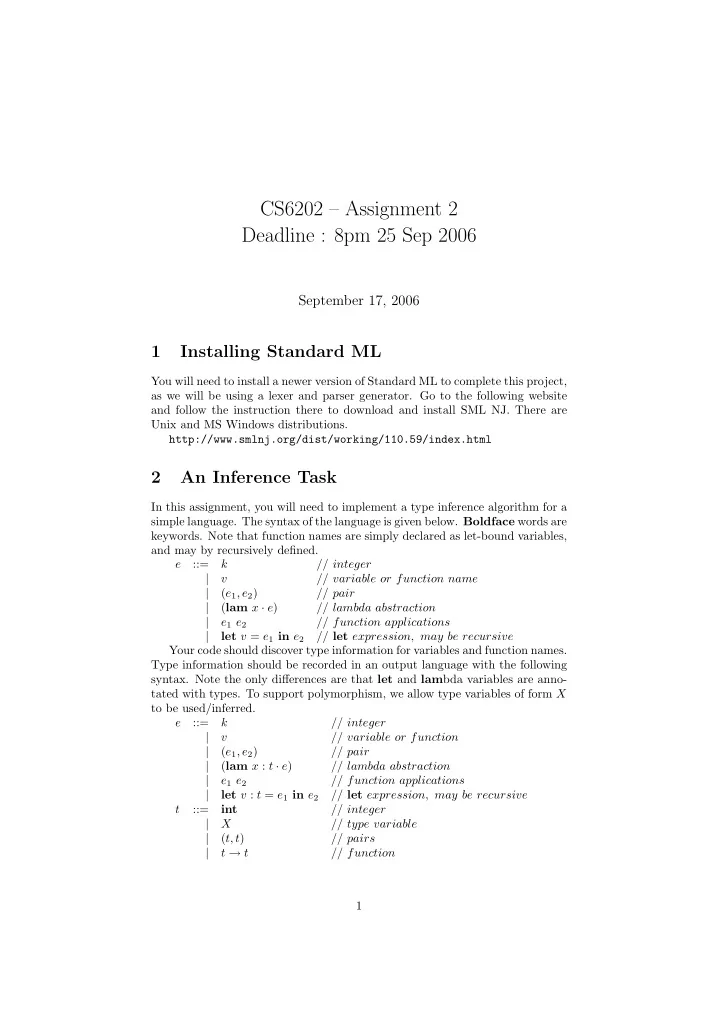
and may by recursively defined. e ::= k // integer | v // variable or function name | (e1, e2) // pair | (lam x · e) // lambda abstraction | e1 e2 // function applications | let v = e1 in e2 // let expression, may be recursive Your code should discover type information for variables and function names. Type information should be recorded in an output language with the following

  • syntax. Note the only differences are that let and lambda variables are anno-

tated with types. To support polymorphism, we allow type variables of form X to be used/inferred. e ::= k // integer | v // variable or function | (e1, e2) // pair | (lam x : t · e) // lambda abstraction | e1 e2 // function applications | let v : t = e1 in e2 // let expression, may be recursive t ::= int // integer | X // type variable | (t, t) // pairs | t → t // function 1

slide-2
SLIDE 2

Example

Input program: let f = (lam x · 2) in (f 0) Output program: let f : A → int = (lam x : A · 2) in (f 0) Input program: let f = (lam x · (lam y · (x, y)) in (f 0 1) Output program: let f : A → (B → (A, B)) = (lam x : A · (lam y : B · (x, y)) in (f 0 1)

3 Supplied Code

You are provided with a lexer and parser. You are also provided with data structure to store input AST and a simple pretty printer for the AST. The contents of the source files are as follows:

  • absyn.ml Abstract syntax tree
  • exp.grm Grammar definition file for ML-Yacc. Note that for simplicity,

the concrete syntax for function application is (e1 e2).

  • exp.lex Lexer definition file for ML-Lex.
  • sources.cm CM input
  • link.sml, parse.sml, parse.sml Various glue code

Make the directory storing the above files current working directory of sml. Run CM.make ‘‘sources.cm’’; at the SML/NJ command line to generate the parser/lexer and compile other source. Once everything is compiled and loaded, you can use Parse.prog parse to parse a string, and Parse.file parse to parse a file. Below is a sample session. $ sml Standard ML of New Jersey v110.59 [built: Mon Sep 11 11:47:37 2006]

  • CM.make "sources.cm";

[autoloading] [library $smlnj/cm/cm.cm is stable] [library $smlnj/internal/cm-sig-lib.cm is stable] [library $/pgraph.cm is stable] [library $smlnj/internal/srcpath-lib.cm is stable] [library $SMLNJ-BASIS/basis.cm is stable] [autoloading done] [scanning sources.cm] [library $/ml-yacc-lib.cm is stable] [library $SMLNJ-ML-YACC-LIB/ml-yacc-lib.cm is stable] [loading (sources.cm):interface.sml] [loading (sources.cm):absyn.sml] [loading (sources.cm):exp.grm.sig] [loading (sources.cm):exp.grm.sml] 2

slide-3
SLIDE 3

[loading (sources.cm):exp.lex.sml] [loading (sources.cm):parse.sml] [loading (sources.cm):link.sml] [New bindings added.] val it = true : bool

  • Parse.prog_parse "let x = 1 in (f x)";

val it = - : Absyn.absyn

  • Absyn.print_ast it;

val it = "let x = 1 in (f x)" : string

  • 3