Cryptogenic Strokes in a Ischemic Stroke in the Middle-Aged Man - - PowerPoint PPT Presentation

cryptogenic strokes in a ischemic stroke in the middle
SMART_READER_LITE
LIVE PREVIEW

Cryptogenic Strokes in a Ischemic Stroke in the Middle-Aged Man - - PowerPoint PPT Presentation

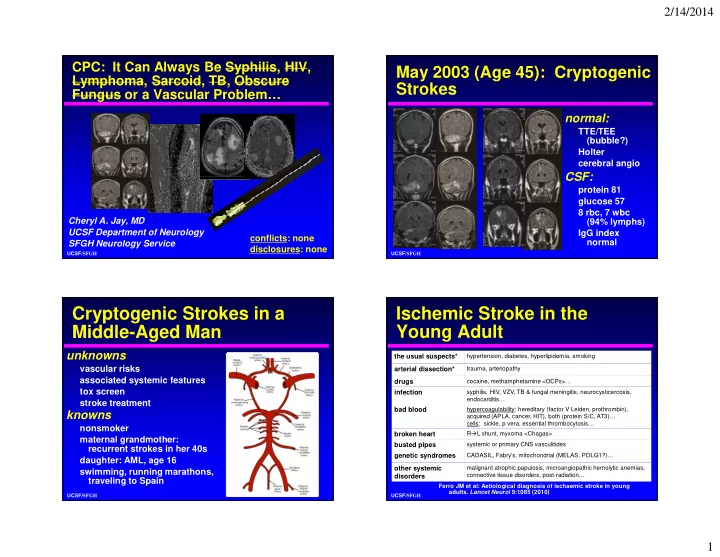
2/14/2014 CPC: It Can Always Be Syphilis, HIV, May 2003 (Age 45): Cryptogenic Lymphoma, Sarcoid, TB, Obscure Strokes Fungus or a Vascular Problem normal: TTE/TEE (bubble?) Holter cerebral angio CSF: protein 81 glucose 57 8 rbc, 7


slide-1
SLIDE 1

2/14/2014 1

UCSF/SFGH

CPC: It Can Always Be Syphilis, HIV, Lymphoma, Sarcoid, TB, Obscure Fungus or a Vascular Problem…

Cheryl A. Jay, MD UCSF Department of Neurology SFGH Neurology Service conflicts: none disclosures: none

UCSF/SFGH

May 2003 (Age 45): Cryptogenic Strokes

normal:

TTE/TEE (bubble?) Holter cerebral angio

CSF:

protein 81 glucose 57 8 rbc, 7 wbc (94% lymphs) IgG index normal

UCSF/SFGH

Cryptogenic Strokes in a Middle-Aged Man

knowns

nonsmoker maternal grandmother: recurrent strokes in her 40s daughter: AML, age 16 swimming, running marathons, traveling to Spain

unknowns

vascular risks associated systemic features tox screen stroke treatment

UCSF/SFGH

Ischemic Stroke in the Young Adult

the usual suspects*

hypertension, diabetes, hyperlipidemia, smoking

arterial dissection*

trauma, arteriopathy

drugs

cocaine, methamphetamine <OCPs>…

infection

syphilis, HIV, VZV, TB & fungal meningitis, neurocysticercosis, endocarditis…

bad blood

hypercoagulability: hereditary (factor V Leiden, prothrombin), acquired (APLA, cancer, HIT), both (protein S/C, AT3)… cells: sickle, p vera, essential thrombocytosis…

broken heart

RL shunt, myxoma <Chagas>

busted pipes

systemic or primary CNS vasculitides

genetic syndromes

CADASIL, Fabry’s, mitochondrial (MELAS, POLG1?)…

  • ther systemic

disorders

malignant atrophic papulosis, microangiopathic hemolytic anemias, connective tissue disorders, post-radiation… Ferro JM et al: Aetiological diagnosis of ischaemic stroke in young

  • adults. Lancet Neurol 9:1085 (2010)
slide-2
SLIDE 2

2/14/2014 2

UCSF/SFGH

Not So Uncommon After All?

Fabry’s Disease Mitochondrial Encephalomyopathy Lactic Acidosis & Stroke-Like Episodes inheritance X-linked recessive maternal inheritance systemic angiokeratomata, eye, renal, cardiac short stature, hearing loss, cardiac, renal, diabetes neurologic painful neuropathy, ischemic stroke (small vessel) migraine, stroke <age 40, seizure,

  • ptic atrophy, generalized

myopathy, neuropathy mechanism α-galactosidase A deficiency mtDNA mutation, infarct vs ox phos diagnosis genetic testing can be challenging treatment enzyme replacement supportive

Testai FD, Gorelick PB: Inherited metabolic disorders and stroke part I. Arch Neurol 67:19 (2010)

UCSF/SFGH

January – March 2012 (age 55): Left Leg Swelling & Erythema

calf foot: progressive, with pain studies

LE Doppler: no DVT leukopenic with low ANC muscle biopsy: focal mild endomysial inflammation in 1 fascicle, with histiocytes (necrotic fibers or vessel walls?)

rx: better with prednisone?

UCSF/SFGH

Atraumatic Painful, Swollen Leg: Differential Diagnosis

Ahmed S et al: A case of polyarteritis nodosa limited to the right calf muscles, fascia, and skin: a case

  • report. J Med Case Rep 5:450 (2011)

non-neurologic

DVT cellulitis

diabetics

muscle infarction pyomyositis

“focal myositis”

local inflammatory myopathy neurogenic

UCSF/SFGH

May 2012 (Moffitt): Problems Spanning the Neuroaxis

general exam: chronic arterial insufficiency left leg,

with erythema, tenderness, pitting edema

neurological exam

bilateral hemispheric dysfunction (old on the right) left foot drop with painful, swollen posterior compartment muscles

  • inflammatory +/- ischemic (popliteal artery branches)

muscle dysfunction (compartment syndrome?)

  • denervation-related muscle abnormalities, in tibial

nerve distribution (microvascular?) right ulnar (versus lower plexus) sensory loss

slide-3
SLIDE 3

2/14/2014 3

UCSF/SFGH

FLAIR FLAIR T1 POST-GAD T1 POST-GAD

UCSF/SFGH

“The Full Moffitt”

the usual suspects

nonsmoker, normal blood glucose

arterial dissection drugs infection

negative: HIV, BC x 4 (before antibiotics), RPR; CSF VDRL, VZV PCR, AFB, Whipple PCR, CSF culture likely contaminant

bad blood

prothrombin G20210A heterozygote normal PT/PTT, anticardiolipin IgM slightly up, protein S slightly down

broken heart

TTE/TEE neg with bubble, TCD of MCAs quiet x 30”

busted pipes

current MRA/MRV (& prior angio) negative; arteritis of small & medium vessels?

genetic syndromes

focal, not generalized neuromuscular dysfunction, with systemic disease largely hematologic (lactate slightly elevated)

  • ther systemic

disorders

pancytopenia, hyperferritinemia, hypofibrinogenemia, ACE slightly up normal: IL-2, NK cell function, kidneys, liver, lungs, SPEP, UPEP, ESR, CRP, ANA, ANCA, C3, C4, CH50

UCSF/SFGH

CSF Glucose: How Low Is Low?

Fishman RA: CSF in Diseases of the Nervous System, 2nd ed (1992) Chow E, Troy S: The differential of hypoglycorrhachia in adult patients. Am J Med Sci:Dec 10 [Epub ahead

  • f print] (2013)

UCSF/SFGH

Completing the Workup

the usual suspects

Hgb A1C, lipid studies

arterial dissection drugs infection

CSF VZV antibodies, Bartonella serologies

bad blood

hemolysis studies: LDH, indirect bilirubin, haptoglobin, reticulocyte count, blood smear (bone marrow biopsy)

broken heart busted pipes

review muscle biopsy, consider ophthalmology evaluation cerebral angiogram or brain biopsy

genetic syndromes

  • ther systemic

disorders

revisit history & exam of skin and joints assessment of other vascular beds (GI?) monitor liver & renal function

slide-4
SLIDE 4

2/14/2014 4

UCSF/SFGH

HD4 HD4 HD16 HD16

#2: seizurePHTfever & rash #18: IV methylprednisolone + doxy #13: ctx

#2 CSF pro 69 glu 38% #5 CSF pro 90 glu 48% 1 band #14 CSF pro 96 glu 44%

UCSF/SFGH

Recurrent Cerebral Ischemia with Focal Neuromuscular Disease

not typical for cardioembolism (& relevant workup negative) Prothrombin mutation could potentially link the patient & his maternal grandmother but seem unlikely to be sole cause for his illness. Kidney, lung, liver (along with heart) spared, with pancytopenia microangiopathic hemolytic syndrome (DIC or PNH) with multiple thromboses vs sdystemic vasculitis with central & peripheral nervous system involvement?

UCSF/SFGH

Paroxysmal Nocturnal Hemoglobinuria

rare hematopoetic stem cell defect: complement-mediated

intravascular hemolysis

multisystem illness: visceral

(especially abdominal) usually venous, neurologic involvement typically CNS, not PNS

Table 2. Sites and Types of Thrombosis.

SITE AND TYPE OF THROMBOSIS

  • NO. OF

PATIENTS

Intraabdominal Hepatic vein Inferior vena cava Mesenteric vein Splenic vein Renal vein Unspecified 8 3 4 1 1 1 Other venous sites Cerebral vein Pulmonary embolism Deep vein Superficial 4 9 7 3 Arterial Myocardial infarction Cerebrovascular accident 6 2

Hillmen P et al: The natural history of paroxysmal nocturnal hemoglobinuria. New Engl J Med 333:1253 (1995)

dx: hemoglobinuria, markers of

intravascular hemolysis, flow cytometry, bone marrow biopsy

tx: eculizamab + anticoagulation?

UCSF/SFGH

Systemic Vasculitis 101

Jennette JC et al: 2012 revised international Chapel Hill consensus conference nomenclature of vasculitides. Arthritis Rheum 65:1 (2013)

slide-5
SLIDE 5

2/14/2014 5

UCSF/SFGH

Polyarteritis Nodosa, Classified

Chapel Hill, 2012:

“Necrotizing arteritis

  • f medium or small

arteries without glomerulonephritis or vasculitis in arterioles, capillaries, or venules, and not associated with antineutrophil cytoplasmic antibodies (ANCAs).”

ACR, 1990

weight loss > 4kg livedo reticularis testicular pain myalgias mononeuritis or polyneuritis hypertension creatinine >1.5mg/dL HBV or HCV pathologic angio histology

UCSF/SFGH

Polyarteritis Nodosa

rare necrotizing medium (& small) vessel vasculitis associated with HBV: epidemiology evolving multisystem illness: constitutional, renal,

  • rchitis, neurologic (PNS>CNS), cutaneous, GI,

cardiovascular (pulmonary & hematologic rare)

dx: biopsy or angio (stenoses, microaneurysms) tx: corticosteroids + cyclosphosphamide for

severe disease

UCSF/SFGH

Thanks

collaborators

Mark Burish, MD PhD Andy Bollen, MD DVM

co-conspirators

Vineeta Singh, MD Alisa Gean, MD