Cryptogenic Strokes: Evaluation and Management 77 yo man with - - PDF document

cryptogenic strokes evaluation and management
SMART_READER_LITE
LIVE PREVIEW

Cryptogenic Strokes: Evaluation and Management 77 yo man with - - PDF document

Ischemic Stroke Case Cryptogenic Strokes: Evaluation and Management 77 yo man with hypertension and hyperlipidemia developed onset of left J. Claude Hemphill III, MD, MAS hemiparesis and right gaze preference, last seen normal Kenneth


slide-1
SLIDE 1

Page 1

NEUROCRITICAL CARE PROGRAM

UC SF

Cryptogenic Strokes: Evaluation and Management

  • J. Claude Hemphill III, MD, MAS

Kenneth Rainin Chair in Neurocritical Care Professor of Neurology and Neurological Surgery University of California, San Francisco Chief of Neurology, San Francisco General Hospital Past-President, Neurocritical Care Society

Disclosures Research Support: NIH/NINDS; Cerebrotech Medical Stock (options): Ornim

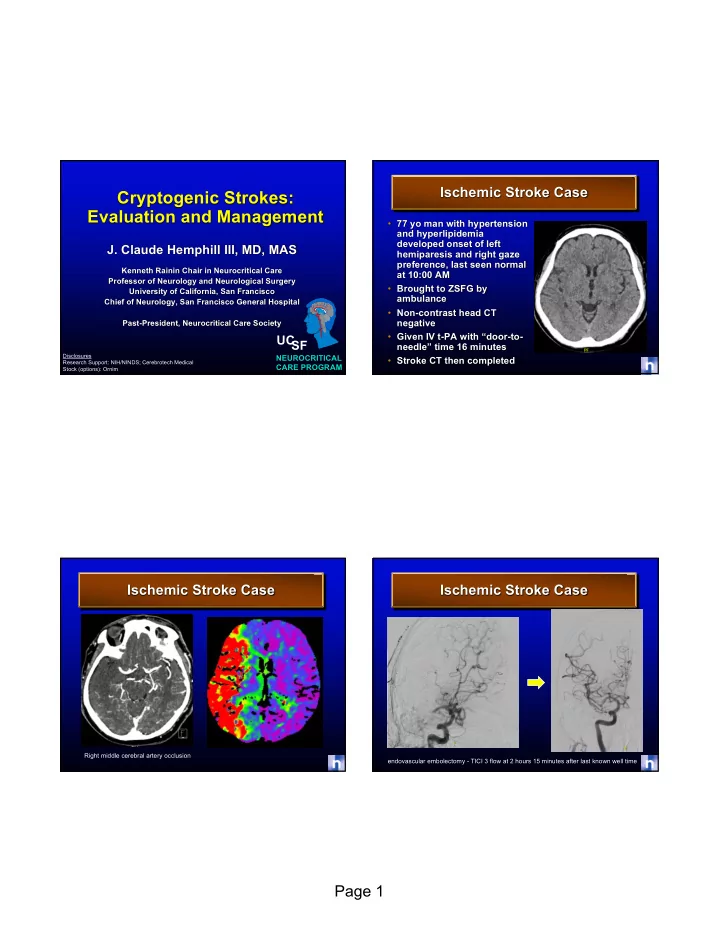
Ischemic Stroke Case

  • 77 yo man with hypertension

and hyperlipidemia developed onset of left hemiparesis and right gaze preference, last seen normal at 10:00 AM

  • Brought to ZSFG by

ambulance

  • Non-contrast head CT

negative

  • Given IV t-PA with “door-to-

needle” time 16 minutes

  • Stroke CT then completed

Ischemic Stroke Case

Right middle cerebral artery occlusion

Ischemic Stroke Case

endovascular embolectomy - TICI 3 flow at 2 hours 15 minutes after last known well time

slide-2
SLIDE 2

Page 2

Ischemic Stroke Case

  • Over next 4 days, recovered well and remained

with only left lower visual field deficit and mild gait instability

  • Workup

– 3 days of telemetry – no arrhythmias – Transthoracic echo – mild diastolic dysfunction, borderline enlarged atrium – Glucose normal – LDL 117 – Carotid imaging with CTA and angio without stenosis

  • Diagnosis – cryptogenic stroke

Cryptogenic Stroke

  • Symptomatic cerebral infarct for which

no probable cause is identified after adequate diagnostic evaluation

  • ~40% of strokes in 1970s
  • ~15% of strokes in advanced stroke

centers currently

Saver NEJM 2016

Ischemic Stroke Case

  • Discharged to rehabilitation on

– ASA – High-dose statin – ACE inhibitor

  • Also sent with Zio patch
  • Zio patch showed 3 self-limited runs of

paroxysmal atrial fibrillation

  • Diagnosis – cardioembolic stroke

Frequency of Stroke by Etiologic Subtype

Ischemic Hemorrhagic 84%

16%

Thrombotic Embolic 53% 31% 10% 6% Intracerebral Subarachnoid

slide-3
SLIDE 3

Page 3

Ischemic Stroke Subtypes - Localization

  • Large Vessel

–MCA –ACA –PCA –Basilar

  • Small Vessel -

Lacunar

Qureshi NEJM 2001

Imaging of Ischemic Stroke

http://www.uiowa.edu/~c064s01/nradcerebrovascular.html

Ischemic Stroke Causes

  • Large Vessel

– Embolic

» Cardiac (e.g. atrial fibrillation) » Artery-to-Artery (e.g. carotid stenosis) » Aortic Arch

– Thrombotic

» Atherosclerotic stenosis » Hypercoaguable state

  • Small vessel

– Microthrombosis in chronically damaged penetrating artery – Hypertension or diabetes in most cases

  • Distinction between ischemic stroke risk factors and

causes

Hart Lancet Neurology 2014

slide-4
SLIDE 4

Page 4

What’s a Good Stroke Workup?

  • Reason - acute treatment or stroke cause?
  • Large vessel versus small vessel?
  • Age of patient?
  • Vascular risk factors?
  • Usual start

– BP, ECG, CBC, Chem7 – Lipid panel, glucose, Hgb A1C, tox screen – Carotid imaging for anterior circulation stroke (CTA, ultrasound, MRA) – Transthoracic echo if not lacunar

Hart Lancet Neurology 2014

Cryptogenic Stroke

  • So let’s treat it
  • WARSS randomized trial

– Warfarin-aspirin recurrent stroke study – 2206 patients with ischemic stroke – No high-grade carotid stenosis (with planned surgery) or inferred cardioembolic source (mostly atrial fibrillation) – Randomized to » ASA 325 mg daily or » Warfarin for INR 1.4-2.8 – 26% of patients classified as cryptogenic – 56% small vessel disease

Mohr NEJM 2001 Mohr NEJM 2001

slide-5
SLIDE 5

Page 5

Cryptogenic Stroke

  • So when is it a cryptogenic stroke?
  • Doesn’t this just mean we have not

looked hard enough or smart enough?

  • What are stroke causes that we used to

call cryptogenic? –And what can we do about them?

  • Many are known stroke causes that we

just not had the technology to sufficiently evaluate (or not have sufficiently appreciated)

Intracranial stenosis

WASID randomized trial

  • 50-99% stenosis
  • No difference in ASA and

warfarin

  • ~22% event rate in 1.8

years SAMMPRIS randomized trial

  • 70-99% stenosis
  • Intracranial stenting

worse than medical therapy

Chimowitz NEJM 2005 and 2011

Patent Foramen Ovale(?)

  • Found in ~50% of cryptogenic stroke

patients and ~25% of healthy people

  • PICSS study (substudy of WASID)

– No difference in time to event between warfarin and ASA

  • Three randomized trials of PFO closure

negative for ischemic stroke reduction

  • But if you find a DVT, a right-to-left

shunt, and a PFO you may have a cause

Homma Circulation 2002 Saver NEJM 2016

Vasculitis - Angiography

  • Classic finding is “sausaging” of small-medium arteries
  • Angiography may be normal
  • Is abnormal angiogram diagnostic?
slide-6
SLIDE 6

Page 6 Moya-Moya

  • Obliterative arteropathy

with b/l distal intracranial ICA occlusions or high- grade stenoses

  • Usually diagnosed

angiographically (“vague or hazy puff of smoke”)

  • Not restricted to Asians
  • MRI/MRA by be strongly

suggestive

  • Non-inflammatory with

intimal thickening and smooth muscle proliferation

RICA LICA

LICA lenticulostriate “puff of smoke”

Other Causes

  • Hypercoaguable States

– Cancer – Antiphospholipid antibody syndrome

  • Genetic Conditions

– CADASIL – Fabry’s disease

  • Migraine-associated stroke

Undiagnosed Atrial Fibrillation

  • As little as a single 1-hour episode of

atrial fibrillation during 2 years of monitoring doubles stroke risk

  • ~15% of acute stroke patients have atrial

fibrillation at stroke onset

– Additional ~13% are diagnosed based on inpatient telemetry or 24 hour holter

  • Numerous studies have shown

detection of paroxysmal atrial fibrillation with prolonged monitoring

  • How long to monitor?

– 2-4 weeks? – 2-4 years?

Saver NEJM 2016

CRYSTAL AF Study

  • Randomized study (n=441) of patients with

cryptogenic stroke or TIA

  • Insertable cardiac monitor (ICM) versus

conventional follow-up

  • At 6 months

– ICM group – afib 8.9% – Conventional F/U – afib 1.4%

  • Mean time in afib was 4.3 minutes in a day

Sanna NEJM 2014

slide-7
SLIDE 7

Page 7

Sanna NEJM 2014 Sanna NEJM 2014

How About a New “Cause” of Stroke

  • ESUS

(embolic stroke of undetermined source)

  • Definition - a non-lacunar brain infarct without

proximal arterial stenosis or cardioembolic source with a clear indication for anticoagulation

  • Proposed as term to replace (most)

cryptogenic stroke

  • “a therapeutically relevant entity” (??)

Hart Lancet Neurology 2014 Hart Lancet Neurology 2014

slide-8
SLIDE 8

Page 8

Hart Lancet Neurology 2014 Hart Lancet Neurology 2014 Saver NEJM 2016

Proposed Workup Algorithm for Ischemic Stroke

slide-9
SLIDE 9

Page 9

Cryptogenic Stroke

  • Despite an extensive workup, a significant % of

patients will not have an identified cause of ischemic stroke

– Workup is not just inpatient anymore – If your rate is >15% you aren’t looking hard enough

  • Recurrent annual stroke rate in “true” cryptogenic

stroke is ~3-6%

  • Aggressive treatment of vascular risk factors is

always part of the intervention

– Antiplatelet agents as first-line antithrombotic

  • ESUS (embolic stroke of undetermined source) may

become an actual diagnosis with a defined treatment

– Clinical trials ongoing