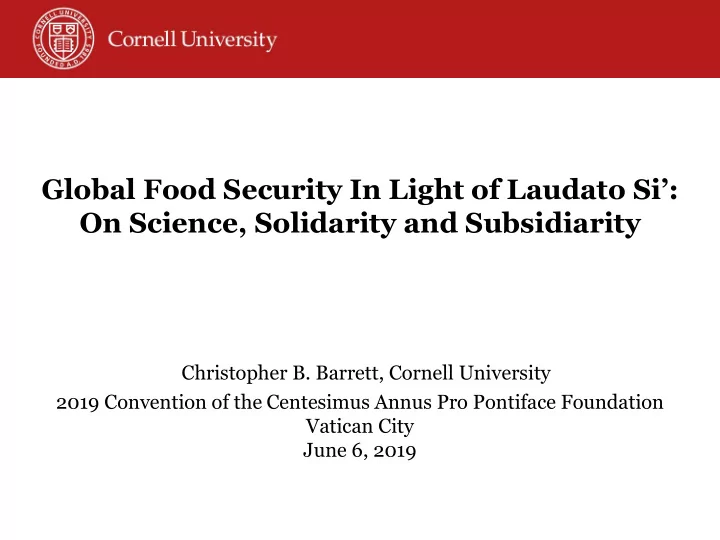
SLIDE 1
Christopher B. Barrett, Cornell University 2019 Convention of the Centesimus Annus Pro Pontiface Foundation Vatican City June 6, 2019
Global Food Security In Light of Laudato Si’: On Science, Solidarity and Subsidiarity
SLIDE 2
Food security is foundation to human dignity Food security exists if and only if “all people at all times have physical, social, and economic access to sufficient, safe and nutritious food that meets their dietary needs and food preferences for an active and healthy life” (1996 World Food Summit definition, emphasis added)
SLIDE 3 Food security may be the defining global challenge of the century. Integral human development, social stability, and the protection of the planet all at risk if we fail.
Photo credits: CIFOR, Bloomberg
SLIDE 4 Food security depends on :
- 1. Promoting and directing science to address the
needs of the poor and of the planet
- 2. Showing solidarity with the poor through generous
and effective social protection and safety nets
- 3. Embracing subsidiarity to contextualize actions in
heterogeneous agri-food systems and to inculcate care for others and ‘our common home’
Photo credits: Mike Gore, Holly Kristinsson, Forward Press
SLIDE 5
Great progress in raising calorie availability …
2011-13 min. dietary energy req’t [1770,2340]
Scientific advances
SLIDE 6
Reason for celebration
As global population grew, >2 bn more people adequately nourished in a quarter century. Each week for a generation, another 1.5 mn people have enjoyed adequate caloric intake!
SLIDE 7 Future challenges may be tougher than past
- 1. Less progress on ‘hidden hunger”: micronutrient
(mineral/vitamin) deficiencies. Ex: 1.6 bn suffer iron- or vitamin B12 deficiency anemia … and growing! >2 bn at MN risk.
- 2. Planetary boundaries increasingly bind. Climate change
in particular creates a previously unobserved context. Water/climate/soil nutrient constraints + changing pest/pathogen pressures = new production challenges
- 3. Human suffering is more spatially concentrated and more
tied to conflict. In 1990 Africa home to 119 mn (24%) of the world’s ultra-poor (<$0.95/day pc) … grew to 133 mn (82%) by
- 2011. Poverty traps increasingly salient to the remaining poor.
Growing challenges
SLIDE 8 75-80% of food consumed w/n country where grown Food system performance improvements must occur in Africa/Asia, where most demand growth will be greatest. w/urbanization, income growth, post-harvest value chains (incl. social protection programs) grow ever more important.
Store photo credit: Business Daily Africa
‘Glocal’ solutions needed
SLIDE 9
Challenge: Vitamin/mineral rich food supply not growing fast enough for diet transition (Bennett’s Law) Especially since loss/waste rates ≥50% higher for vegetables due to perishability and vitamin degradation, and relative price increases due to differences in demand elasticities.
Micronutrient deficiencies
SLIDE 10
Result: relative prices of more nutritious foods increase faster than less nutritious foods, hurting dietary diversity
Micronutrient deficiencies
Example: In Pakistan, fruit/veg/ASF prices have increased 2-2.5x those of oils/fats and 25-75% > cereals
(Source: Dizon & Herforth 2018 WB PRWP)
SLIDE 11 Challenge: loss/waste of key nutrients along the value chain from crop production to human consumption
For some nutrients (calcium, folate) residual food availability <10% >DRs. Keep in mind, however, loss/waste endogenous to prices.
Source: Ritchie et al. 2018 FSFS
Micronutrient deficiencies
Ex: We lose >60% of zinc between plant and belly
SLIDE 12 We need complementary innovations upstream (fertilizers, biofortification), midstream (fortification in processing) and downstream (consumer behavior change)
Graphic credit: Ross Welch/Mike Gore
Micronutrient deficiencies
SLIDE 13
Science: Need to reorient global agri-f00d R&D towards (i) veg/fruit supply, (ii) novel protein/MN sources, (iii) (bio) fortification to improve nutrient content, lower F&V prices, and induce greater dietary diversity in poor communities. Solidarity: Need to design safety nets around health and nutrition (not agribusiness income support) objectives. Subsidiarity: Community-supported ag, local farmers markets, school feeding programs based on local crops, etc.
Micronutrient deficiencies
SLIDE 14 Planetary boundaries limit input expansion:
- Arable land essentially fixed w/o major (ecol. risky)
conversion of forest, wetlands, or drylands, esp in Asia
- Soil nutrient depletion (esp. N, P and key minerals)
- Increasing urban/protected area competition for land
- Ag already accounts for ~70% of human water usage,
> 80% in Africa and Asia, climate changes makes worse
- Agrifood systems stress natural env’ts … must reduce
loss/waste, esp. by enhancing repurposing of loss/waste via products and nutrient recycling (circular economy)
Planetary boundaries
SLIDE 15
So must rely mainly on technological advances to boost agricultural productivity. But… – Site specificity due to agroecological heterogeneity – Innovation most needed in Africa/Asia, where demand growth will occur but ag R&D capacity also most limited – Technological advance requires investment, and governments and philanthropies are essential but insufficient … will rely heavily on the private sector. – Private IP regimes increasingly pose obstacles – Ongoing opposition to GMOs/gene editing
Planetary boundaries
SLIDE 16
We need innovations – Greater efficiency in use of increasingly scarce natural inputs to boost total factor productivity – Reduce damage to natural ecosystems – Promote re-use and re-cycling within agri-food system … untapped potential of circular local economies – More efficient post-harvest distribution and processing to reduce loss/waste and prices – Secure land/water tenure for farmers/herders – Intellectual property regimes to accelerate discovery … in and for Africa and Asia, especially
Planetary boundaries
SLIDE 17 Increased co-location of food insecurity with conflict
Conflict
- Over past 2 decades, conflict-affected
countries’ share of stunted children grew from 46% to 79%. (FAO et al. 2017)
- According to UNHCR, a record ~69mn
forcibly displaced people globally now.
- And strong relationship between drought
and conflict (von Uexkul et al. 2016 PNAS)
SLIDE 18 A sustainable food secure future for all requires innovations:
- 1. Growing the supply of affordable, healthy minerals and
vitamins from vegetables, fruits, and animal source foods.
- 2. Enhancing social protection and safety nets for the poor.
- 3. Accelerating adaptation to climate change, water scarcity,
and improving soil nutrient cycling in food production.
- 4. Reducing food loss/waste throughout the food value chain,
especially through advances in circular economies.
Summary
SLIDE 19
Thank you for your time, interest and comments!