
SLIDE 1
CPSC 213
Introduction to Computer Systems
Unit 2f
Inter-Process Communication
1Reading For Next Three Lectures
- Textbook
- The Client Server Programming Model - Web Servers
- 2nd ed: 11.1-11.5
- 1st ed: 12.1-12.5
IPC Basic Idea
- Communication for processes that don’t share memory
- could be on same processor (shared physical, but not virtual) memory
- could be on different processors connected by a network
- same communication mechanism for both cases
- Unformatted data transfer
- message payload is the data to be transferred from sender to receiver
- sender assembles the payload as an array of bytes -- like a file block
- receiver translates byte array back into programming-language types
- Asynchronous control transfer
- send
initiate sending message payload to receiving process, but do not wait
- recv
receive next available message, either blocking or not if no data waiting
- Naming
- sender needs to name the receiving process
- receiver needs to name something --- options?
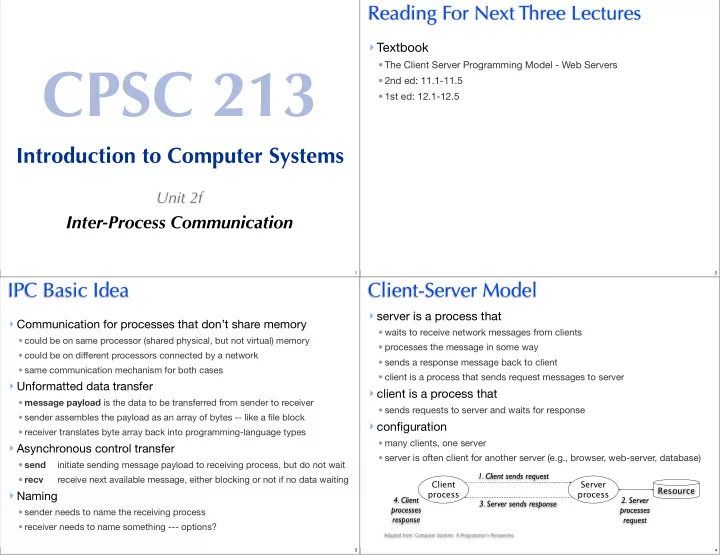
- server is a process that
- waits to receive network messages from clients
- processes the message in some way
- sends a response message back to client
- client is a process that sends request messages to server
- client is a process that
- sends requests to server and waits for response
- configuration
- many clients, one server
- server is often client for another server (e.g., browser, web-server, database)
Client-Server Model
Client process Server process
- 1. Client sends request
- 2. Server
processes request
- 3. Server sends response
- 4. Client
processes response Resource
Adapted from: Computer Systems: A Programmer’s Perspective 4