CPSC 213 2.4.4-2.4.5 Textbook Structures, Dynamic Memory - - PowerPoint PPT Presentation

cpsc 213
SMART_READER_LITE
LIVE PREVIEW

CPSC 213 2.4.4-2.4.5 Textbook Structures, Dynamic Memory - - PowerPoint PPT Presentation

Reading For Next 3 Lectures Companion CPSC 213 2.4.4-2.4.5 Textbook Structures, Dynamic Memory Allocation, Understanding Pointers 2nd edition: 3.9.1, 9.9, 3.10 1st edition: 3.9.1, 10.9, 3.11 Introduction to Computer


slide-1
SLIDE 1

CPSC 213

Introduction to Computer Systems

Unit 1c

Instance Variables and Dynamic Allocation

1

Reading For Next 3 Lectures

  • Companion
  • 2.4.4-2.4.5
  • Textbook
  • Structures, Dynamic Memory Allocation, Understanding Pointers
  • 2nd edition: 3.9.1, 9.9, 3.10
  • 1st edition: 3.9.1, 10.9, 3.11
2

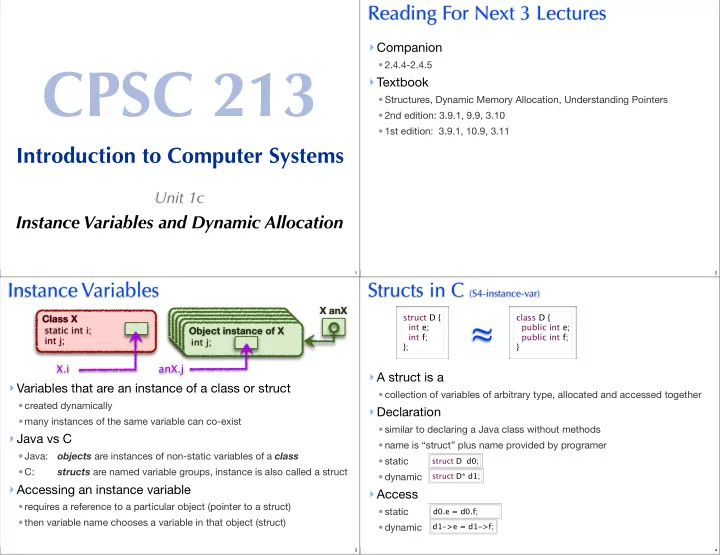
Instance Variables

  • Variables that are an instance of a class or struct
  • created dynamically
  • many instances of the same variable can co-exist
  • Java vs C
  • Java: objects are instances of non-static variables of a class
  • C:

structs are named variable groups, instance is also called a struct

  • Accessing an instance variable
  • requires a reference to a particular object (pointer to a struct)
  • then variable name chooses a variable in that object (struct)

Class X

static int i; int j;

Object instance of X

int j;

Object instance of X

int j;

Object instance of X

int j;

Object instance of X

int j;

Object instance of X

int j;

X anX

anX.j X.i

3

Structs in C (S4-instance-var)

  • A struct is a
  • collection of variables of arbitrary type, allocated and accessed together
  • Declaration
  • similar to declaring a Java class without methods
  • name is “struct” plus name provided by programer
  • static
  • dynamic
  • Access
  • static
  • dynamic

struct D { int e; int f; }; class D { public int e; public int f; }

struct D d0; struct D* d1; d0.e = d0.f; d1->e = d1->f;

4
slide-2
SLIDE 2

Struct Allocation

  • Static structs are allocated by the compiler
  • Dynamic structs are allocated at runtime
  • the variable that stores the struct pointer may be static or dynamic
  • the struct itself is allocated when the program calls malloc

struct D d0; struct D { int e; int f; };

Static Memory Layout

0x1000: value of d0.e 0x1004: value of d0.f

struct D* d1;

Static Memory Layout

0x1000: value of d1

5
  • runtime allocation of dynamic struct
  • assume that this code allocates the struct at address 0x2000

void foo () { d1 = (struct D*) malloc (sizeof(struct D)); }

0x1000: 0x2000 0x2000: value of d1->e 0x2004: value of d1->f

struct D { int e; int f; };

6

Struct Access

  • Static and dynamic differ by an extra memory access
  • dynamic structs have dynamic address that must be read from memory
  • in both cases the offset to variable from base of struct is static

struct D { int e; int f; };

d0.e = d0.f; d1->e = d1->f;

m[0x1000] ← m[0x1004] m[m[0x1000]+0] ← m[m[0x1000]+4] r[0] ← 0x1000 r[1] ← m[r[0]+4] m[r[0]] ← r[1] r[0] ← 0x1000 r[1] ← m[r[0]] r[2] ← m[r[1]+4] m[r[1]] ← r[2] load d1

7

struct D { int e; int f; };

d0.e = d0.f; d1->e = d1->f;

r[0] ← 0x1000 r[1] ← m[r[0]+4] m[r[0]] ← r[1] r[0] ← 0x1000 r[1] ← m[r[0]] r[2] ← m[r[1]+4] m[r[1]] ← r[2] load d1

ld $0x1000, r0 # r0 = address of d0 ld 4(r0), r1 # r0 = d0.f st r1, (r0) # d0.e = d0.f ld $0x1000, r0 # r0 = address of d1 ld (r0), r1 # r1 = d1 ld 4(r1), r2 # r2 = d1->f st r2, (r1) # d1->e = d1->f
  • The revised load/store base plus offset instructions
  • dynamic base address in a register plus a static offset (displacement)

ld 4(r1), r2

8
slide-3
SLIDE 3
  • Machine format for base + offset
  • note that the offset will in our case always be a multiple of 4
  • also note that we only have a single instruction byte to store it
  • and so, we will store offset / 4 in the instruction
  • The Revised ISA

The Revised Load-Store ISA

Name Semantics Assembly Machine

load immediate

r[d] ← v ld $v, rd 0d-- vvvvvvvv

load base+offset

r[d] ← m[r[s]+(o=p*4)] ld o(rs), rd 1psd

load indexed

r[d] ← m[r[s]+4*r[i]] ld (rs,ri,4), rd 2sid

store base+offset m[r[d]+(o=p*4)] ← r[s]

st rs, o(rd) 3spd

store indexed

m[r[d]+4*r[i]] ← r[s] st rs, (rd,ri,4) 4sdi

9

Dynamic Allocation

10

Dynamic Allocation in C and Java

  • Programs can allocate memory dynamically
  • allocation reserves a range of memory for a purpose
  • in Java, instances of classes are allocated by the new statement
  • in C, byte ranges are allocated by call to malloc procedure
  • Wise management of memory requires deallocation
  • memory is a scare resource
  • deallocation frees previously allocated memory for later re-use
  • Java and C take different approaches to deallocation
  • How is memory deallocated in Java?
  • Deallocation in C
  • programs must explicitly deallocate memory by calling the free procedure
  • free frees the memory immediately, with no check to see if its still in use
11

Considering Explicit Delete

  • Lets look at this example
  • is it safe to free mb where it is freed?
  • what bad thing can happen?

struct MBuf * receive () { struct MBuf* mBuf = (struct MBuf*) malloc (sizeof (struct MBuf)); ... return mBuf; } void foo () { struct MBuf* mb = receive (); bar (mb); free (mb); }

12
slide-4
SLIDE 4
  • Lets extend the example to see
  • what might happen in bar()
  • and why a subsequent call to bat() would expose a serious bug

struct MBuf * receive () { struct MBuf* mBuf = (struct MBuf*) malloc (sizeof (struct MBuf)); ... return mBuf; } void foo () { struct MBuf* mb = receive (); bar (mb); free (mb); } void MBuf* aMB; void bar (MBuf* mb) { aMB = mb; } void bat () { aMB->x = 0; }

This statement writes to unallocated (or re-allocated) memory.

13
  • A dangling pointer is
  • a pointer to an object that has been freed
  • could point to unallocated memory or to another object
  • Why they are a problem
  • program thinks its writing to object of type X, but isn’t
  • it may be writing to an object of type Y, consider this sequence of events

Dangling Pointers

0x2000: a struct mbuf aMB: 0x2000

(1) Before free:

0x2000: free memory aMB: 0x2000

(2) After free:

0x2000: another thing aMB: 0x2000

(3) After another malloc:

dangling pointer dangling pointer that is really dangerous

14

Avoiding Dangling Pointers in C

  • Understand the problem
  • when allocation and free appear in different places in your code
  • for example, when a procedure returns a pointer to something it allocates
  • Avoid the problem cases, if possible
  • restrict dynamic allocation/free to single procedure, if possible
  • don’t write procedures that return pointers, if possible
  • use local variables instead, where possible
  • we’ll see later that local variables are automatically allocated on call and freed on return
  • Engineer for memory management, if necessary
  • define rules for which procedure is responsible for deallocation, if possible
  • implement explicit reference counting if multiple potential deallocators
  • define rules for which pointers can be stored in data structures
  • use coding conventions and documentation to ensure rules are followed
15
  • If procedure returns value of dynamically allocated object
  • allocate that object in caller and pass pointer to it to callee
  • good if caller can allocate on stack or can do both malloc / free itself

struct MBuf * receive () { struct MBuf* mBuf = (struct MBuf*) malloc (sizeof (struct MBuf)); ... return mBuf; } void foo () { struct MBuf* mb = receive (); bar (mb); free (mb); }

Avoiding dynamic allocation

void receive (struct MBuf* mBuf) { ... } void foo () { struct MBuf mb; receive (&mb); bar (mb); }

16
slide-5
SLIDE 5

Reference Counting

  • Use reference counting to track object use
  • any procedure that stores a reference increments the count
  • any procedure that discards a reference decrements the count
  • the object is freed when count goes to zero

struct MBuf* malloc_Mbuf () { struct MBuf* mb = (struct MBuf* mb) malloc (sizeof (struct MBuf)); mb->ref_count = 1; return mb; } void keep_reference (struct MBuf* mb) { mb->ref_count ++; } void free_reference (struct MBuf* mb) { mb->ref_count --; if (mb->ref_count==0) free (mb); }

17
  • The example code then uses reference counting like this

struct MBuf * receive () { struct MBuf* mBuf = malloc_Mbuf (); ... return mBuf; } void foo () { struct MBuf* mb = receive (); bar (mb); free_reference (mb); } void MBuf* aMB = 0; void bar (MBuf* mb) { if (aMB != 0) free_reference (aMB); aMB = mb; keep_reference (aMB); }

18

Garbage Collection

  • In Java objects are deallocated implicitly
  • the program never says free
  • the runtime system tracks every object reference
  • when an object is unreachable then it can be deallocated
  • a garbage collector runs periodically to deallocate unreachable objects
  • Advantage compared to explicit delete
  • no dangling pointers

MBuf receive () { MBuf mBuf = new MBuf (); ... return mBuf; } void foo () { MBuf mb = receive (); bar (mb); }

19
  • What are the advantages of C’s explicit delete
  • What are the advantages of Java’s garbage collection
  • Is it okay to ignore deallocation in Java programs?

Discussion

20
slide-6
SLIDE 6
  • Memory leak
  • occurs when the garbage collector fails to reclaim unneeded objects
  • memory is a scarce resource and wasting it can be a serous bug
  • its huge problem for long-running programs where the garbage accumulates
  • How is it possible to create a memory leak in Java?
  • Java can only reclaim an object if it is unreachable
  • but, unreachability is only an approximation of whether an object is needed
  • an unneeded object in a hash table, for example, is never reclaimed
  • The solution requires engineering
  • just as in C, you must plan for memory deallocation explicitly
  • unlike C, however, if you make a mistake, you can not create a dangling pointer
  • in Java you remove the references, Java reclaims the objects
  • Further reading
  • http://java.sun.com/docs/books/performance/1st_edition/html/JPAppGC.fm.html

Memory Management in Java

21

Ways to Avoid Unintended Retention

  • imperative approach with explicit reference annulling
  • explicitly set references to NULL when referent is longer needed
  • add close() or free() methods to classes you create and call them explicitly
  • use try-finally block to ensure that these clean-up steps are always taken
  • these are imperative approaches; drawbacks?
  • declarative approach with reference objects
  • refer to objects without requiring their retention
  • store object references that the garbage collector can reclaim
  • different levels of reference stickiness
  • soft

discarded only when new allocations put pressure on available memory

  • weak

discarded on next GC cycle when no stronger reference exists

  • phantom

unretrievable (get always returns NULL), used to register with GC reference queue WeakReference<Widget> weakRef = new WeakReference<Widget>(widget); Widget widget = weakRef.get() // may return NULL

22

Using Reference Objects

  • Creating a reclaimable reference
  • the Reference class is a template that be instantiated for any reference
  • store instances of this class instead of the original reference
  • allows the garbage collector to collect the MBuf even if aMB points to it
  • This does not reclaim the weak reference itself
  • while the GC will reclaim the MBuf, it can’t reclaim the WeakReference
  • the problem is that aMB stores a reference to WeakReference
  • not a big issue here, there is only one
  • but, what if we store a large collection of weak references?

void bar (MBuf mb) { aMB = new WeakReference<Mbuf>(mb); }

23

Using Reference Queues

  • The problem
  • reference objects will be stored in data structures
  • reclaiming them requires first removing them from these data structures
  • The reference queue approach
  • a reference object can have an associated reference queue
  • the GC adds reference objects to the queue when it collects their referent
  • your code scans the queue periodically to update referring data structures

ReferenceQueue<MBuf> refQ = new ReferenceQueue<MBuf> (); void bar (MBuf mb) { aMB = new WeakReference<Mbuf> (mb,refQ); } void removeGarbage () { while ((WeakReference<Mbuf> ref = refQ.poll()) != null) // remove ref from data structure where it is stored if (aMB==ref) aMB = null; }

24