COUNTRY PROFI LE Area: 750,614 square km. GMT + 2 Capital: Lusaka - - PDF document

country profi le
SMART_READER_LITE
LIVE PREVIEW

COUNTRY PROFI LE Area: 750,614 square km. GMT + 2 Capital: Lusaka - - PDF document

Reporting on Energy I ssues in Zambia Presented by Newton Sibanda to the 14 th Session of the UN Commission on Sustainable Development (CSD 14), UN Headquarters, New York. May 9, 2006 COUNTRY PROFI LE Area: 750,614 square km. GMT + 2


slide-1
SLIDE 1

1

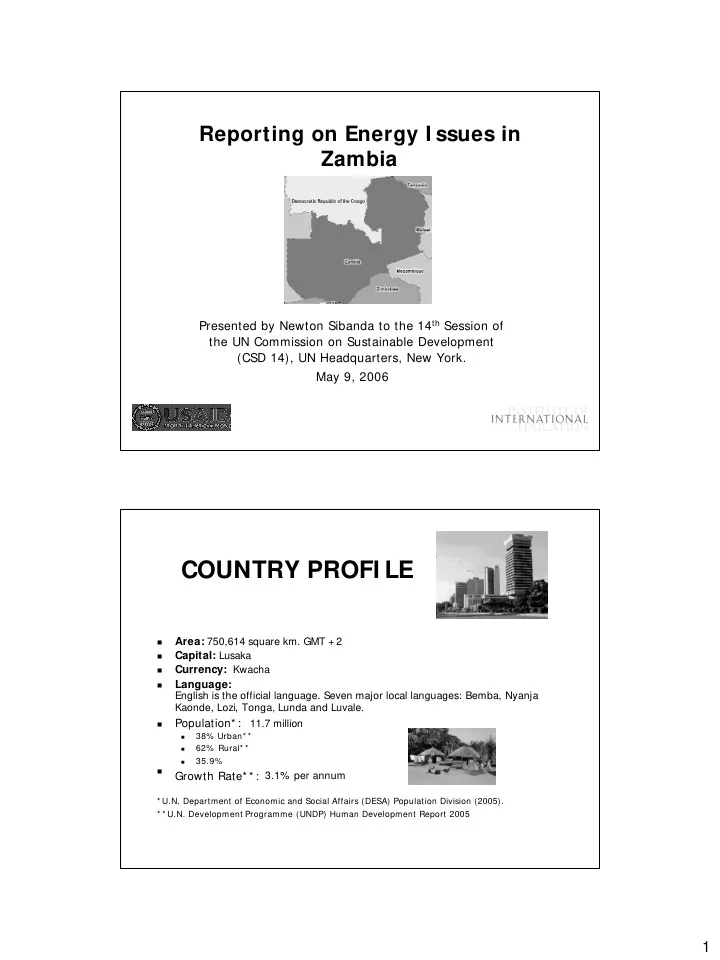
Reporting on Energy I ssues in Zambia

Presented by Newton Sibanda to the 14th Session of the UN Commission on Sustainable Development (CSD 14), UN Headquarters, New York. May 9, 2006

COUNTRY PROFI LE

  • Area: 750,614 square km. GMT + 2
  • Capital: Lusaka
  • Currency: Kwacha
  • Language:

English is the official language. Seven major local languages: Bemba, Nyanja Kaonde, Lozi, Tonga, Lunda and Luvale.

  • Population* : 11.7 million
  • 38% Urban* *
  • 62% Rural* *
  • 35.9%
  • Growth Rate* * : 3.1% per annum

* U.N. Department of Economic and Social Affairs (DESA) Population Division (2005). * * U.N. Development Programme (UNDP) Human Development Report 2005

slide-2
SLIDE 2

2

Average life expectancy: 37.4 years Human development index (HDI rank): 166

Literacy

2003: 67.9 percent average Male, 2003: 76.1 percent Female, 2003: 59.7 percent Source: UNDP - Human Development Report 2005

Population Statistics:

ECONOMY:

  • Population living on less than US$1 a day: 63.7% (2002)
  • One of world’s poorest and most debt -ridden countries.
  • Traditionally dependent on mining of copper, cobalt, zinc and lead,

accounting for 53% of national budget.

  • Percentage HI V+ (adults aged 15-49): 16.5% (End 2003)
  • HIV/AIDS currently Zambia’s development and humanitarian crisis.
  • Identified central theme for poverty reduction strategies.
  • Featuring as a cross-cutting theme in UN Development Program

Assistance Framework (UNDPAF) document.

Sources:

  • Sources: UNDP Human Development Report,2005
  • UN Programme on HIV and AIDs (UNAIDS) 2004
slide-3
SLIDE 3

3

Access to Energy:

20 percent of population have access to electricity. In rural areas, only 2 percent have access to

electricity.

The majority of population in rural and peri-urban

areas are dependent on charcoal for energy.

Sources of Energy

  • Wood fuel : 80%
  • Electricity : 9%
  • Petroleum :10%
  • Others : 1%

Energy Sector Goals:

Rural electrification – increase from 2% to 15% in 10

years

Urban electrification – increase from 45% to 78% in

10 years

Charcoal consumption - reduce by 400,000 tonnes in

10 years

Re-introduce LPG in households Increase generation capacity Increase power export Increase regional connectivity

slide-4
SLIDE 4

4

Barriers to Rural Electrification:

Low density demand. High cost of transmission and distribution systems. Consumer acceptance. Low levels of cost recovery. Lack of finance. Frail institutional infrastructure in most rural

communities.

I mplications for the Media:

Profile places premium on Media to do something. Important role for the Media in sensitisation, public

awareness and prompting action to address energy problems.

“Whistle-blower” role for Media.

slide-5
SLIDE 5

5

Energy Reporting Status:

  • Still on the fringes of mainstream media
  • Occasional reportage of energy issues: fuel crisis, scandal

etc.

  • Evolution of reporting on energy issues in Zambia:
  • Status quo
  • I ssues
  • The importance of quality reporting as a way of contributing

to energy development as well as responding to socioeconomic, climate and environmental concerns.

Energy Sector

  • Working on expansion plans for energy pilot projects.

Installation of solar home systems: Nyimba 100, Lundazi 150 and Chipata 150

  • International response to articles: attracting interest from

development organisations such as GTZ InWent, a German Capacity building programme, who sent personnel from projects similar to the one in Nyimba for training in Germany and within the region.

  • Reporting on the rural electrification efforts in the Mkushi

farming block and its boosting of agricultural productivity awakened other communities to the need for rural electrification as a necessity for development and improved agricultural production.

slide-6
SLIDE 6

6

Examples of Energy Reporting Making a Change:

  • Reporting on a solar power success story in

Nyimba, an area that was off-grid, contributed to expanding the reach of solar power to other villages.

  • Reporting on the elements of success, the best

practices that came out of the project and the success in Nyimba, inspired replication of solar projects in other towns of Zambia’s Eastern Province: Chipata, the capital, and Lundazi, another remote district in the same province.

Reporting Challenges:

There are many obstacles in getting to the nitty-gritty

  • f reporting on energy issues, e.g, difficulties in

accessing information, statistics on energy issues, and internet facilities are a major detriment to reporting.

Journalists respond to those challenges by

networking and sharing experiences, but this effort needs to be improved and supported.

slide-7
SLIDE 7

7

Energy as News Agenda- The I ssues

  • Energy – Poverty Nexus: Energy poverty is still reigning

supreme.

  • Editors in Zambia: Their response to news on energy
  • Do editors and reporters have a phobia for the science surrounding

energy issues?

  • The need to engage editors to make them appreciate energy

issues and make them part of the news agenda.

  • The audience: Their views on energy news
  • High value for boredom?
  • Ingredients of drama, personality and conflict are important in

news stories

  • The reporters: Writing energy stories in the context of people not

just statistics, etc.

  • How to inspire more journalists to see this relationship and want to

write on energy?

Way Forward:

  • Making energy issues part of mainstream Media news agenda;

“Humanising" energy stories. How to encourage more reporters to write on energy (workshops, training for editors, competitions and awards, etc).

  • Writing energy stories in compelling ways.
  • Energy issues slowly making it into the news agenda.
  • Innovation by journalists with a keen interest in environmental

issues is helping to slowly make more space available for energy stories in newspapers and electronic Media.

  • Donors like the UN or bilateral agencies can help to strengthen

the role of journalists in energy development.

slide-8
SLIDE 8

8

HOW DONORS CAN HELP

Support training for journalists Support and host networks of energy

journalists e.g World Bank on water Media.

Provide reliable research and information

links for energy journalists.

THANK YOU!