Myanmar Cou Country Part artnership Fr Fram amework NA - - PowerPoint PPT Presentation

myanmar
SMART_READER_LITE
LIVE PREVIEW

Myanmar Cou Country Part artnership Fr Fram amework NA - - PowerPoint PPT Presentation

Myanmar Cou Country Part artnership Fr Fram amework NA NATIONAL CON ONSULTATIONS November December 2019 World Bank Group (WBG) Country Engagement Process Country Systematic Performance Completion Partnership Country and Learning


slide-1
SLIDE 1

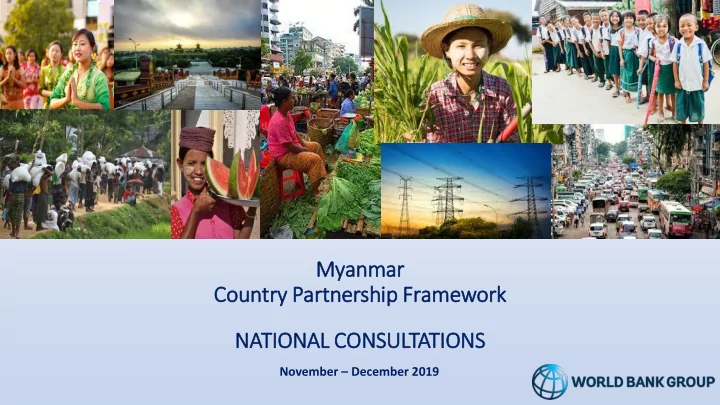
Myanmar Cou Country Part artnership Fr Fram amework NA NATIONAL CON ONSULTATIONS

November – December 2019
slide-2
SLIDE 2

World Bank Group (WBG) Country Engagement Process

Performance and Learning Review (PLR) Systematic Country Diagnostic (SCD) Completion and Learning Review (CLR)

Country Partnership Framework

(CPF)

1. The SCD identifies the challenges and opportunities for eliminating poverty and boosting shared prosperity in Myanmar; it includes a political and social context, recent economical developments, poverty profile, and main development challenges. It is linked to the national development strategy. 2. The CPF is a multi-year development plan built on the SCD, outlining the WBG’s program of interventions in Myanmar for the next 4 years; it is prepared using a consultative process. 3. The PLR reviews implementation of the CPF plans, to assess whether the WBG is on track and to make adjustments to the framework to ensure it supports the achievement of substantive outcomes; It compliments annual monitoring and reviews 4. The CLR evaluates if the goals set in the CPF are achieved and identifies lessons for future WBG engagement in Myanmar

slide-3
SLIDE 3

The proposed Country Partnership Framework:

▪ Addresses lessons learned from the current (2015 – 2019) Framework ▪ Links with Myanmar’s Sustainable Development Plan 2018-2030 ▪ Aligns with the UN Sustainable Development Goals 2015-2030 ▪ Seeks nationwide inputs from all stakeholders in Myanmar ▪ Will be submitted to the WBG Board in early 2020

slide-4
SLIDE 4

Main lessons learned between 2015-2019:

▪ Ensure a systemic and measurable approach to promoting inclusion and peace ▪ Strengthen support for improving governance and institutional capacity ▪ Focus on more targeted interventions, adequate resources and time to accompany and support the government in implementation ▪ Combine public and private approaches to responding to Myanmar's development challenges

slide-5
SLIDE 5

Focus Area 1: Building human capital and fostering peaceful communities Focus Area 2: Fostering responsible private sector-led growth and inclusive economic

  • pportunities

Focus Area 3: Enhancing climate and disaster resilience and sustainable natural resource and environmental management

Cross-cutting Theme : Promoting social inclusion, including in conflict-affected areas

The proposed CPF identifies 3 focus areas:

slide-6
SLIDE 6

Guiding principles to maximize impact:

  • Focus on areas where WBG is already

investing or engaged in policy dialogue

  • Geographically-targeted investments

and support to strengthen institutions to generate bottom-up momentum for national reform

  • Targeting support to people in

underserved and conflict-affected areas

  • Reinforcing inclusive engagement with

non-state actors

slide-7
SLIDE 7

Focus Area 1: Building human capital and fostering peaceful communities

Objectives:

  • Strengthen the capacity of public

institutions to make policies, plan and deliver services more effectively, transparently and equitably

  • Improve inclusive access to community-

level services and infrastructure

  • Improve inclusive access to, and quality
  • f, basic social services
slide-8
SLIDE 8

Examples of activities under Focus Area 1 include:

  • Access to essential health

services and maternal and child cash transfers

  • Access to quality

education for all

  • Community-identified

investments, such as schools, electrification and rural infrastructure, to support peace and inclusive development

slide-9
SLIDE 9

Focus Area 2: Fostering responsible private-sector-led growth and inclusive economic opportunities

Objectives:

  • Strengthen institutional capabilities for

macroeconomic and financial sector management

  • Improve the business environment, foster

responsible private-sector-led growth, and facilitate international trade

  • Narrow the infrastructure and technology

gap

  • Improve income generation and

productivity in selected sectors and zones

slide-10
SLIDE 10

Examples of activities under Focus Area 2 include:

  • Increasing energy access

and reliability of power supply

  • Help farmers and agri-

business to produce better and earn more

  • Strengthen institutional

capacity and improve access to finance

  • Connecting Myanmar

nationwide and to the world

  • Creating a stable and

competitive environment for businesses

slide-11
SLIDE 11

Focus Area 3: Enhancing climate and disaster resilience and sustainable natural resource and environmental management

Objectives:

  • Improve the sustainable

management of natural resources by targeting waterways, fisheries, forests, waste and plastics management

  • Strengthen the resilience of

vulnerable communities against climate and natural disaster risks

slide-12
SLIDE 12

Examples of activities under Focus Area 3 include:

  • Integrated management
  • f the Ayeyarwady river
  • Insurance to finance

recovery from natural disasters

  • Supporting solid waste and

pollution anagement

slide-13
SLIDE 13

Cross-cutting: Promoting Social Inclusion, including in conflict areas

  • Application of Inclusion and

Peace Lens* to all investments to ensure conflict sensitivity and inclusion

  • Identification and closing of

gender gaps

  • Increased investments in

conflict-affected and most- underserved people and areas

*The Inclusion and Peace Lens (IPL) guides project teams in determining whether investments adequately address and cover conflict sensitivity and inclusion (including gender)

slide-14
SLIDE 14

What are the risks to achieving the CPF objectives?

  • A slow-down in reform momentum
  • Weak institutional capacity to

implement reforms and investments

  • Challenges to meet international

standards on environmental and social risk management

  • Differing positions from stakeholders

In a deeply contested environment

  • An upsurge in violent conflict
slide-15
SLIDE 15

Proposed measures to mitigate risks:

  • Strengthen institutional capacity

(fiduciary; social; environmental)

  • Engage widely and inclusively with

state and non-state actors

  • Empower local communities and

subnational institutions to drive development

  • Apply consolidated data monitoring

tools to the program and project

slide-16
SLIDE 16

Guiding questions for discussions at consultations:

  • Do you think the proposed CPF focus areas

and objectives are the right ones for the WBG to focus on in Myanmar?

  • Which other areas of engagement should

be considered?

  • What challenges need to be addressed to

be successful in the focus areas of the CPF?

  • How do we best bring the cross-cutting

theme – promoting social inclusion, including in conflict areas – into practice?

  • How can we support the government in

implementing its own development program?