Country of Origin Labeling Initial and Follow-up Workbook 2016 COOL - - PowerPoint PPT Presentation

country of origin labeling initial and follow up workbook
SMART_READER_LITE
LIVE PREVIEW

Country of Origin Labeling Initial and Follow-up Workbook 2016 COOL - - PowerPoint PPT Presentation

Country of Origin Labeling Initial and Follow-up Workbook 2016 COOL Retail Review Training 1 Introduction Retail reviews are conducted in locations identified by COOL Division. Trained Reviewers conduct reviews to verify the retail


slide-1
SLIDE 1

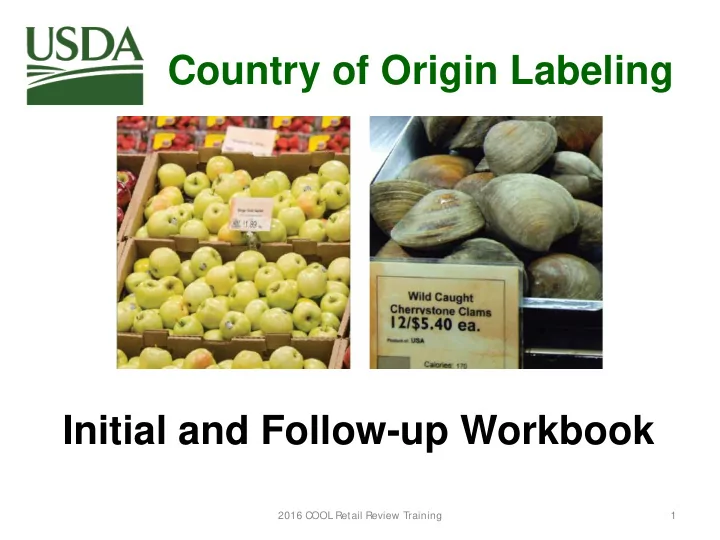
Country of Origin Labeling Initial and Follow-up Workbook

2016 COOL Retail Review Training 1
slide-2
SLIDE 2

Introduction

  • Retail reviews are conducted in locations

identified by COOL Division.

  • Trained Reviewers conduct reviews to

verify the retail store location is compliant with COOL regulatory requirements.

  • The Retail Review Workbook is used to

record findings and report them to the COOL Division.

2016 COOL Retail Review Training 2

slide-3
SLIDE 3

Retail Review Workbook

  • There are 2 types of Retail Surveillance
  • Reviews. The review type will require one
  • f the following workbooks:
  • 1. Initial Retail Surveillance Review Workbook
  • 6 commodity categories
  • 5 interview questions
  • 2. Follow-up Retail Surveillance Review

Workbook

  • 6 commodity categories
  • 6 recordkeeping sections

2016 COOL Retail Review Training 3

slide-4
SLIDE 4

Retail Review Workbook

What do the Initial and Follow-up Retail Review Workbook have in common? Both workbooks include an Information Form

2016 COOL Retail Review Training 4

slide-5
SLIDE 5

Initial Review Workbook

Page 1:

  • General Retailer and

Reviewer information

  • Non-Compliance Code

Legend

2016 COOL Retail Review Training 5

slide-6
SLIDE 6

Initial Review Workbook

Page 2:

  • Labeling Non-

Compliance section for Fruits, Nuts & Ginseng, Vegetables, and Fish & Shellfish

2016 COOL Retail Review Training 6

slide-7
SLIDE 7

Initial Review Workbook

Page 3:

  • Labeling Non-

Compliance section for Chicken and Lamb & Goat

  • 5 Interview questions to

assess retailer Compliance with recordkeeping requirements

2016 COOL Retail Review Training 7

slide-8
SLIDE 8

Initial Review Workbook

Page 4:

  • Additional Items

section

2016 COOL Retail Review Training 8

slide-9
SLIDE 9

Follow-up Review Workbook

Page 1:

  • General Retailer and

Reviewer information

  • Non-Compliance Code

Legend

2016 COOL Retail Review Training 9

slide-10
SLIDE 10

Follow-up Review Workbook

Page 2:

  • Labeling Non-

Compliance section for Fruits and Nuts & Ginseng

  • Recordkeeping section

for Fruits and Nuts & Ginseng

2016 COOL Retail Review Training 10

slide-11
SLIDE 11

Follow-up Review Workbook

Page 3:

  • Labeling Non-

Compliance section for Vegetables and Fish & Shellfish

  • Recordkeeping section

for Vegetables and Fish & Shellfish

2016 COOL Retail Review Training 11

slide-12
SLIDE 12

Follow-up Review Workbook

Page 4:

  • Labeling Non-

Compliance section for Chicken and Lamb & Goat

  • Recordkeeping section

for Chicken and Lamb & Goat

2016 COOL Retail Review Training 12

slide-13
SLIDE 13

Follow-up Review Workbook

Page 5:

  • Additional Items

section

2016 COOL Retail Review Training 13

slide-14
SLIDE 14

Non-Compliance (NC) Codes

2016 COOL Retail Review Training 14

slide-15
SLIDE 15

Introduction

  • Non-Compliance (NC) Codes help identify

and record the type of findings observed at the retail store location.

  • There are 16 NC codes; however,

depending on the type of retail review (initial or follow-up) being conducted, only part of the codes may apply.

2016 COOL Retail Review Training 15

slide-16
SLIDE 16

Initial Retail Review NC Codes NC codes 1 – 9 apply when conducting an Initial Retail Review

2016 COOL Retail Review Training 16

slide-17
SLIDE 17

Follow-up Retail NC Codes NC codes 1 – 16 apply when conducting a Follow-up Retail Review

2016 COOL Retail Review Training 17

slide-18
SLIDE 18

Labeling NC Codes 1-9

Code Non-Compliance Findings for Initial Retail Reviews 1 The covered commodity is not identified with the country of origin. 2 The country of origin declaration is not legible and/or is not placed in a conspicuous location. 3 The country of origin declaration is not accurate at the point of sale. 4a The country of origin is not stated in an acceptable form. The use of "or" and "and/or” and “may contain” is not acceptable. 4b The country of origin is not stated in an acceptable form. The regional designation or the term, “locally grown” does not provide sufficient origin declaration. 4c Production steps for meat muscle cuts are not present or not stated in an acceptable form. 5 Abbreviations and variant spellings do not unmistakably indicate the country of

  • rigin.

6 The covered commodity is not identified with the method of production. 7 The method of production declaration is not legible or is not placed in a conspicuous location. 8 The method of production declaration is not accurate at the point of sale. 9 The method of production is not stated in an acceptable form.

2016 COOL Retail Review Training 18

slide-19
SLIDE 19

Recordkeeping NC Codes 10-16

Code Non-Compliance Findings for Initial Retail Reviews 10

Records were not provided within 5 business days.

11

Records do not provide the country of origin information.

12

Records do not provide the method of production information.

13

Records do not provide the Supplier information. (Supplier records are required for all Traceback Items)

14

Records information for country of origin as provided by supplier is not accurately conveyed to point of sale label.

15

Records information for method of production as provided by supplier is not accurately conveyed to point of sale label.

16

Records that identify the chain of custody for the pre-labeled item were not provided within 5 business days.

2016 COOL Retail Review Training 19

slide-20
SLIDE 20

Let’s Review All NC Codes

2016 COOL Retail Review Training 20

slide-21
SLIDE 21

NC Code 1 – No Country of Origin

The retailer did not convey country of origin information to consumers in any manner.

Code Non-Compliance Findings

1 Covered commodity is not identified with the country of

  • rigin.

2016 COOL Retail Review Training 21

slide-22
SLIDE 22

NC Code 1 – No Country of Origin

  • Some retailers use a box to display

covered commodities and country of

  • rigin. This is acceptable as long as the

consumer can easily read and understand the information.

  • No country of origin means no origin is

visible on the individual package, PLU stickers, store sign, store label, rubber band, etc.

2016 COOL Retail Review Training 22

slide-23
SLIDE 23

NC Code 1 – No Country of Origin

Example:

2016 COOL Retail Review Training 23

slide-24
SLIDE 24

NC Code 1 – No Country of Origin

Example:

2016 COOL Retail Review Training 24

slide-25
SLIDE 25

NC Code 1 – No Country of Origin

Example:

2016 COOL Retail Review Training 25

slide-26
SLIDE 26

NC Code 1 – Grade Standards

  • Grade standards do not indicate COOL.
  • Grade designations only indicate the

product meets the criteria established by the standard.

2016 COOL Retail Review Training 26

slide-27
SLIDE 27

NC Code 1 – Inspection/Organic

  • “US Gov’t Inspected” and the USDA

Organic Seal do not indicate COOL.

  • Domestic and imported items are

inspected by US Government for wholesomeness and may earn USDA Organic seal.

2016 COOL Retail Review Training 27

slide-28
SLIDE 28

NC Code 1 – Supplier’s Address

  • A supplier’s address does not indicate

COOL.

  • The packer’s or distributor’s address

refers to the company, not the product’s

  • rigin.

2016 COOL Retail Review Training 28

slide-29
SLIDE 29

NC Code 2 – Not Legible and/or Conspicuous

Country of origin is present however it is covered, smeared, obstructed, etc.

Code Non-Compliance Findings

2 The country of origin declaration is not legible and/or is not placed in a conspicuous location.

2016 COOL Retail Review Training 29

slide-30
SLIDE 30

NC Code 2 - Inconspicuous

Example: Below the retail store advertisement sign is covering country of

  • rigin claim.

2016 COOL Retail Review Training 30

slide-31
SLIDE 31

NC Code 2 - Inconspicuous

Example: The Organic tape is covering the PLU sticker that contains the country of origin information.

2016 COOL Retail Review Training 31

slide-32
SLIDE 32

NC Code 2 – Less than 50%

  • In the case where less than 50% of the

items in a bulk bin have a country of origin, NC code 2 will apply.

2016 COOL Retail Review Training 32

slide-33
SLIDE 33

NC Code 2 – Less than 50%

Example: Below, 1 of the 6 Green Onion bunches has a tag stating “Produce of Mexico.” The other bunches do not have

  • COOL. Therefore, NC2 is recorded for

Green Onions. Do not count each individual item; estimates are sufficient.

2016 COOL Retail Review Training 33

slide-34
SLIDE 34

NC Code 2 – Additional Examples

  • Smeared printing making the country of
  • rigin illegible.
  • The origin sign is located far away from

the item it is referencing or too small to see.

2016 COOL Retail Review Training 34

slide-35
SLIDE 35

NC Code 2 – Smeared

Example: COOL information has rubbed off the sign.

2016 COOL Retail Review Training 35

slide-36
SLIDE 36

NC Code 2 – Additional Examples

  • NC code 2 applies when checkboxes list

the possible country(ies) of origin; however, none of the checkboxes are selected.

2016 COOL Retail Review Training 36

NC 2

slide-37
SLIDE 37

NC Code 3 – Not Accurate

NC 3 is appropriate when contradictory

  • rigin labels are visible to the consumer.

Code Non-Compliance Findings

3 The country of origin declaration is not accurate at point of sale.

2016 COOL Retail Review Training 37

slide-38
SLIDE 38

NC Code 3 – Inaccurate

  • Examples of NC code 3 include:
  • Product Tag vs. Store Label – tag states USA

but store label states Mexico

  • Product Label vs. Store Banner – label states

Peru however store banner states Canada

  • Package Label vs. Store Label – pre-labeled

package states Product of Australia however store label states born, raised, harvested USA

2016 COOL Retail Review Training 38

slide-39
SLIDE 39

NC Code 3 – Inaccurate

Example: The kale has a product tag stating “Product of USA.” The store sign on the shelf states “Product of Mexico.” The product tag and shelf sign contradict; therefore, this is NC code 3.

2016 COOL Retail Review Training 39

slide-40
SLIDE 40

NC Code 3 – Inaccurate

Example:

2016 COOL Retail Review Training 40

slide-41
SLIDE 41

NC Code 3 – Inaccurate

Example:

2016 COOL Retail Review Training 41

slide-42
SLIDE 42

NC Code 1, 2, & 3

NC Code 1: COOL is not listed. NC Code 2: Checkbox with absent marking. NC Code 3: Checkbox with unclear marking.

NC 3

2016 COOL Retail Review Training 42

slide-43
SLIDE 43

NC Code 4a, 4b, 4c – Unacceptable Form

  • Appropriate when the country of origin is

not stated in an acceptable form.

Code Non-Compliance Findings

4a The country of origin is not stated in an acceptable form. The use of "or" and "and/or” and “may contain” is not acceptable. 4b The country of origin is not stated in an acceptable form. The regional designation or the term, “locally grown” does not provide sufficient origin declaration. 4c The country of origin is not stated in an acceptable form. Production steps for meat muscle cuts are not present or not stated in an acceptable form.

2016 COOL Retail Review Training 43

slide-44
SLIDE 44

NC Code 4a

  • Disjunctive (“or,” “and/or”) and ambiguous

(“may contain”) COOL statements are not acceptable.

2016 COOL Retail Review Training 44

slide-45
SLIDE 45

NC Code 4a – Use of “OR”

Example: Store sign states “Grown in US or Mexico”. The use of “OR” is not acceptable.

2016 COOL Retail Review Training 45

slide-46
SLIDE 46

NC Code 4b

  • Indistinct localities, continent names,

compass points, or regions comprised of more than one country are not acceptable in lieu of the country of origin.

2016 COOL Retail Review Training 46

slide-47
SLIDE 47

NC Code 4b – Indistinct Locality

Example: The store sign states “Southern Grown”. This location cannot be clearly identified.

2016 COOL Retail Review Training 47

slide-48
SLIDE 48

NC Code 4c – Production Steps

Meat muscle lacking accurate production step information (born, raised, harvested) are cited with NC code 4c. Only applies to Chicken, Lamb, and Goat

2015 COOL New Reviewer Training-Day 2 48

slide-49
SLIDE 49

NC Code 4c – Production Steps

Some muscle cut meat labels may contain multiple errors (non-distinct region; “or” disjunction; missing production steps). In these situations, default to NC code 1 – No country of origin.

2015 COOL New Reviewer Training-Day 2 49

slide-50
SLIDE 50

Imported Meat

Meat that is imported and for which no production steps have occurred in the United States, shall retain the origin as declared by U.S. Customs and Border Protection.

2016 COOL Retail Review Training 50

slide-51
SLIDE 51

NC Code 5 – Spelling and Abbreviations

Improper spelling or abbreviations of the country of origin are not acceptable.

Code Non-Compliance Findings

5 Abbreviations and variant spellings do not unmistakably indicate the country of origin.

2016 COOL Retail Review Training 51

slide-52
SLIDE 52

NC Code 5

Example: The images below are examples

  • f unacceptable COOL, and warrant NC

code 5:

  • Belt Fish sign states “VIET/Wild”
  • Lime with sign states “MEX”

2016 COOL Retail Review Training 52

slide-53
SLIDE 53

NC Codes 6-9

  • NC Code 6, 7, 8, and 9 apply to Fish and

Shellfish covered commodities.

  • Only Fish and Shellfish covered

commodities are required to be labeled with the Method of Production (MOP)

2016 COOL Retail Review Training 53

slide-54
SLIDE 54

NC Code 6 – Missing MOP

  • The retailer did not convey method of

production to consumers in any manner.

  • Applies to Fish and Shellfish only.

Code Non-Compliance Findings

6 Covered commodity is not identified with the method of production.

2016 COOL Retail Review Training 54

slide-55
SLIDE 55

Acceptable Method of Production

Reminder:

  • Acceptable MOP include:

– Wild – Wild-Caught – Farmed – Farm-Raised

2016 COOL Retail Review Training 55

slide-56
SLIDE 56

NC Code 6 – Missing MOP

  • An NC code 6 may be assigned

irrespective of the presence or absence of country of origin.

  • The MOP is not required to be near the
  • rigin declaration; they may be on
  • pposite sides of the item (common for

pre-labeled frozen items).

2016 COOL Retail Review Training 56

slide-57
SLIDE 57

NC Code 6 – Missing MOP

Example:

  • Basa Filets are missing MOP
  • Lake Perch Fillet is missing MOP

2016 COOL Retail Review Training 57

slide-58
SLIDE 58

NC Code 7 – MOP Illegible and/or Inconspicuous

  • MOP is present; however, it is covered,

smeared, obstructed, or not indicated on checkbox.

  • Applies to Fish and Shellfish only.

Code Non-Compliance Findings

7 The method of production declaration is not legible and/or is not placed in a conspicuous location.

2016 COOL Retail Review Training 58

slide-59
SLIDE 59

NC Code 7 – MOP Illegible and/or Inconspicuous

Example: Both examples show there are checkboxes to indicate the MOP; however, the MOP is not selected.

59 2016 COOL Retail Review Training

slide-60
SLIDE 60

NC Code 8 – Inaccurate MOP

  • Both Farm-Raised and Wild-Caught are

declared to the consumer.

  • Applies to Fish and Shellfish only.

Code Non-Compliance Findings

8 The method of production declaration is not accurate at point

  • f sale.

2016 COOL Retail Review Training 60

slide-61
SLIDE 61

NC Code 8 – Inaccurate MOP

Example: Store sign below declares both Farm-Raised and Wild as the MOP.

2016 COOL Retail Review Training 61

slide-62
SLIDE 62

NC Code 8 – Inaccurate MOP

Example: Store bar code label states “Wild Caught”. Additional sticker states “Farm- Raised”.

2016 COOL Retail Review Training 62

slide-63
SLIDE 63

NC Code 9 – MOP Not in Acceptable Form

  • MOP is not stated in one of these

acceptable forms:

  • Wild, Wild-Caught
  • Farmed, Farm-Raised
  • Applies to Fish and Shellfish only.

2016 COOL Retail Review Training 63

Code Non-Compliance Findings

9 The method of production is not stated in an acceptable form. (i.e., wild, wild caught, farmed, farm-raised, etc.)

slide-64
SLIDE 64

NC Code 9 – MOP Not Acceptable

Example: Store signs below are examples

  • f unacceptable MOP.

2016 COOL Retail Review Training 64

slide-65
SLIDE 65

Multiple NC Codes

  • There are instances when multiple NC

codes on a single commodity are warranted.

  • Multiple codes are NOT to be used for

indecision, but rather specific situations when more than 1 Non-compliance is

  • bserved.
  • Most common: NC1 and NC6 on Fish &

Shellfish items.

2016 COOL Retail Review Training 65

slide-66
SLIDE 66

Multiple NC Codes

Example: NC code 1 and NC code 6 apply

2016 COOL Retail Review Training 66

slide-67
SLIDE 67

Multiple NC Codes

Example: NC code 3 and NC code 5 apply

2016 COOL Retail Review Training 67

slide-68
SLIDE 68

Multiple NC Codes

Example: NC code 2 and NC code 7 apply

2016 COOL Retail Review Training 68

slide-69
SLIDE 69

NC Code 10 – No Records within 5 business days

  • Records were not provided within 5

business days from the day of the review.

  • Day 1 is the day after the review is

conducted.

  • Only applies to non-Pre-labeled items.

Code Non-Compliance Findings

10 Records were not provided within 5 business days.

2016 COOL Retail Review Training 69

slide-70
SLIDE 70

NC Code 11 – No Country

  • f Origin on Records
  • The records provided did not include

country of origin.

  • The country of origin can be abbreviated
  • n records only provided the retailer can

accurately decipher it.

Code Non-Compliance Findings

11 Records do not provide the country of origin information.

2016 COOL Retail Review Training 70

slide-71
SLIDE 71

NC Code 12 – No MOP on Records

  • The records provided did not include

method of production.

  • MOP can be abbreviated on records only

provided the retailer can accurately decipher it. Code

Non-Compliance Findings

12 Records do not provide the method of production information.

2016 COOL Retail Review Training 71

slide-72
SLIDE 72

NC Code 13 – No Supplier Information on Records

  • Multiple records can be provided to show

the supplier’s information.

  • The required supplier information includes

name and address (city/state).

Code Non-Compliance Findings

13 Records do not provide the Supplier information. (Supplier records are required for all Traceback Items)

2016 COOL Retail Review Training 72

slide-73
SLIDE 73

NC Code 14 – Record’s Country of Origin

  • Retailer states different country of origin

than the one provided by the supplier.

  • Example: Master container states Brazil

as the country of origin; however, store sign states product of Peru.

Code Non-Compliance Findings

14 Records information for country of origin as provided by supplier is not accurately conveyed to point of sale label.

2016 COOL Retail Review Training 73

slide-74
SLIDE 74

NC Code 15 – Record’s MOP

  • Retailer states different MOP than the one

provided by the supplier.

  • Example: Invoice states Farm-Raised as

the method of production; however, store sign states Wild-caught.

Code Non-Compliance Findings

15 Records information for method of production as provided by supplier is not accurately conveyed to point of sale label.

2016 COOL Retail Review Training 74

slide-75
SLIDE 75

NC Code 16 – Records for Pre-labeled item

  • Records identifying the immediate

previous source for a pre-labeled item were not provided within 5 business days.

Code Non-Compliance Findings

16 Records that identify the chain of custody for the pre-labeled item were not provided within 5 business days.

2016 COOL Retail Review Training 75

slide-76
SLIDE 76

Is this a Pre-labeled Item?

2016 COOL Retail Review Training 76

slide-77
SLIDE 77

Is this a Pre-labeled Item?

2016 COOL Retail Review Training 77

slide-78
SLIDE 78

Questions?

2016 COOL Retail Review Training 78