
SLIDE 1
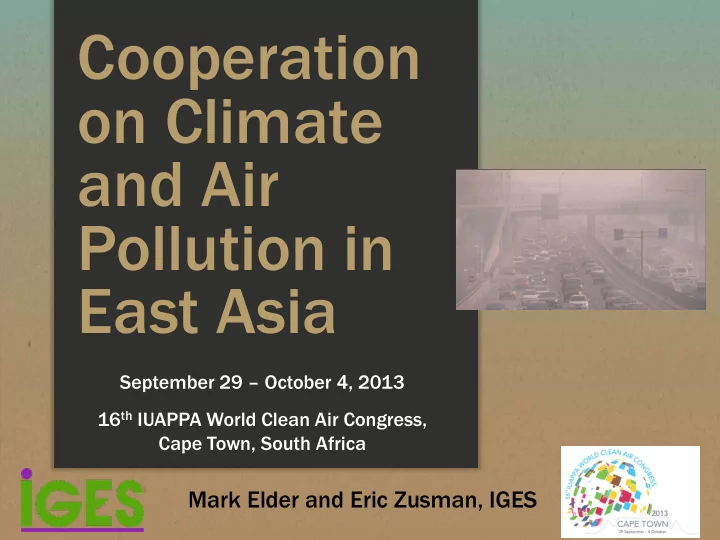
Cooperation
- n Climate
and Air Pollution in East Asia
Mark Elder and Eric Zusman, IGES
September 29 – October 4, 2013 16th IUAPPA World Clean Air Congress, Cape Town, South Africa
Cooperation on Climate and Air Pollution in East Asia September - - PowerPoint PPT Presentation
Cooperation on Climate and Air Pollution in East Asia September 29 October 4, 2013 16 th IUAPPA World Clean Air Congress, Cape Town, South Africa Mark Elder and Eric Zusman, IGES 1. Air Pollution Cooperation in East Asia 2. Air
Mark Elder and Eric Zusman, IGES
September 29 – October 4, 2013 16th IUAPPA World Clean Air Congress, Cape Town, South Africa
in East Asia
Cooperation in East Asia
2
Existing UNEP-related regional/sub-regional air pollution initiatives in Asia
Southeast Asia:
1 ASEAN member countries are working under the framework of ASEAN Haze Agreement
GMS
East Asia:
13 countries, which includes Northeast and Southeast Asia, working under the framework
Acid Deposition Monitoring (EANET)
South Asia:
8 countries are cooperating under the framework of Male’ Declaration on Control and Prevention of Air Pollution and Its likely Transboundary Effects for South Asia
Central Asia
5 Central Asia countries formulated the Framework Convention on Preservation
Development of Central Asia
UNEP-related regional/sub-regional initiatives
3
Closer cooperation among regional/sub-regional air pollution networks to enhance exchange of information/experiences and capacity building
Example, Joint Meeting in Asia:
Joint Forum on the Atmospheric Environment in Asia and the Pacific
Malé Declaration EANET ASEAN Haze Agreement
Central Asian Environment Convention
SPREP
Meeting of the Joint Forum on Atmospheric Environment in Asia and the Pacific, 10-11 March 2010
Joint Forum on the Atmospheric Environment in Asia and the Pacific
4
Selected Existing g Regional A Air Pol
ution
Coop
st Asi sia
ABC Atmospheric Brown Clouds
EANET Acid Deposition Monitoring Network in East Asia
Joint Forum Joint Forum on the Atmospheric Environment in Asia and the Pacific
(UNEP) TEMM Tripartite Environment Ministers Meeting
LTP Long Range Transboundary Air Pollutants in Northeast Asia
not climate) NEASPEC Northeast Asia Program on Environmental Cooperation
SRO
CAA Clean Air Asia (formerly CAI-Asia)
partnership
5
Membership in Selected Existing Frameworks
Co Countries EANET AS ASEAN AN Ha Haze NEASPEC LT LTP TEMM CCAC AC China
Lao PDR
Overall ll Pro roble lems w with E h Existin ing Frameworks ks (From
standpoi
t of a air p polluti tion
Overall: too cautious and lacking in ambition, voluntary Duplication & overlap, extra cost Insufficient scope: need more emphasis on mitigation,
linkage between air pollution & climate change
Limited effectiveness Insufficient funding Should strengthen linkage to policy & implementation
7
Potential Li Links b between A Air P Pol
ution Frame mewor
s and C Clima mate
Additional scientific research (especially
monitoring)
Awareness raising on air and climate
issues
Capacity building Policy dialogues Projects
8
Question: to what extent can existing frameworks make these links? May be challenging to incorporate into some existing frameworks.
Challenges to linking climate and air pollution in existing frameworks
Most frameworks limit the scope of pollutants. Expansion to air pollutants like O3 and PM2.5 may be easier. Can they be further expanded to Hg or others? However, in the past, it has been difficult to expand the scope of existing initiatives/ frameworks once they were established. Strong effort may be needed to persuade governments about the priority of co-beneifits, and the appropriateness of using existing initiatives/ frameworks Many developing countries need comprehensive capacity building, including for scientific research
9
10
Promising new network
Activities in Asia
Challenges
KEY ISSUES:
to discuss air pollution and climate change issues in East Asia?
discussions?
intergovernmental networks)
11
POSSIBLE OPTIONS
OPTION ON CONS NSIDERATION ONS UNEP
UNESCAP
Joint Forum
CAA
Japan’s Policies on Co-benefits: Co-benefit Projects in the Asian Region
Asian countries.
& experience utilizing existing activities & promoting bilateral credit offsets.
Background
Project Overview/Scheme
countries
Objectives, expected results
12
New B Budget R Requ quest (Mini nistry of f Envi vironment) FY 20 2013 => => FY20 2014 (2 (215 15 => => 658 658 mil. Y Yen)
Japan’s Policies on Co-benefits: Promotion of the Co-benefit Approach
13
New B Budget R Requ quest (Mini nistry of f Envi vironment) FY2014 (101 = => 105 mil. Y . Yen) n)
Project S Summary ( (General l Budget)
Promotion activities
Implementation cooperation
effects (including related capacity building) Support for research
Project S Summary ( (Specia ial B Budget)
Research / project support
human resources keeping in mind the importance of supporting the introduction
▪ A plat
atfor
mprove informa mation
stak akeholder c coor
benefits ts in Asia.
▪ Goal
: suppor
mainstreaming of
co co-benefits ts into deci cisi sions i s in Asi sia.
▪ Partners: ADB, C
CAA, ESCAP, UN UNU, UN , UNEP, GAP Por
China, , Indon
a, Jap apan an, , Thai ailan and etc.
14
IGES is the secretariat
▪ Informa
mation
g and nd kno nowledge m e mana nagem gement nt, including knowledge generation and dissemination
▪ Enh
nhanc nced ed communica cati tion among ACP members
▪ Development of co
co-benefits ts polici cies s and project cts in Asia
▪ Strengthening of region
al coop
ation to promote co- benefits
15
16
Research on Co-benefits in Asia (examples)
GMS
CHINA
using GAINS model
Several studies on co-benefits in Beijing and national study
Environmental Sciences- Estimate of co-benefits in Shanghai JAPAN
benefits in transport and waste sectors as well transregional air pollution
benefit project tool for CDM projects in China & Southeast Asia
INDIA TERI-estimating climate co-benefits; inserted into climate national action plan RITES-supporting co- benefits modeling in Hyderabad
KOREA
co-benefits of transport and energy policies in Korea PHILIPPINES
series of research and
co-benefits, including community of practice
INDIA
climate co-benefits; inserted into climate national action plan
benefits modeling in Hyderabad
*This is not an exhaustive list; it is meant to convey the growing interest in estimating co-benefits
Chinese government is very interested in co-benefits (for
cost savings)
Chinese government funds domestic co-benefits research Chinese researchers use the concept of co-control, not co-
benefit.
China is already implementing large scale co-benefit
measures in a broad sense (e.g. energy efficiency)
China’s interest in joining formal multilateral cooperation
frameworks or networks is not clear. Some bilateral cooperation is occurring.
17
18
principle.
capacity building, mitigation, adaptation, etc.
Optimistic Points
SLCP/co-benefits in the short term
building, including for scientific research
Challenges
facilitate
climate and air pollution authorities.
Other Points
19
Institute for Global Environmental Strategies www.iges.or.jp
Tha hank nk Y You
Acknowledgments: This research was supported by the Environment Research and Technology Development Fund (S-7-3) of the Ministry of the Environment, Japan.