Aluminium Aluminium The Link between Increase in Water Colour and - - PowerPoint PPT Presentation

aluminium aluminium
SMART_READER_LITE
LIVE PREVIEW

Aluminium Aluminium The Link between Increase in Water Colour and - - PowerPoint PPT Presentation

Aluminium Aluminium The Link between Increase in Water Colour and DOC The Link between Increase in Water Colour and DOC and Reduction in Acid Rain and Reduction in Acid Rain Al-DNOM flocks in a raw water treatment work Rolf D. Vogt


slide-1
SLIDE 1

13th 13th Int.IHSS Int.IHSS

Aluminium Aluminium

– – The Link between Increase in Water Colour and DOC

The Link between Increase in Water Colour and DOC and Reduction in Acid Rain and Reduction in Acid Rain

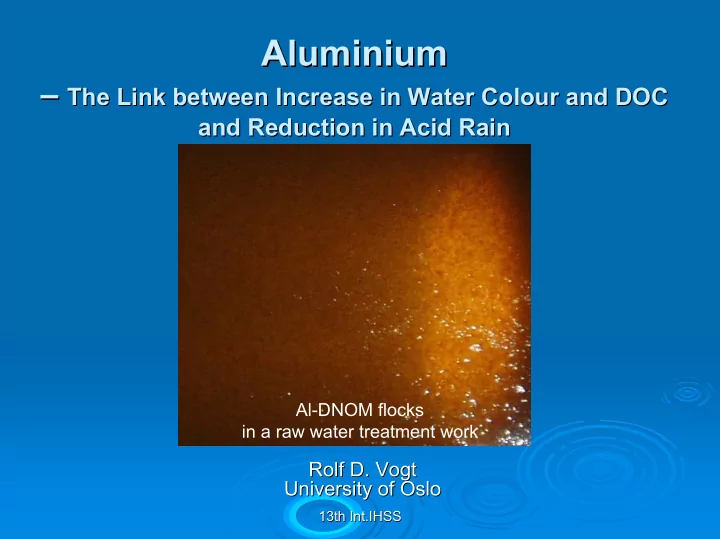
Al-DNOM flocks in a raw water treatment work

Rolf D. Vogt Rolf D. Vogt University University of Oslo

  • f Oslo
slide-2
SLIDE 2

13th Int. IHSS 13th Int. IHSS

Increasing Dissolved Natural Organic Increasing Dissolved Natural Organic Matter (DNOM) in surface waters Matter (DNOM) in surface waters

in Northern Europe and North in Northern Europe and North-

  • Eastern America

Eastern America

ICP Waters, Skjelkvåle, 2003

“Large increases in dissolved carbon concentration across the UK may be a combined response to climate change and decreasing acid deposition” Evans et al., 2005

Regional trend results for ICP Waters sites for the period 1990-2001

slide-3
SLIDE 3

13th Int. IHSS 13th Int. IHSS

Increased color Increased color in surface waters in SE Norway in surface waters in SE Norway

Eikebrokk et al., 2004

Color increase in Oslo’s raw waters:

Maximum color levels from monthly samples

A doubling or almost tripling of color

in some sources from 1990-2002

slide-4
SLIDE 4

13th Int. IHSS 13th Int. IHSS

UK Acid Waters Monitoring Network, Evans et al., 2006

Increased DOC Increased DOC in surface waters in UK in surface waters in UK

DOC concentration increases in streams and lakes :

  • 2

2 4 Jul-88 Jul-89 Jul-90 Jul-91 Jul-92 Jul-93 Jul-94 Jul-95 Jul-96 Jul-97 Jul-98 Jul-99 Jul-00 Jul-01 Jul-02 standardised concentration

Lakes

  • 2

2 4 Jul-88 Jul-89 Jul-90 Jul-91 Jul-92 Jul-93 Jul-94 Jul-95 Jul-96 Jul-97 Jul-98 Jul-99 Jul-00 Jul-01 Jul-02 standardised concentration

Streams

Concentration standardized plots

Since 1988, there has been, on average,

a 91% increase in DOC concentrations of UK lakes and streams

slide-5
SLIDE 5

13th Int. IHSS 13th Int. IHSS

Color is changing more than DOC Color is changing more than DOC

Hongve et al., 2004

The change that took

place by the end of 2000 was > 40% for color and

  • nly 11–13% for DOC

This implies

changes in the composition of DNOM

Higher Mw,

more hydrophobic and more humic

slide-6
SLIDE 6

13th Int. IHSS 13th Int. IHSS

Possible causes Possible causes for changes in for changes in DNOM amount DNOM amount and quality

+/- Site preparation +/- Drainage + Biomass +/- Species + Forestation +/- +/- + +/- +

Land use changes

? Sea-salts + Accumulated N + Reduced acid rain

Changes in Atmospheric deposition

+ +

  • +

Fall and winter temperature + ? Radiation + + Water retention time

  • +

Soil moisture + + Hydrologic connectivity + +/- Spring flood

  • +

Snow relative to rain

  • +/-

Precipitation intensity + + Precipitation amount +

Climate variation

NOM Conc. Key variable factors Considered shift +/- Site preparation +/- Drainage + Biomass +/- Species + Forestation +/- +/- + +/- +

Land use changes

+ Fall and winter temperature + ? Radiation + + Water retention time

  • +

Soil moisture + + Hydrologic connectivity + +/- Spring flood

  • +

Snow relative to rain

  • +/-

Precipitation intensity + + Precipitation amount +

Climate variation

NOM Conc. Key variable factors Considered shift + Fall and winter temperature + ? Radiation + + Water retention time

  • +

Soil moisture + + Hydrologic connectivity + +/- Spring flood

  • +

Snow relative to rain

  • +/-

Precipitation intensity + + Precipitation amount +

Climate variation

DNOM Conc. Key variable factors Considered shift

and quality

NORDTEST Workshop, Vogt 2003

Three main causes:

  • 1. Climate variation
  • 2. Land use changes
  • 3. Changes in

Anthropogenic deposition
slide-7
SLIDE 7

13th Int. IHSS 13th Int. IHSS

  • 1. Climate variation
  • 1. Climate variation

The Intergovernmental Panel on Climate Change, IPCC 2001

  • Increased temperature and precipitation

Increased temperature and precipitation

  • Northern hemisphere over the 20th century

Northern hemisphere over the 20th century

  • 1990s being the warmest decade of the

1990s being the warmest decade of the millennium millennium. .

  • Precipitation increased by 5

Precipitation increased by 5-

  • 10%

10%

  • Likely also an increase in heavy precipitation events

Likely also an increase in heavy precipitation events

slide-8
SLIDE 8

13th Int. IHSS 13th Int. IHSS

0,100 0,200 0,300 0,400 0,500 0,600 0,700 1 10 100 1000 Discharge L sek-1 UV absorbency Fall Spring Summer

Birkenes catchment

  • Climate can not

alone explain the unprecedented high DOC concentration and color in 2001

  • Evans et al. (2006)

argue that “climatic factors may not be the dominant drivers

  • f DOC change”.

Waterworks, Oslo, data from Hongve et al., 2004

Relation between Relation between precipitation intensity precipitation intensity and DNOM and DNOM

  • Variation in color and

DOC is well correlated to runoff

  • DNOM in the forest

floor is larger and more colored than in the mineral soil

slide-9
SLIDE 9

13th Int. IHSS 13th Int. IHSS

  • 2. Land
  • 2. Land-
  • use change

use change

  • There has been an

There has been an increase in the terrestrial increase in the terrestrial

  • rganic mass over the
  • rganic mass over the

past two decades past two decades

  • This is evident as a

This is evident as a significant carbon sink significant carbon sink

Nature; Schimel et al., 2001

High DNOM flux

from watersheds with:

Large soil pools of humus

relative to mineral soil

Forestation increase

DNOM leaching

NIJOS

slide-10
SLIDE 10

13th Int. IHSS 13th Int. IHSS

  • 3. Decrease in
  • 3. Decrease in

Acid Rain Acid Rain

Wright, R.F., et al. 2005; SFT, 2005; a.o.

  • By 2000,

By 2000, relative to mid relative to mid-

  • 1980s,

1980s, sulfur deposition had sulfur deposition had decreased regionally decreased regionally

  • by >50% in Europe

by >50% in Europe

  • by ~40% in North America

by ~40% in North America

  • Sulfate concentrations in

Sulfate concentrations in surface waters dropped surface waters dropped by between 30 by between 30 – – 70%. 70%.

slide-11
SLIDE 11

13th Int. IHSS 13th Int. IHSS

Exceedence of acid in meq/m2/yr

Empirical relation Empirical relation between between acid rain and DNOM acid rain and DNOM

The same regions

experiencing a decrease in H2SO4 are experiencing an increased DNOM

  • In the 70 and 80ties reduction

in the color in lakes were reported in the regions suffering acid rain

(Dixit et al., 2001)

Skjelkvåle et al., 2001

Evans et al., 2006

slide-12
SLIDE 12

13th Int. IHSS 13th Int. IHSS

DNOM solubility is DNOM solubility is linked to its charge linked to its charge

H B O B B He He B He Bg He B He Bg Bg H He B B He B B B O Bg Bg B B He Hi H/ O He He B B B Bg B B He B B B He B Bg B H/ O B H B H/ O Bg He Bg O B O/ H He B Hi He O Bg H Bg B O He O B H/ O Bg B B He B He Bg B He He Bg Hi B OH O B O Hi Bg He O He O B BgHe H H H B Hi O He Hi He O B O O O Hi HeO O/ H H B H H H/ O B He B Bg O O H Hi H/ O O B He He B Bg B H He O B O He He H O/ H He H/ O H/ O H/ O He He He H O/ H He O H/ O He O B H/ O O He He H He He He O O Bg O O/ H He He H H HeH H/ O O H O H He He He He H H O He B O O H/ OO He He O H H/ O He He He He B He B He He H H Hi H/ O H/ O H/ O He Hi He OO Hi He O O He He H He O O/ H He O O B O H H/ O He H O/ H H HO He H/ O H/ O He O H/ O B O He He He O He He H He O O H H He O/ H H He H H/ O H/ O B H B H He H O H B H O/ H O/ H O H/ O H/ O O/ H O H He O O B B H/ O O H/ O B O H/ O H/ O O/ H B H H/ O H/ O He O H/ O H H/ O O/ H H H H/ O H O H B H H/ O O O/ H H He O Hi H H He H/ O H H/ O H H/ O H Hi H/ O H/ O H H/ O H/ O H/ O O HH H Bs Bs Bs Bhs Bhs Bhs Bhs Bhs Bs Bhs Bs Bs Bhs Bh Bs Bh Bh Bhs Bhs Bs Bs Bs Bhs Bhs Bh Bs Bs He Bhs Bhs Bs Bh Bhs Ha Ha Bs Bh Bs Bhs Bhs Bhs Bs Ha Bhs Bs Bs Bh Bh Bhs Bhs Bs Bs E Bh Bs Bh Bhs Bhs Ha Bs Bh Bs Ha E Bhs E Bhs E E Bhs Bh Bs Bhs E Ha Bs Ha Bh Bhs E Bh Bh Bh Bh E Bhs E Bs Bs Bs He E E E Ha Bh Bh Ha H He HaO Bh Bhs Bh He He Ha Hi Bh He Ha Ha He Ha He Ha Ha E E He E Ha Ha Hi O O He Ha Bhs He Ha Ha Hi He He Ha O E He He Ha Ha O Hi Ha He He Ha H He He He He Ha H He He Bs He Hi O He Hi Ha He Hi Hi Bh He Ha E O He He Bh H H He Hi He E He Ha Ha He O He Ha H Hi Hi O O He He He Hi He H H Bh O Hi He H Ha He He He He He H Hi Ha He H Hi O He O H Hi He He Hi He Hi He He Hi O O H Hi Hi Ha Hi H O H Hi Hi H O He He O H O O Hi Hi H O H Hi Hi Hi HeHe Hi Hi He He He Hi H He O H Hi H O H Hi H H He He H Hi H He He O H He H Hi Hi H Ha Ha Hi H He H He Hi He O H Hi H H Hi Hi Hi H Hi H H Ha H Hi H Hi H Ha Ha Ha He H H HeHa He H H Hi H HiHe H H He Hi HiHi Ha Ha H Bh H Ha H H H

0,005 0,01 0,015 0,02 0,025

Alo/TOC

0,01 0,02 0,03 0,04 0,05 0,06 0,07 0,08

OA-/TOC

HUMEX data

  • Charge of DNOM

Charge of DNOM is increased by: is increased by:

  • Increased pH

Increased pH

  • Decreased concentration

Decreased concentration

  • f cations
  • f cations
  • Esp. Al
  • Esp. Al3+

3+

and and Ca Ca2+

2+

  • pH has not changed much

pH has not changed much in acid sensitive in acid sensitive dystrophic watersheds dystrophic watersheds as a result of less acid rain as a result of less acid rain

ICP Waters, Skjelkvåle, 2003

slide-13
SLIDE 13

13th Int. IHSS 13th Int. IHSS

High Al concentration High Al concentration in regions with acid rain in regions with acid rain

  • Acid rain = Strong mineral acidity

Acid rain = Strong mineral acidity along with increased fluxes of along with increased fluxes of sulfate, serving as a mobile anion sulfate, serving as a mobile anion

  • Allow for elevated

Allow for elevated concentrations of Al in concentrations of Al in acid sensitive acid sensitive mineral soil waters mineral soil waters

  • Dystrophic and

Dystrophic and Oligothrophic watersheds Oligothrophic watersheds

500 1000

Ratanica Janow Czerniawka Brenna Ciekon Birkenes Skjervatjern

ueq/L

H+ Ali NH4+ Na+K Ca+Mg SO4 NO3

slide-14
SLIDE 14

13th Int. IHSS 13th Int. IHSS

Al effect on DOM Al effect on DOM

  • The excellent

The excellent properties of Al properties of Ali

i as a

as a flocculent and flocculent and coagulant may be coagulant may be clearly envisioned at clearly envisioned at water treatment works water treatment works were Alum were Alum (i.e. Al (i.e. Al2

2(SO

(SO4

4)

)3

3) is used

) is used for removal of DOM for removal of DOM

View down into processing raw water added 15 mg Al/L at pH 5.9 at Bærum vann AS

slide-15
SLIDE 15

13th Int. IHSS 13th Int. IHSS

% change in DOC vs. change in mobile anions % change in DOC vs. change in mobile anions

DOC Workshop, Oslo; Monteith et al, 2006

  • 6
  • 4
  • 2

2 4 6 8 10 12 14

  • 25
  • 20
  • 15
  • 10
  • 5

5 10

sulphate theil slope (microeqs l-1 yr-1) % change in DOC concentration

  • 6
  • 4
  • 2

2 4 6 8 10 12 14

  • 14
  • 12
  • 10
  • 8
  • 6
  • 4
  • 2

2 4 6

chloride theil slope (microeqs l-1 yr-1) % change in DOC concentration

  • 6
  • 4
  • 2

2 4 6 8 10 12 14

  • 30
  • 25
  • 20
  • 15
  • 10
  • 5

5 10 15

[SO4

2-] + [Cl-] theil slope (microeqs l-1 yr-1)

% change in DOC concentration y = -0.4762x + 0.0923 R2 = 0.28

  • 6
  • 4
  • 2

2 4 6 8 10 12 14

  • 20
  • 15
  • 10
  • 5

5

[SO4

2- ] + [Cl- ] theil slope (microeqs l-1 yr-1)

% change in DOC concentration

Sulphate Chloride Sulphate + Chloride ([Ca2+] + [Mg2+]) < 150 µeq l-1 Sulphate + Chloride Rising temperature, declining SO4

2- deposition and changing seasalt (Cl-) loading

accounted for 65 % of the 91 % increase in DOC in UK (Evans et al., 2006)

slide-16
SLIDE 16

13th Int. IHSS 13th Int. IHSS

Main spatial variation in Main spatial variation in DNOM quality explained DNOM quality explained by S deposition by S deposition

PCA indicate that sites with

less S-deposition have DNOM with higher:

  • sUVa
  • MW

C:N HPO-A Mw Radii m/z sUVa SAR C=C; COO- O-H; C-O

  • Cond. Mat.

HIX SFE Phenol Phenol/Arom Spin density Arom/Aliph Tot-COOH BDOM KB[a]P PS POD

  • 0.4
  • 0.2

0.2 0.4

PC1 (41.4%)

  • 0.5
  • 0.25

0.25 0.5

PC2 (20.7%)

NOMiNiC study; Vogt et al., 2004

  • Principal component analysis

Principal component analysis

  • n 21 selected parameters
  • n 21 selected parameters

from 5 sites and 2 seasons from 5 sites and 2 seasons

R2 = 0,8956 0,2 0,4 0,6 0,8 1 1,2

  • 4
  • 2

2 4 6 8 PC1 (41.4%)

  • Tot. S deposition

g m-2 yr-1

slide-17
SLIDE 17

13th Int. IHSS 13th Int. IHSS

Conclusions Conclusions

10 out of 11 ICP Waters regions

in Europe and North America seeing decreased acid rain showed increasing DOC trend

The increased DNOM is

more colored, higher Mw and more hydrophobic

DNOM in sites receiving less loads of acid rain are

more colored, higher Mw and more hydrophobic

Changes in the concentration of dissolved

inorganic aluminum is a likely underlying governing factor for increased DNOM in dystrophic and oligothrophic watersheds draining mineral forest soils.

slide-18
SLIDE 18

13th Int. IHSS 13th Int. IHSS

Acknowledgement Acknowledgement

  • NORDTEST for funding

NORDTEST for funding

  • Profs.
  • Profs. Egil

Egil Gessing Gessing, Hans Martin , Hans Martin Seip Seip, , Don Don Monteith Monteith and several reviewers for and several reviewers for valuable comments valuable comments

  • Monteith

Monteith and the ICP program for data and the ICP program for data