Control of Noise at Work - Employee training [ABC] Version 01 - - PowerPoint PPT Presentation

control of noise at work employee training abc version 01
SMART_READER_LITE
LIVE PREVIEW

Control of Noise at Work - Employee training [ABC] Version 01 - - PowerPoint PPT Presentation

Meeting the Training Requirements of the 2007 General Apps Regulations - Control of Noise at Work This programme is designed to comply with the requirements of Regulation 130. You should preview the slides and include your specific


slide-1
SLIDE 1

Version 01 October 2011.

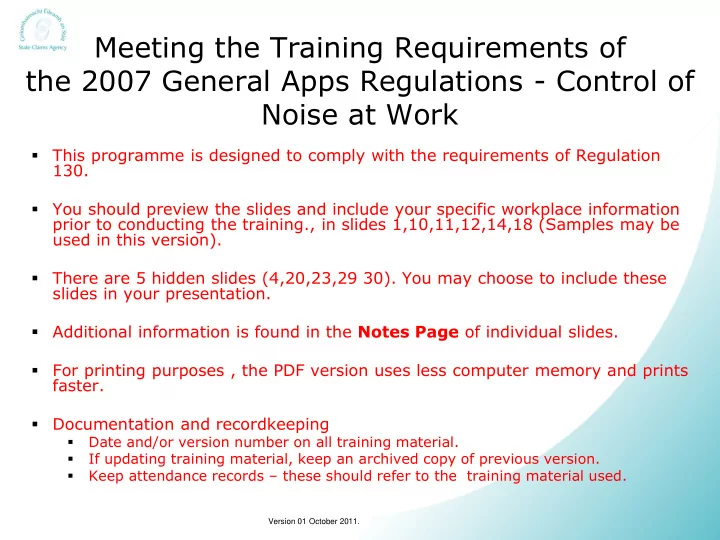
Meeting the Training Requirements of the 2007 General Apps Regulations - Control of Noise at Work

  • This programme is designed to comply with the requirements of Regulation

130.

  • You should preview the slides and include your specific workplace information

prior to conducting the training., in slides 1,10,11,12,14,18 (Samples may be used in this version).

  • There are 5 hidden slides (4,20,23,29 30). You may choose to include these

slides in your presentation.

  • Additional information is found in the Notes Page of individual slides.
  • For printing purposes , the PDF version uses less computer memory and prints

faster.

  • Documentation and recordkeeping
  • Date and/or version number on all training material.
  • If updating training material, keep an archived copy of previous version.
  • Keep attendance records – these should refer to the training material used.
slide-2
SLIDE 2

Version 01 October 2011.

Control of Noise at Work - Employee training [ABC]

slide-3
SLIDE 3

Version 01 October 2011.

Control of Noise At Work

  • Hearing protection – their

purpose, types and use

  • Safe working practices
  • Why and how to detect and

report signs of hearing damage

  • Health surveillance - purpose
  • f hearing checks

(audiometric testing)

  • The risks from noise –

effects on hearing

  • Exposure limit values and

exposure action levels

  • Results of the noise risk

assessment at [name]

  • Controls used to reduce

noise levels

  • Technical and engineering

measures This presentation will cover the following topics:

2

slide-4
SLIDE 4

Version 01 October 2011.

Effects of exposure to loud noise

  • Causes hearing loss over time.
  • Hearing Loss is usually not noticed

because it is so gradual

  • Usually a person loses the ability to

hear high pitches first

  • Often the first noticeable effect is

difficulty in hearing speech

  • Noise exposure can damages or

destroy the nerves in the inner ear.

  • Other possible effects: “tinnitus” or

permanent ringing in the ear.

3

slide-5
SLIDE 5

Version 01 October 2011.

Long Term Exposure to Noise Ears can recover from short exposure to loud noise, but over time nerve damage will occur The longer and louder the noise, the greater chance permanent damage will

  • ccur

5

slide-6
SLIDE 6

Version 01 October 2011.

Effects of noise to inner ear

Normal hair cells Noise-damaged hair cells

6

slide-7
SLIDE 7

Version 01 October 2011.

When is Noise Too Loud?

Damage depends on both the loudness and length of exposure. Loudness is measured in units called “decibels” or “dB”

  • Quiet library 30 dB
  • Classroom 70 dB
  • Tractor cab 80 dB

Rule of thumb: If two people 2 metres apart must shout to be heard, the background noise is too loud

7

slide-8
SLIDE 8

Version 01 October 2011.

What is too much noise exposure?

  • Hearing loss can occur when the

levels exceeds 85 decibels over the average working day (8-hours)

  • There is a residual risk down to

levels of 80 dB

  • Impact (instant) or banging noise

above 140 dB will cause immediate damage

  • 95 dB for 15 minutes = 86 dB for 2

hours = 80 dB averaged over 8 hours

8

slide-9
SLIDE 9

Version 01 October 2011.

Limit values and action values

Criterion Daily personal exposure (Lex, 8h) in dB(A) Peak pressure (Ppeak) in dB(C) Limit value 87 140 Upper Action level 85 137 Lower Action Level 80 135

Legislators have decided what safe levels are and what limits should apply to workers’ hearing

Source: General Applications Regulations 2007 9

slide-10
SLIDE 10

Version 01 October 2011.

Noise Risk Assessment Equipment noise levels at ABC 2011

Equipment Noise Levels LAeq , dB(A) Radial saw, jig saw , planer 90-95 Circular Saw, hammer action drill >100 Bench Grinder 85 Average for woodworking tools 96.7 Strimmer 97 Quad 90 Self-powered mower 91 Rifle fitted with moderator 73

10

slide-11
SLIDE 11

Version 01 October 2011.

Personal exposures in [ABC]

Tasks /Persons Main Sources of Noise Exposure Noise Exposure Category dB(A) Risk Risk Without Hearing Protection With Hearing Protection

Woodwork repairs and fabrication Powered woodworking tools (radial, circular and jig saws, planer) >85 Moderate Negligible Grounds and path maintenance Strimmer, Quad, Mower >85 Moderate Negligible General work, including shooting No significant sources

  • f noise exposure

<75 Negligible Negligible Tree surgeon Chainsaw, wood chipper, leaf blower >85 High Low People may/not be using equipment continuously. The daily exposure values above are based

  • n typical work pattern.

11

slide-12
SLIDE 12

Version 01 October 2011.

Noise controls we use in [ABC]

  • Purchasing quieter equipment where

possible

  • Maintaining equipment
  • Providing PPE:

Earmuffs or equivalent,

  • r ear plugs
  • Signs on equipment or in place of use

where exposure > 80 dB(A)

  • Supervision

12

slide-13
SLIDE 13

Version 01 October 2011.

Types of hearing protection

  • Three types of hearing protection –

ear muffs, earplugs and ear caps.

  • Ear muffs and earplugs provide

about equal protection, ear caps somewhat less.

  • All designed to reduce the intensity

(loudness) of noise to the inner ear.

  • The two types have advantages

and disadvantages and people vary

  • n which they prefer to use.

Earmuffs Earplugs

Tissue doesn’t work!

13

slide-14
SLIDE 14

Version 01 October 2011.

Hearing Protection – ear plugs

  • Earplugs are made of foam,

rubber or plastic and are either

  • ne-size-fits-all or in sizes small,

medium and large.

  • Some are disposable, some are

reusable.

  • They are lightweight, and require

no maintenance.

  • They are inserted into the ear

canal.

  • [Insert specific type of ear plug

used in your location]

14

slide-15
SLIDE 15

Version 01 October 2011.

Hearing Protection – ear plugs

  • Some people may find ear plugs

uncomfortable to wear for long periods at first.

  • Ear plugs rarely cause infection or

prolonged irritation of the ear canal.

  • Most people can find a comfortable

fit by trying several different sizes, types or brands.

15

slide-16
SLIDE 16

Version 01 October 2011.

Inserting foam earplugs

Foam type earplugs are one-size-fits-all and must be inserted properly into the ear. Roll earplug into small cylinder first, then insert in ear.

16

slide-17
SLIDE 17

Version 01 October 2011.

Inserting foam earplugs

Earplug incorrectly inserted Earplug correctly inserted

17

slide-18
SLIDE 18

Version 01 October 2011.

Hearing Protection – Ear muffs

  • They cover the whole ear
  • Replaceable pads and some high-

tech styles filter out specific noise pitches.

  • Can last a long time
  • Less prone to contamination
  • Some are attached to hard hats or

goggles.

  • Can be uncomfortable in hot

weather.

  • Don’t seal well for someone with

glasses or heavy sideburns

  • [ ABC] uses [insert specific type

here]

18

slide-19
SLIDE 19

Version 01 October 2011.

How can you hear anything with earmuffs on?

  • Using earmuffs or plugs in

noisy areas can actually make it easier to hear coworkers or machinery.

  • They reduce overwhelming

loud background noise.

  • Some high-tech muffs can

filter out certain frequencies

  • r have radios inside for

communication in high noise areas.

19

slide-20
SLIDE 20

Version 01 October 2011.

Proper use of hearing protection

  • Earmuffs and plugs

provide good protection

  • nly when used properly.
  • Sometimes people will

remove hearing protection for “just a minute” in a noisy area.

  • In areas of very high noise

exposure, this could result in noise overexposure.

It won’t protect your ears if it is around your neck!!!

21

slide-21
SLIDE 21

Version 01 October 2011.

Proper use of hearing protection

  • It takes just a few minutes of unprotected

exposure at noise above 115 decibels to risk hearing damage.

  • Earplugs not well inserted into the ear canal

will not provide complete protection.

  • Likewise, earmuffs not snug against the head

will “leak” noise into the ear.

22

slide-22
SLIDE 22

Version 01 October 2011.

DOs .... And .... DON’Ts

Comply with all signage. Check the condition of hearing protection before each use If possible, rotate tasks to limit prolonged exposure. Report any faults or unusually increased noise levels from equipment. Report any problems with your hearing. Use machinery without wearing proper ear protection. Wear someone else’s ear protection. Use damaged ear protection – get a new supply

24

slide-23
SLIDE 23

Version 01 October 2011.

Detecting and reporting hearing damage

  • Difficulty in hearing speech
  • Problem hearing over the telephone
  • Trouble following the conversation when

two or more people are talking at the same time

  • People complaining that the TV volume is

too high

  • Straining to understand conversation
  • Asking people to repeat themselves

25

slide-24
SLIDE 24

Version 01 October 2011.

When are hearing checks and audiometric testing required?

  • Based on the risk assessment
  • If >80 dB(A) over 8hours,

“audiometric testing” may be done by trained technicians.

  • If > 85 d B(A), then

hearing checks are done by a medical practitioner.

  • Your manager will arrange.
  • State authorities – via the

CMOCS.

26

slide-25
SLIDE 25

Version 01 October 2011.

Purposes of hearing checks (audiometric testing) Most of us develop a mild hearing loss as we age, especially in the higher pitches. A severe or significant hearing loss at a younger age may mean you have had excessive noise exposure. Audiometric testing done regularly can detect early stages of hearing loss.

27

slide-26
SLIDE 26

Version 01 October 2011.

  • Hearing protection in use is

adequate

  • A change in noise exposure
  • A medical condition of the

ear unrelated to noise exposure

Audiometric testing results can be used to check the following: You are entitled to the results

28

Audiometric Testing

slide-27
SLIDE 27

Version 01 October 2011.

How does Audiometric Testing Work?

It is preferable to have a ‘baseline’ test , for instance

  • n starting work.

The testing is repeated at suitable intervals after that and compared to the baseline test result. If a hearing loss is detected, you will be referred to a doctor or audiologist.

29

slide-28
SLIDE 28

Version 01 October 2011.

Audiometric Testing

  • Audiometric testing

produces printed audiograms which show hearing ability at several pitches or frequencies, including those of the human voice.

  • The second and

subsequent tests are compared to the baseline.

  • If there is a significant drop then further review may be

required.

  • mage source: Simon Fraser University, Canada)

30

slide-29
SLIDE 29

Version 01 October 2011.

End of Presentation Thank You !

31

Some slide content courtesy of http://www.lni.wa.gov/