Mandatory Access Control 1 DAC and Trojan Horse Brown: read, write - - PDF document

mandatory access control
SMART_READER_LITE
LIVE PREVIEW

Mandatory Access Control 1 DAC and Trojan Horse Brown: read, write - - PDF document

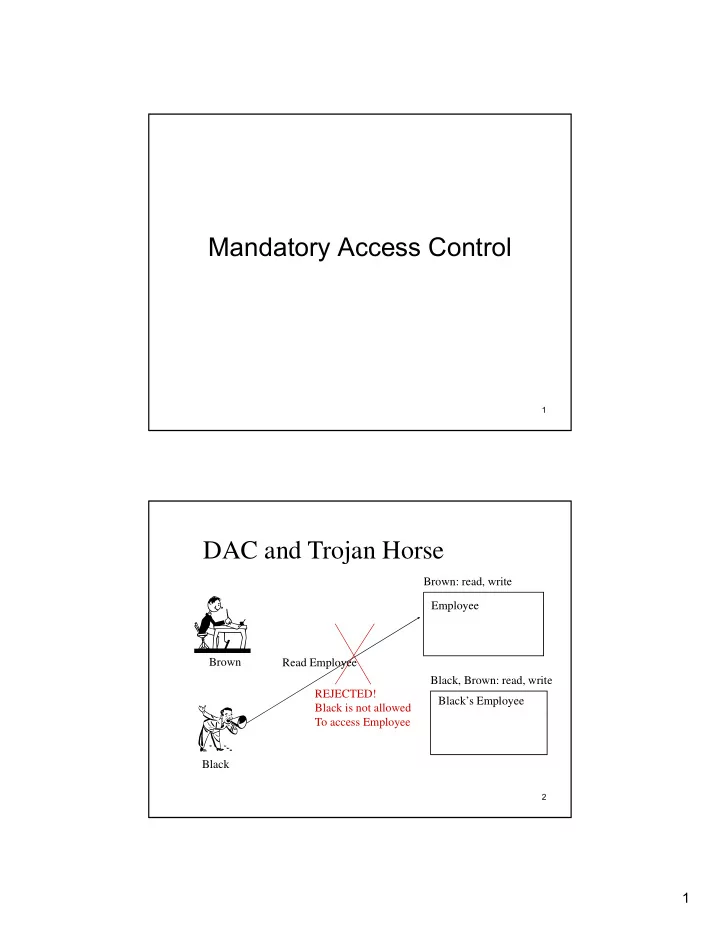
Mandatory Access Control 1 DAC and Trojan Horse Brown: read, write Employee Employee Brown Read Employee Black, Brown: read, write REJECTED! Blacks Employee Black is not allowed To access Employee Black 2 1 DAC and Trojan Horse


slide-1
SLIDE 1

1

Mandatory Access Control

1

DAC and Trojan Horse

Employee Brown: read, write Employee Black’s Employee Black, Brown: read, write Brown Read Employee REJECTED! Black is not allowed

2

Black To access Employee
slide-2
SLIDE 2

2

DAC and Trojan Horse

Employee Brown: read, write Employee Black’s Employee Black, Brown: read, write Brown Word Processor Uses shared program Reads Employee Copies

3

Black TH Inserts Trojan Horse Into shared program Copies Employee To Black’s Employee

Black has access to Employee now!

Mandatory Access Control (MAC)

  • Security level of object (security label):

Sensitivity of object

  • Security level of subject (security class): user’s

clearance

– E.g. Top Secret > Secret > Confidential > Unclassified

  • MAC specifies the access that subjects have to
  • bjects based on the subjects and objects

4

classification

  • This type of security has also been referred to as

multilevel security

slide-3
SLIDE 3

3

Mandatory Access Control (MAC)

  • Controlling information flow (Bell-LaPadulla

properties BLP):

– No READ UP: Subject clearance  object security – No READ UP: Subject clearance  object security – No WRITE DOWN (*-property): Subject clearance 

  • bject security

– Prevent information in high level objects from flowing to low level subjects – Tranquility property: The classification of a resource cannot be changed while the resource is in use by

5

g y any user of the system

  • Necessary but not sufficient conditions
  • May still have problems – covert channel

– Indirect means by which info at higher levels passed to lower levels

MAC – Controlling Information Flow

6

slide-4
SLIDE 4

4

MAC – Problems?

  • Write-up allows destruction of more secure info

– Limit to same level; disable write-up

  • Write up means cannot send info to lower level
  • Write-up means cannot send info to lower-level

subjects

– Subject can sign in at lower level – Prevent malicious programs from leaking secrets – Users are trusted, not programs

  • Hierarchy of security levels is too restrictive

7

  • Hierarchy of security levels is too restrictive

– Consider the notion of “need-to-know”

  • In military applications, someone cleared for TOP SECRET

information on OPERATION X may not even need to know about UNCLASSIFED documents on OPERATION Y

– Lattice of security labels

Lattice of Security Labels

  • Security level is (clearance, category set)
  • Examples

– ( Top Secret, { NUC, EUR, ASI } ) – ( Confidential, { EUR, ASI } ) – ( Secret, { NUC, ASI } )

8

slide-5
SLIDE 5

5

Levels and Lattices

  • (A, C) dom (A, C) iff A ≤ A and C  C
  • Examples

(Top Secret {NUC ASI}) dom (Secret {NUC}) – (Top Secret, {NUC, ASI}) dom (Secret, {NUC}) – (Secret, {NUC, EUR}) dom (Confidential,{NUC, EUR}) – (Top Secret, {NUC}) dom (Confidential, {EUR}) – (Secret, {NUC}) dom (Confidential,{NUC, EUR})

  • Let C be set of classifications, K set of categories. Set
  • f security levels L = C  K, dom form lattice

– Partially ordered set

9

– Any pair of elements

  • Has a greatest lower bound
  • Has a least upper bound

Example Lattice

ASI NUC EUR ASI,NUC ASI,EUR ASI EUR NUC NUC,EUR ASI,NUC,EUR

10

ASI NUC

slide-6
SLIDE 6

6

Subset Lattice

TS: NUC EUR TS: ASI, NUC,EUR NUC,EUR TS: NUC,ASI TS:NUC S:NUC C: NUC,EUR C:EUR

11

U: 

Why Apply MAC to DB?

  • Data can be viewed as sensitive for many different
  • reasons. Examples:

– personal and private matters or communications, professional personal and private matters or communications, professional trade secrets – company plans for marketing or finance – military information, or government plans

  • Such data is often mixed with other, less sensitive

information that is legitimately needed by diverse users

  • Restricting access to entire tables or segregating

Restricting access to entire tables or segregating sensitive data into separate databases can create a working environment that is costly in hardware, software, user time, and administration.

12

slide-7
SLIDE 7

7

Multilevel Relational (MLR) Model

  • The multilevel relational (MLR for short)

d l lt f th li ti f th model results from the application of the BLP model to relational databases

  • Several issues

– Granularity: to which element do we apply the classification?

13

– Integrity constraints

Traditional Relational Model

Standard relational model – each relation is characterized by two components characterized by two components

  • A state-invariant relation schema R(A1,…., An) where Ai

is an attribute over some domain Di

  • A state-dependent relation
  • ver R composed of

distinct tuples of the form (a1 an) where

S N L R W H 123-22-3666 Attishoo 48 8 10 40 231-31-5368 Smiley 22 8 10 40

14

form (a1,…, an), where each ai is a value in domain Di

231 31 5368 Smiley 22 8 10 40 131-24-3650 Smethurst 35 5 7 30 434-26-3751 Guldu 35 5 7 30 612-67-4134 Madayan 35 8 10 40

slide-8
SLIDE 8

8

Relational Model – keys and FD

  • Functional dependencies

– Let R be a relation and let X and Y be attribute sets, b h b f h ib f R both subsets of the attribute set of R – we say that X functionally determines Y if and

  • nly if no two tuples may exist in R with the same

value for X but different values for Y

  • Primary Keys (entity integrity property)

– the primary key uniquely identifies each tuple in the relation

15

– A primary key cannot contain attributes with null values – A relation cannot contain two tuples with the same value for the primary key

Example

  • Consider relation Hourly_Emps:

– Hourly_Emps (ssn, name, lot, rating, hrly_wages, hrs_worked)

  • FDs S  SNLRWH
  • ssn is the key
  • FDs give more detail than

the mere assertion of a key

  • rating determines hrly wages

S N L R W H 123-22-3666 Attishoo 48 8 10 40 231-31-5368 Smiley 22 8 10 40 131-24-3650 Smethurst 35 5 7 30

16

  • rating determines hrly_wages
  • R  W

434-26-3751 Guldu 35 5 7 30 612-67-4134 Madayan 35 8 10 40

slide-9
SLIDE 9

9

MLR Model

  • Given a relation, an access class can be

associated with: associated with:

– The entire relation – Each tuple in the relation

  • This is the common choice in commercial systems

– Each attribute value of each tuple in the relation

17

relation

  • In the remainder we consider this case

– Toward a Multilevel Secure Relational Data Model. Proc 1991 ACM Int'l. Conf. on Management of Data (SIGMOD), 50-59.

Multilevel (ML) relations

A ML relation is characterized by two components

  • A state-invariant relation scheme

R(A1,C1,…., An,Cn, TC) where:

  • Ai is an attribute over some domain Di
  • Ci is a classification attribute for Ai; its domain is the set of access

classes that can be associated with values of Ai

  • TC is the classification attribute of the tuple
  • A set of state-dependent relation instances Rc over R for

each access class in the access class lattice. Each instance Rc is composed of distinct tuples of the form (a1,c1,…, an,cn, tc), where:

18

(a1,c1,…, an,cn, tc), where:

  • ai is a value in domain Di
  • ci is the access class for ai
  • tc is the access class of the tuple determined as the least upper

bound of all ci in the tuple

  • Classification attributes cannot assume null values
slide-10
SLIDE 10

10

ML relations - example

Vessel (AK) Objective Destination TC Micra U Shipping U Moon U U Micra U Shipping U Moon U U Vision U Spying U Saturn U U Avenger C Spying C Mars C C Logos S Shipping S Venus S S

19

ML relations - instances

  • A given relation may thus have instances at different

access classes

  • The relation instance at class c contains all data that are

visible to subjects at level c

– It contains all data whose access classes are dominated by c – All elements with access classes higher than c, or incomparable, are masked by null values – Sometimes, to avoid signaling channels, fictitious values (called cover story values) can be used

20

y )

slide-11
SLIDE 11

11

ML relations - example

Vessel (AK) Objective Destination TC Micra U Shipping U Moon U U Micra U Shipping U Moon U U Micra U Shipping U Moon U U Micra U Shipping U Moon U U Micra U Shipping U Moon U U Vision U Spying U Saturn U U Avenger C Spying C Mars C C Logos S Shipping S Venus S S Micra U Shipping U Moon U U Vision U Spying U Saturn U U Micra U Shipping U Moon U U Vision U Spying U Saturn U U Avenger C Spying C Mars C C Micra U Shipping U Moon U U Vision U Spying U Saturn U U Avenger C Spying C Mars C C Logos S Shipping S Venus S S

21

  • Level U users see first 2 tuples
  • Level C users see first 3 tuples
  • Level S users see all tuples

MLS Model

  • Entity integrity rule

– All attributes that are members of the apparent key must not be null (i.e., Ai  AK  t[Ai]  NULL) All tt ib t f AK t h th it l ifi ti – All attributes of AK must have the same security classification within each individual tuple (i.e., Ai, Aj  AK  t[Ci] = t[Cj]) – For each tuple, the access class associated with the non-key attributes must dominate the access class of the primary key (i.e., Ai  AK  t[Ci]  t[CAK]).

  • Null integrity

– Nulls are classified at the level of the key – One tuple does not subsume another (null values subsumed by non null values)

22

non-null values)

  • Inter-Instance Integrity

– User can only see portion of relation for which he/she is cleared – Data not cleared is set to null – Eliminate subsumed tuples

slide-12
SLIDE 12

12

MLS Model - Example

S-user view: Vessel Objective Destination TC Enterprise U Exploration U Talos U U Voyager U Spying S Mars S S U-user view:

23

Vessel Objective Destination TC Enterprise U Exploration U Talos U U Voyager U Null U Null U U

ML relations – keys and polyinstantiation

  • In the standard relational model, each

tuple is uniquely identified, by the values

  • f its key attributes
  • When access classes are introduced,

there may be the need for the simultaneous presence of multiple tuples

24

simultaneous presence of multiple tuples with the same value for the apparent key attributes!

slide-13
SLIDE 13

13

MLS Insert

  • What if a U user wants to insert a tuple

with vessel = Avenger?

If i t i ll d ill th b bl ? – If insert is allowed – will there be any problems?

  • We will have 2 Avengers
  • Duplicate primary key - violates unique constraints

– If we reject the insert – what will happen?

  • Covert channel – U user knows that there is another record

with same key value that is not visible to him

25

Vessel (AK) Objective Destination TC Micra U Shipping U Moon U U Vision U Spying U Saturn U U Avenger C Spying C Mars C C Logos S Shipping S Venus S S

Polyinstantiation

  • Phenomenon where simultaneous presence of

multiple tuples with the same value for the key ff f attributes with different classification

  • Two situations:

– A low user inserts data in a field which already contains data at higher or incomparable level – invisible polyinstantiation

26

– A high user inserts data in a field which already contains data at a lower level – visible polyinstantiation

slide-14
SLIDE 14

14

ML relations – invisible polyinstantiation

Suppose a low user asks to insert a tuple with the same primary key as an existing tuple at a higher level; the DBMS has three choices: DBMS has three choices:

1) Notify the user that a tuple with the same primary key exists at higher level and reject the insertion

  • signaling channel

2) Replace the existing tuple at higher level with the new tuple being inserted at low level

  • allows the low user to overwrite data not visible to him and thus

27

allows the low user to overwrite data not visible to him and thus compromising integrity

3) Insert the new tuple at low level without modifying the existing tuple at the higher level (i.e. polyinstantiate the entity)

  • is a reasonable choice; as consequence, it introduces a polyinstantiated

entity

ML relations – invisible polyinstantiation (Example)

Vessel Objective Destination TC Micra U Shipping U Moon U U Vision U Spying U Saturn U U Avenger U Shipping U Mars U U Avenger C Spying C Mars C C

28

A U-user inserts (Avenger, Shipping, Mars) The tuples with primary key “Avenger” are polyinstantied

Logos S Shipping S Venus S S

slide-15
SLIDE 15

15

ML relations – visible polyinstantiation

Suppose a high user asks to insert a tuple with the same primary key as an existing tuple at lower level; the DBMS has three choices: DBMS has three choices:

1) Notify the user that a tuple with the same primary key exists and reject the insertion

  • does not introduce a signaling channel; however, rejecting the insertion

my result in a DoS problem

2) Replace the existing tuple at lower level with the new tuple being inserted at the high level

29

g g

  • would result in removing a tuple at lower level and thus introduce a

signaling channel

3) Insert the new tuple at high level without modifying the existing tuple at the lower level (i.e. polyinstantiate the entity)

  • is a reasonable choice; as consequence, it introduces a polyinstantiated

entity

ML relations – visible polyinstantiation (Example)

Vessel Objective Destination TC Micra U Shipping U Moon U U Vision U Spying U Saturn U U Avenger S Shipping S Mars S S Avenger C Spying C Mars C C

30

A S-user inserts (Avenger, Shipping, Mars) The tuples with primary key “Avenger” are polyinstantied

Logos S Shipping S Venus S S

slide-16
SLIDE 16

16

MLS Model

  • Polyinstantiation Integrity

AK, CAK, Ci -> Ai – Implies Primary key in MLS is:

  • AK U CAK U CR
  • AK are data in PK, CAK is class of PK data, CR is

data not in AK

31

MLS Model - Updates

Vessel Objective Destination TC Enterprise U Exploration U null U U S-user updates Destination to Rigel: ?? Vessel Objective Destination TC Enterprise U Exploration U Rigel S S OR

32

Vessel Objective Destination TC Enterprise U Exploration U null U U Enterprise U Exploration U Rigel S S

slide-17
SLIDE 17

17 Vessel Objective Destination TC Enterprise U Exploration U null U U

MLS Model - Update

S-user updates Objective to Spying: ?? Vessel Objective Destination TC Enterprise U Spying S null U S OR

33

Vessel Objective Destination TC Enterprise U Exploration U null U U Enterprise U Spying S null U S

More Update Examples

U view: Vessel Objective Destination TC Vessel Objective Destination TC Enterprise U Exploration U null U U S view: Vessel Objective Destination TC Enterprise U Exploration U Rigel S S

34

Enterprise U Exploration U Rigel S S U-user wants to update, set Destination = Talos where Vessel = ‘Enterprise”

slide-18
SLIDE 18

18

Update

U view: Vessel Objective Destination TC Vessel Objective Destination TC Enterprise U Exploration U Talos U U S View: Vessel Objective Destination TC Enterprise U Exploration U Talos U U Enterprise U Exploration U Rigel S S

35

Enterprise U Exploration U Rigel S S Suppose S-users want to update, set objective=spying where Vessel = ‘Enterprise” and destination =‘Rigel’

Update

Vessel Objective Destination TC Enterprise U Exploration U Talos U U Enterprise U Exploration U Talos U U Enterprise U Spying S Rigel S S What if S-user set objective=spying where Vessel=“Enterprise”? Vessel Objective Destination TC Enterprise U Exploration U Talos U U

36

Enterprise U Exploration U Talos U U Enterprise U Spying S Talos U S Enterprise U Spying S Rigel S S

slide-19
SLIDE 19

19

Delete

  • Because of the *-property, only tuples that

satisfy the predicates AND t[TC] = c are deleted satisfy the predicates AND t[TC] = c are deleted from Rc (Rc is table at classification c)

  • To maintain inter-instance integrity,

polyinstantiated tuples are also deleted from Rc’>c

If t[AK] = c then any polyinstantiated tuples in R – If t[AK] = c, then any polyinstantiated tuples in Rc’>c will be deleted from Rc’>c – If t[AK] < c, then the entity will continue to exist in Rt[AK] and in Rc’>t[AK]

37

Summary

  • MAC protects against TH
  • Vulnerable to covert channels
  • Subjects and objects have to be classified

which may not always be feasible

38