Contrail-Cirrus Man-made Experiments on Complex Cloud Physics - - PowerPoint PPT Presentation

contrail cirrus man made experiments on complex cloud
SMART_READER_LITE
LIVE PREVIEW

Contrail-Cirrus Man-made Experiments on Complex Cloud Physics - - PowerPoint PPT Presentation

Contrail-Cirrus Man-made Experiments on Complex Cloud Physics Ulrich Schumann German Aerospace Center, Oberpfaffenhofen, Germany TOPICS: Cirrus Contrails Past: Brewer Dobson, TIL, Ice Supersaturation, Nucleation Present:


slide-1
SLIDE 1

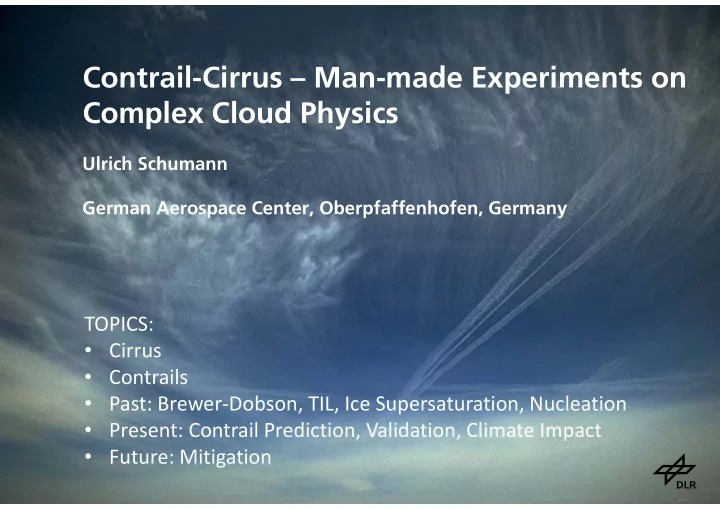
Contrail-Cirrus – Man-made Experiments on Complex Cloud Physics

Ulrich Schumann German Aerospace Center, Oberpfaffenhofen, Germany

TOPICS:

  • Cirrus
  • Contrails
  • Past: Brewer‐Dobson, TIL, Ice Supersaturation, Nucleation
  • Present: Contrail Prediction, Validation, Climate Impact
  • Future: Mitigation
slide-2
SLIDE 2
slide-3
SLIDE 3

Cirrus clouds are thin ice clouds covering about 40 % of the Earth. They affect climate by contributions to the Earth albedo and the natural Earth Greenhouse effect, with a net global warming effect. The physical and chemical effects of ice clouds are complex.

Cirrus

slide-4
SLIDE 4

Cirrus Optical properties (optical depth and altitude) derived from Caliop and Seviri (“COCS”)

(Kox et al., AMT, 2014)

slide-5
SLIDE 5

5

Contrails

Contrails are a specific type of cirrus clouds induced in cool and humid air masses by aircraft. Contrail cirrus contribute the largest and most uncertain part to the climate forcing from aviation. Contrail formation is predictable and controllable to some extent. Contrail cirrus formation can be interpreted as a man-made experiment in the atmosphere.

slide-6
SLIDE 6

Temperature (°C)

  • 60
  • 55
  • 50
  • 45
  • 40
  • 35
  • 30

5 10 15 20 25 30

H2O Partial Pressure (Pa)

5 10 15 20 25 30 5 10 15 20 25 30 ATTAS A310 POLINAT (B747, DC10, A340, DC8) SUCCESS (DC8) a) Contrail Observed c) Aircraft Observed Without Contrail b) Contrail Observed Just Forming 6

Contrail formation, requires liquid saturation -> water vapor condenses on soot-CCN and then freezes

(Schumann, 1996, 2000)

slide-7
SLIDE 7

Temperature (°C)

  • 60
  • 55
  • 50
  • 45
  • 40
  • 35
  • 30

5 10 15 20 25 30

H2O Partial Pressure (Pa)

5 10 15 20 25 30 5 10 15 20 25 30 ATTAS A310 POLINAT (B747, DC10, A340, DC8) SUCCESS (DC8) a) Contrail Observed c) Aircraft Observed Without Contrail b) Contrail Observed Just Forming 7

Contrail formation, requires liquid saturation -> water vapor condenses on soot-CCN and then freezes

A340, A380

  • bserved during CONCERT

(Voigt et al., 2010) (Schumann, 1996, 2000)

slide-8
SLIDE 8

Contrail Cirrus

Since the first observations of contrails in 1915, the investigation of contrail formation led to important general insight into the atmosphere system, such as the detection of ice supersaturation, homogeneous and heterogeneous ice particle formation, and the Brewer-Dobson circulation.

slide-9
SLIDE 9

9

Discovering the Stratospheric Circulation

Brewer (1946, Bakerian Lecture): frost-point profiles were measured to explain short contrails above tropopause → the stratosphere was found to be very dry.

slide-10
SLIDE 10

10

Discovering the Stratospheric Circulation

Brewer (1949): “... dryness is maintained by a slow circulation of the air in which air rises at the equator moves poleward in the stratosphere and then descends into the troposphere in temperate and polar regions ...”

“freeze‐drying” limits humidity

slide-11
SLIDE 11

11

Discovering the Stratospheric Circulation

Brewer (1949): “... dryness is maintained by a slow circulation of the air in which air rises at the equator moves poleward in the stratosphere and then descends into the troposphere in temperate and polar regions ...”

Tropopause

Troposphere

Lowermost stratosphere Subtropical barrier

H2O molar mixing ratio/(μmol mol‐1)

September (from EMAC, courtesy Volker Grewe)

“freeze‐drying” limits humidity

Stratosphere

slide-12
SLIDE 12

12

Latitude (°N) Altitude (km)

Tropopause Inversion Layer (TIL), detected in 2002

(10‐4 s‐2)

Birner et al. (GRL, 2002; JGR, 2006)

baroclinic mixing Moist convective mixing Subsidence

z g N     

2

Tropopause (contrails/cirrus) TIL

slide-13
SLIDE 13

Physics questions Relative humidity over ice: Supersaturation Ice particle formation: Homogeneous or heterogeneous Particle growth and persistence: Ice supersaturation Contrails/cloud spreading: Shear driven What limits particle size/ lifetime: Sedimentation Predictability Climate impact

slide-14
SLIDE 14

14

Relative humidity over ice: departure from thermodynamics

Measured with frostpoint instrument on DLR‐Falcon Ovarlez et al. (2002)

ice saturation A‐A: liquid saturation B: homogeneous ice nucleation limit (Koop et al. (2000))

slide-15
SLIDE 15

Ice supersaturation in Numerical Weather Prediction scheme of ECMWF: Comparison to MOZAIC humidity measurements

new

  • ld

data

Relative humidity over ice/%

H 2 O - S e n s o r A IR C R A F T S K I N S E N S O R S R H : H U M IC A P -H T : P T 1 0 0 D E IC IN G H E A T E R B O U N D A R Y L A Y E R S C O N T R O L H O L E S R IG H T A N G L E P R O D U C E S P A R T IC L E S E P A R A T I O N

Tompkins, Gierens, Rädel (2007) (Smit et al., Jülich)

slide-16
SLIDE 16

ML-CIRRUS 1

Learn from model-observation comparisons

Voigt, Minikin, Schumann et al., ML-CIRRUS team

slide-17
SLIDE 17

Contrails persist in ice supersaturated air masses

  • U. Schumann, C. Voigt, S. Kaufmann, A. Giez et al.: ML-CIRRUS
slide-18
SLIDE 18

Contrail Prediction with the Contrail Cirrus Simulation and Prediction Model (CoCiP)

Input: Aircraft (BADA) Traffic (e.g., FAA

2006)

Meteorology

(e.g., ECMWF)

Output: Contrail,

life cycle, cover, radiation

Cirrus Simulation (insitu, Lidar, MSG, Modis) Sensitivity studies Prediction & Mitigation Contrail Cirrus Prediction Tool

  • From regional to global
  • Comparable to observations

(Schumann, 2012) No 18

slide-19
SLIDE 19

19

Optical depth of contrails + cirrus from CoCiP/ECMWF during ML‐CIRRUS

(K. Graf and U. Schumann)

Optical depth of thin cirrus derived from METEOSAT SEVIRI IR data using the COCS algorithm (Kox, 2014),

Data processed and plotted by L. Bugliaro, 2015

Predicted and observed optical thickness (Meteosat-COCS)

slide-20
SLIDE 20

Correlation between forecast and observations

dust period 29.3. ‐7.4. correlation: 70‐90 %

  • utside dust

period Heterogeneous nucleation on dust not yet modelled in ECMWF IFS model

Schumann, Bugliaro et al..: ML-CIRRUS

slide-21
SLIDE 21

Comparisons of observed and modelled contrail-cirrus properties along flight path during ML-CIRRUS.

Here: Ice water content for 10 April 2014

preliminary data, Schumann, Voigt, Jurkat, êt al.: ML-CIRRUS

slide-22
SLIDE 22

Comparisons of observed and modelled contrail-cirrus properties along flight path during ML-CIRRUS.

Here: Ice particle number concentration for 10 April 2014

preliminary data, Schumann, Voigt, Jurkat, Krämer et al.: ML-CIRRUS

slide-23
SLIDE 23

Comparisons of observed and modelled contrail- cirrus properties along flight path during ML-

  • CIRRUS. Here IWC for all ML-CIRRUS flights

preliminary data, Schlage, Voigt, Graf, Schumann et al.: ML-CIRRUS

slide-24
SLIDE 24

Comparisons of observed and modelled contrail-cirrus properties along flight path during ML-CIRRUS.

Here: Ice particle concentration for all ML-CIRRUS flights

strong contrail contributions

preliminary data, Krämer, Schumann, Voigt et al.: ML-CIRRUS

slide-25
SLIDE 25

Global mean cirrus cover and cover of contrails (>0.1)

25

Schumann, Penner, Chen, Zhou, Graf, (ACPD, 2015)

slide-26
SLIDE 26

Pdf of contrail solar optical depth occurrence

from MODIS-CALIPSO Observations and CoCiP-CAM Model

26

(Iwabuchi et al., 2012, JGR) (Schumann, Penner et al., ACPD, 2015) mean 0.256

slide-27
SLIDE 27

Annual mean radiative forcing by contrails

27

0.140 ‐0.079 shortwave (SW) longwave (LW)

Schumann, Penner, Chen, Zhou, Graf, (ACPD, 2015)

slide-28
SLIDE 28

Local RF per unit contrail area: contrails may cool or warm

28

Schumann, Penner, Chen, Zhou, Graf, (ACPD, 2015)

slide-29
SLIDE 29

Green Aviation: what can be done?

ETS Aviation. http://www.etsaviation.com/documents/ETS%20-%20corporate%20brochure%202011.pdf

slide-30
SLIDE 30

Route optimisation: avoid contrails

Mannstein, Meilinger et al. (2010), referred to in Mannstein and Schumann (patent, 2015)

slide-31
SLIDE 31

Better: avoid warming contrails but enforce cooling contrails

Mannstein, Meilinger et al. (2010), referred to in Mannstein and Schumann (patent, 2015)

slide-32
SLIDE 32

Conclusions

Cirrus clouds are thin ice clouds affecting Earth’ albedo and greenhouse effect, and hence climate Contrails are reproducible prototypes of cirrus clouds Investigations of contrail formation led to important general insight into the atmosphere system Examples: Brewer‐Dobson circulation, detection of ice supersaturation, homogeneous and heterogeneous ice particle formation. Understanding requires model‐observation comparisons Contrail Cirrus is predictable to some quantifiable degree Contrails cool or warm ‐ this opens mitigation options

32

slide-33
SLIDE 33

33

(Foto from Falcon: ships in the Strait of Malacca ‐ Courtesy Hans Schlager)

Outlook

Improve prediction reliability (e.g. soot and dust aerosols) Include other emissions (NOx, SO2, etc.) Include other traffic modes (ships, car traffic) Support sustainable development by better science Science does not exclude applications