Continuous Expectation and Variance, the Law of Large Numbers, and - - PowerPoint PPT Presentation

continuous expectation and variance the law of large
SMART_READER_LITE
LIVE PREVIEW

Continuous Expectation and Variance, the Law of Large Numbers, and - - PowerPoint PPT Presentation

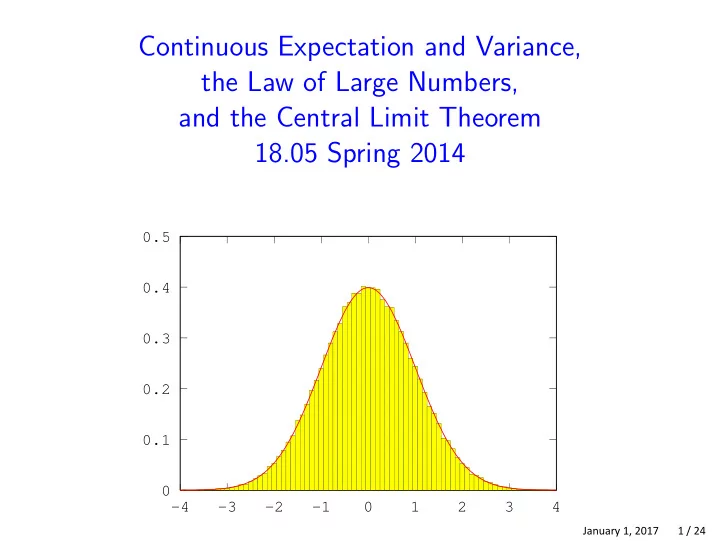
Continuous Expectation and Variance, the Law of Large Numbers, and the Central Limit Theorem 18.05 Spring 2014 0.5 0.4 0.3 0.2 0.1 0 -4 -3 -2 -1 0 1 2 3 4 January 1, 2017 1 / 24 Expected value Expected value: measure of


slide-1
SLIDE 1

Continuous Expectation and Variance, the Law of Large Numbers, and the Central Limit Theorem 18.05 Spring 2014

0.1 0.2 0.3 0.4 0.5

  • 4
  • 3
  • 2
  • 1

1 2 3 4

January 1, 2017 1 / 24

slide-2
SLIDE 2

Expected value Expected value: measure of location, central tendency X continuous with range [a, b] and pdf f (x): b E (X ) = xf (x) dx.

a

X discrete with values x1, . . . , xn and pmf p(xi ):

n

n E (X ) = xi p(xi ).

i=1

View these as essentially the same formulas.

January 1, 2017 2 / 24

slide-3
SLIDE 3

Variance and standard deviation Standard deviation: measure of spread, scale For any random variable X with mean µ Var(X ) = E ((X − µ)2), σ = Var(X ) X continuous with range [a, b] and pdf f (x):

b

Var(X ) = (x − µ)2f (x) dx.

a

X discrete with values x1, . . . , xn and pmf p(xi ):

n

n Var(X ) = (xi − µ)2 p(xi ).

i=1

View these as essentially the same formulas.

January 1, 2017 3 / 24

slide-4
SLIDE 4

Properties Properties: (the same for discrete and continuous)

  • 1. E (X + Y ) = E (X ) + E (Y ).
  • 2. E (aX + b) = aE (X ) + b.
  • 3. If X and Y are independent then

Var(X + Y ) = Var(X ) + Var(Y ).

  • 4. Var(aX + b) = a2Var(X ).
  • 5. Var(X ) = E (X

2) − E (X )2 .

January 1, 2017 4 / 24

slide-5
SLIDE 5

Board question

2

The random variable X has range [0,1] and pdf cx . (a) Find c. (b) Find the mean, variance and standard deviation of X . (c) Find the median value of X . (d) Suppose X1, . . . X16 are independent identically-distributed copies of X . Let X be their

  • average. What is the standard deviation of X ?

(e) Suppose Y = X

4 . Find the pdf of Y .

January 1, 2017 5 / 24

slide-6
SLIDE 6

Quantiles Quantiles give a measure of location.

z φ(z) q0.6 = 0.253 left tail area = prob. = .6 z Φ(z) q0.6 = 0.253 F(q0.6) = 0.6 1

q0.6: left tail area = 0.6 ⇔ F (q0.6) = 0.6

January 1, 2017 6 / 24

slide-7
SLIDE 7

Concept question

Each of the curves is the density for a given random variable. The median of the black plot is always at q. Which density has the greatest median?

  • 1. Black
  • 2. Red
  • 3. Blue
  • 4. All the same 5. Impossible to tell

Curves coincide to here.

q (A) q (B)

January 1, 2017 7 / 24

slide-8
SLIDE 8

Law of Large Numbers (LoLN)

Informally: An average of many measurements is more accurate than a single measurement. Formally: Let X1, X2, . . . be i.i.d. random variables all with mean µ and standard deviation σ. Let n X1 + X2 + . . . + Xn 1

n

X

n =

= Xi . n n i=1 Then for any (small number) a, we have lim P(|X

n − µ| < a) = 1. n→∞

No guarantees but: By choosing n large enough we can make X

n as close as we want to µ with probability close to 1.

January 1, 2017 8 / 24

slide-9
SLIDE 9

Concept Question: Desperation

You have $100. You need $1000 by tomorrow morning. Your only way to get it is to gamble. If you bet $k, you either win $k with probability p or lose $k with probability 1 − p. Maximal strategy: Bet as much as you can, up to what you need, each time. Minimal strategy: Make a small bet, say $5, each time.

  • 1. If p = 0.45, which is the better strategy?

(a) Maximal (b) Minimal (c) They are the same

  • 2. If p = 0.8, which is the better strategy?

(a) Maximal (b) Minimal (c) They are the same

January 1, 2017 9 / 24

slide-10
SLIDE 10

Histograms

Made by ‘binning’ data. Frequency: height of bar over bin = number of data points in bin. Density: area of bar is the fraction of all data points that lie in the

  • bin. So, total area is 1.

x frequency 0.25 0.75 1.25 1.75 2.25 1 2 3 4 x density 0.25 0.75 1.25 1.75 2.25 0.2 0.4 0.6 0.8

Check that the total area of the histogram on the right is 1.

January 1, 2017 10 / 24

slide-11
SLIDE 11

Board question

  • 1. Make both a frequency and density histogram from the data below.

Use bins of width 0.5 starting at 0. The bins should be right closed. 1 1.2 1.3 1.6 1.6 2.1 2.2 2.6 2.7 3.1 3.2 3.4 3.8 3.9 3.9

  • 2. Same question using unequal width bins with edges 0, 1, 3, 4.
  • 3. For question 2, why does the density histogram give a more

reasonable representation of the data.

January 1, 2017 11 / 24

slide-12
SLIDE 12

Solution

Frequency

1 2 3 4 0.0 1.0 2.0 3.0

Density

1 2 3 4 0.0 0.2 0.4

Histograms with equal width bins

Frequency

1 2 3 4 2 4 6 8

Density

1 2 3 4 0.0 0.2 0.4

Histograms with unequal width bins

January 1, 2017 12 / 24

slide-13
SLIDE 13

LoLN and histograms LoLN implies density histogram converges to pdf:

0.1 0.2 0.3 0.4 0.5

  • 4
  • 3
  • 2
  • 1

1 2 3 4

Histogram with bin width 0.1 showing 100000 draws from a standard normal distribution. Standard normal pdf is

  • verlaid in red.

January 1, 2017 13 / 24

slide-14
SLIDE 14

Standardization Random variable X with mean µ and standard deviation σ. X − µ Standardization: Y = . σ Y has mean 0 and standard deviation 1. Standardizing any normal random variable produces the standard normal. If X ≈ normal then standardized X ≈ stand. normal. We use reserve Z to mean a standard normal random variable.

January 1, 2017 14 / 24

slide-15
SLIDE 15

Concept Question: Standard Normal

z −σ σ −2σ 2σ −3σ 3σ Normal PDF within 1 · σ ≈ 68% within 2 · σ ≈ 95% within 3 · σ ≈ 99% 68% 95% 99%

  • 1. P(−1 < Z < 1) is

(a) 0.025 (b) 0.16 (c) 0.68 (d) 0.84 (e) 0.95

  • 2. P(Z > 2)

(a) 0.025 (b) 0.16 (c) 0.68 (d) 0.84 (e) 0.95

January 1, 2017 15 / 24

slide-16
SLIDE 16
  • Central Limit Theorem

Setting: X1, X2, . . . i.i.d. with mean µ and standard dev. σ. For each n: 1 X

n =

(X1 + X2 + . . . + Xn) average n Sn = X1 + X2 + . . . + Xn sum. Conclusion: For large n: σ2 X

n ≈ N µ, n

Sn ≈ N nµ, nσ2 Standardized Sn or X

n ≈ N(0, 1)

Sn − nµ X

n − µ

That is, √ = √ ≈ N(0, 1). nσ σ/ n

January 1, 2017 16 / 24

slide-17
SLIDE 17

CLT: pictures Standardized average of n i.i.d. uniform random variables with n = 1, 2, 4, 12.

0.05 0.1 0.15 0.2 0.25 0.3 0.35 0.4

  • 3
  • 2
  • 1

1 2 3 0.1 0.2 0.3 0.4 0.5

  • 3
  • 2
  • 1

1 2 3 0.05 0.1 0.15 0.2 0.25 0.3 0.35 0.4

  • 3
  • 2
  • 1

1 2 3 0.05 0.1 0.15 0.2 0.25 0.3 0.35 0.4

  • 3
  • 2
  • 1

1 2 3 January 1, 2017 17 / 24

slide-18
SLIDE 18

CLT: pictures 2 The standardized average of n i.i.d. exponential random variables with n = 1, 2, 8, 64.

0.2 0.4 0.6 0.8 1

  • 3
  • 2
  • 1

1 2 3 0.1 0.2 0.3 0.4 0.5 0.6 0.7

  • 3
  • 2
  • 1

1 2 3 0.1 0.2 0.3 0.4 0.5

  • 3
  • 2
  • 1

1 2 3 0.1 0.2 0.3 0.4 0.5

  • 3
  • 2
  • 1

1 2 3 January 1, 2017 18 / 24

slide-19
SLIDE 19

CLT: pictures 3 The standardized average of n i.i.d. Bernoulli(0.5) random variables with n = 1, 2, 12, 64.

0.05 0.1 0.15 0.2 0.25 0.3 0.35 0.4

  • 3
  • 2
  • 1

1 2 3 0.05 0.1 0.15 0.2 0.25 0.3 0.35 0.4

  • 3
  • 2
  • 1

1 2 3 0.05 0.1 0.15 0.2 0.25 0.3 0.35 0.4

  • 3
  • 2
  • 1

1 2 3 0.05 0.1 0.15 0.2 0.25 0.3 0.35 0.4

  • 4
  • 3
  • 2
  • 1

1 2 3 4 January 1, 2017 19 / 24

slide-20
SLIDE 20

CLT: pictures 4 The (non-standardized) average of n Bernoulli(0.5) random variables, with n = 4, 12, 64. (Spikier.)

0.2 0.4 0.6 0.8 1 1.2 1.4

  • 1
  • 0.5

0.5 1 1.5 2 0.5 1 1.5 2 2.5 3

  • 0.2

0.2 0.4 0.6 0.8 1 1.2 1.4 1 2 3 4 5 6 7

  • 0.2

0.2 0.4 0.6 0.8 1 1.2 1.4 January 1, 2017 20 / 24

slide-21
SLIDE 21

Table Question: Sampling from the standard normal distribution

As a table, produce a single random sample from (an approximate) standard normal distribution. The table is allowed nine rolls of the 10-sided die. Note: µ = 5.5 and σ2 = 8.25 for a single 10-sided die. Hint: CLT is about averages.

January 1, 2017 21 / 24

slide-22
SLIDE 22

Board Question: CLT

  • 1. Carefully write the statement of the central limit theorem.
  • 2. To head the newly formed US Dept. of Statistics, suppose that

50% of the population supports Ani, 25% supports Ruthi, and the remaining 25% is split evenly between Efrat, Elan, David and Jerry. A poll asks 400 random people who they support. What is the probability that at least 55% of those polled prefer Ani?

  • 3. What is the probability that less than 20% of those polled prefer

Ruthi?

January 1, 2017 22 / 24

slide-23
SLIDE 23

Bonus problem Not for class. Solution will be posted with the slides. An accountant rounds to the nearest dollar. We’ll assume the error in rounding is uniform on [-0.5, 0.5]. Estimate the probability that the total error in 300 entries is more than $5.

January 1, 2017 23 / 24

slide-24
SLIDE 24

MIT OpenCourseWare https://ocw.mit.edu

18.05 Introduction to Probability and Statistics

Spring 2014 For information about citing these materials or our Terms of Use, visit: https://ocw.mit.edu/terms.