Continuous Expectation and Variance, the Law of Large Numbers, and - - PowerPoint PPT Presentation

continuous expectation and variance the law of large
SMART_READER_LITE
LIVE PREVIEW

Continuous Expectation and Variance, the Law of Large Numbers, and - - PowerPoint PPT Presentation

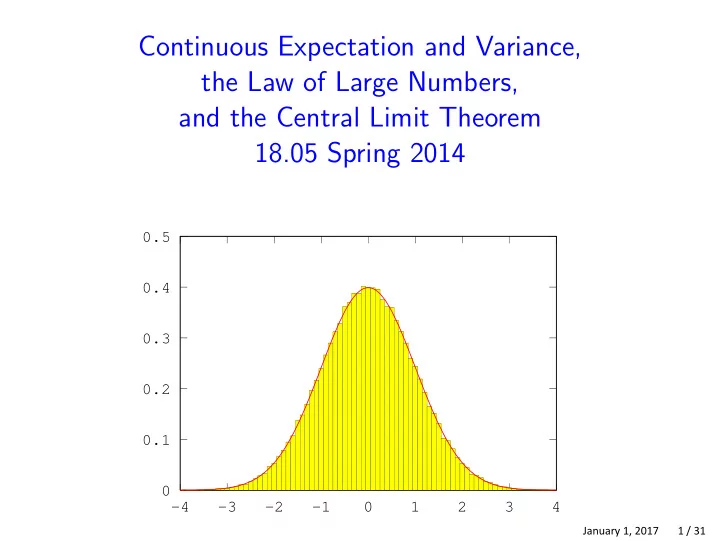
Continuous Expectation and Variance, the Law of Large Numbers, and the Central Limit Theorem 18.05 Spring 2014 0.5 0.4 0.3 0.2 0.1 0 -4 -3 -2 -1 0 1 2 3 4 January 1, 2017 1 / 31 Expected value Expected value: measure of


slide-1
SLIDE 1

Continuous Expectation and Variance, the Law of Large Numbers, and the Central Limit Theorem 18.05 Spring 2014

0.1 0.2 0.3 0.4 0.5

  • 4
  • 3
  • 2
  • 1

1 2 3 4

January 1, 2017 1 / 31

slide-2
SLIDE 2

Expected value Expected value: measure of location, central tendency X continuous with range [a, b] and pdf f (x): b E (X ) = xf (x) dx.

a

X discrete with values x1, . . . , xn and pmf p(xi ):

n

n E (X ) = xi p(xi ).

i=1

View these as essentially the same formulas.

January 1, 2017 2 / 31

slide-3
SLIDE 3

Variance and standard deviation Standard deviation: measure of spread, scale For any random variable X with mean µ Var(X ) = E ((X − µ)2), σ = Var(X ) X continuous with range [a, b] and pdf f (x):

b

Var(X ) = (x − µ)2f (x) dx.

a

X discrete with values x1, . . . , xn and pmf p(xi ):

n

n Var(X ) = (xi − µ)2 p(xi ).

i=1

View these as essentially the same formulas.

  • January 1, 2017 3 / 31
slide-4
SLIDE 4

Properties Properties: (the same for discrete and continuous)

  • 1. E (X + Y ) = E (X ) + E (Y ).
  • 2. E (aX + b) = aE (X ) + b.
  • 3. If X and Y are independent then

Var(X + Y ) = Var(X ) + Var(Y ).

  • 4. Var(aX + b) = a2Var(X ).
  • 5. Var(X ) = E (X

2) − E (X )2 .

January 1, 2017 4 / 31

slide-5
SLIDE 5

Board question

2

The random variable X has range [0,1] and pdf cx . (a) Find c. (b) Find the mean, variance and standard deviation of X . (c) Find the median value of X . (d) Suppose X1, . . . X16 are independent identically-distributed copies of X . Let X be their

  • average. What is the standard deviation of X ?

(e) Suppose Y = X

4 . Find the pdf of Y .

answer: See next slides.

January 1, 2017 5 / 31

slide-6
SLIDE 6
  • Solution

1

(a) Total probability is 1: cx

2 dx = 1 ⇒ c = 3 .

1 (b) µ = 3x3 dx = 3/4. 1

9 3

σ2 = ( (x − 3/4)2 3x2 dx) = 3 − 9 + =

5 8 16 80 .

σ = 3/80 = 1 3/5 ≈ .194

4 x 3

(c) Set F (q0.5) = 0.5, solve for q0.5: F (x) = 3u

2 du = x . Therefore,

F (q0.5) = q3 = .5. We get, q0.5 = (0.5)1/3 .

0.5

(d) Because they are independent Var(X1 + . . . + X16) = Var(X1) + Var(X2) + . . . + Var(X16) = 16Var(X ).

16Var(X ) Var(X )

σX Thus, Var(X ) = = . Finally, σ = = 0.194/4 .

162 16 X

4

  • January 1, 2017 6 / 31
slide-7
SLIDE 7

Solution continued

(e) Method 1 use the cdf:

1 1 3

FY (y) = P(X

4 < y) = P(X < y 4 ) = FX (y 4 ) = y 4 .

3 − 1

4

Now differentiate. fY (y) = F

(y) =

y .

Y

4 Method 2 use the pdf: We have

4

y = x ⇒ dy = 4x

3 dx ⇒

dy = dx

3/4

4y dy 3y2/4 dy 3 This implies fX (x) dx = fX (y

1/4)

= = dy

3/4 3/4 1/4

4y 4y 4y 3 Therefore fY (y) =

1/4

4y

January 1, 2017 7 / 31

slide-8
SLIDE 8

Quantiles Quantiles give a measure of location.

z φ(z) q0.6 = 0.253 left tail area = prob. = .6 z Φ(z) q0.6 = 0.253 F(q0.6) = 0.6 1

q0.6: left tail area = 0.6 ⇔ F (q0.6) = 0.6

January 1, 2017 8 / 31

slide-9
SLIDE 9

Concept question

Each of the curves is the density for a given random variable. The median of the black plot is always at q. Which density has the greatest median?

  • 1. Black
  • 2. Red
  • 3. Blue
  • 4. All the same 5. Impossible to tell

Curves coincide to here.

q (A) q (B)

answer: See next frame.

January 1, 2017 9 / 31

slide-10
SLIDE 10

Solution

Curves coincide to here.

q

Area to the left of the me- dian = 0.5

(A)

Plot A: 4. All three medians are the same. Remember that probability is computed as the area under the curve. By definition the median q is the point where the shaded area in Plot A .5. Since all three curves coincide up to q. That is, the shaded area in the figure is represents a probability of .5 for all three densities. Continued on next slide.

January 1, 2017 10 / 31

slide-11
SLIDE 11

Solution continued

q (B)

Plot B: 2. The red density has the greatest median. Since q is the median for the black density, the shaded area in Plot B is .5. Therefore the area under the blue curve (up to q) is greater than .5 and that under the red curve is less than .5. This means the median of the blue density is to the left of q (you need less area) and the median of the red density is to the right of q (you need more area).

January 1, 2017 11 / 31

slide-12
SLIDE 12

Law of Large Numbers (LoLN)

Informally: An average of many measurements is more accurate than a single measurement. Formally: Let X1, X2, . . . be i.i.d. random variables all with mean µ and standard deviation σ. Let n X1 + X2 + . . . + Xn 1

n

X

n =

= Xi . n n i=1 Then for any (small number) a, we have lim P(|X

n − µ| < a) = 1. n→∞

No guarantees but: By choosing n large enough we can make X

n as close as we want to µ with probability close to 1.

January 1, 2017 12 / 31

slide-13
SLIDE 13

Concept Question: Desperation

You have $100. You need $1000 by tomorrow morning. Your only way to get it is to gamble. If you bet $k, you either win $k with probability p or lose $k with probability 1 − p. Maximal strategy: Bet as much as you can, up to what you need, each time. Minimal strategy: Make a small bet, say $5, each time.

  • 1. If p = 0.45, which is the better strategy?

(a) Maximal (b) Minimal (c) They are the same

  • 2. If p = 0.8, which is the better strategy?

(a) Maximal (b) Minimal (c) They are the same

answer: On next slide

January 1, 2017 13 / 31

slide-14
SLIDE 14

Solution to previous two problems

answer: If p = 0.45 use maximal strategy; If p = 0.8 use minimal strategy. If you use the minimal strategy the law of large numbers says your average winnings per bet will almost certainly be the expected winnings of one bet. The two tables represent p = 0.45 and p = 0.8 respectively. Win

  • 10

10 Win

  • 10

10 p 0.55 0.45 p 0.2 0.8 The expected value of a $5 bet when p = 0.45 is -$0.50 Since on average you will lose $0.50 per bet you want to avoid making a lot of bets. You go for broke and hope to win big a few times in a row. It’s not very likely, but the maximal strategy is your best bet. The expected value when p = 0.8 is $3. Since this is positive you’d like to make a lot of bets and let the law of large numbers (practically) guarantee you will win an average of $6 per bet. So you use the minimal strategy.

January 1, 2017 14 / 31

slide-15
SLIDE 15

Histograms

Made by ‘binning’ data. Frequency: height of bar over bin = number of data points in bin. Density: area of bar is the fraction of all data points that lie in the

  • bin. So, total area is 1.

x frequency 0.25 0.75 1.25 1.75 2.25 1 2 3 4 x density 0.25 0.75 1.25 1.75 2.25 0.2 0.4 0.6 0.8

Check that the total area of the histogram on the right is 1.

January 1, 2017 15 / 31

slide-16
SLIDE 16

Board question

  • 1. Make both a frequency and density histogram from the data below.

Use bins of width 0.5 starting at 0. The bins should be right closed. 1 1.2 1.3 1.6 1.6 2.1 2.2 2.6 2.7 3.1 3.2 3.4 3.8 3.9 3.9

  • 2. Same question using unequal width bins with edges 0, 1, 3, 4.
  • 3. For question 2, why does the density histogram give a more

reasonable representation of the data.

January 1, 2017 16 / 31

slide-17
SLIDE 17

Solution

Frequency

1 2 3 4 0.0 1.0 2.0 3.0

Density

1 2 3 4 0.0 0.2 0.4

Histograms with equal width bins

Frequency

1 2 3 4 2 4 6 8

Density

1 2 3 4 0.0 0.2 0.4

Histograms with unequal width bins

January 1, 2017 17 / 31

slide-18
SLIDE 18

LoLN and histograms LoLN implies density histogram converges to pdf:

0.1 0.2 0.3 0.4 0.5

  • 4
  • 3
  • 2
  • 1

1 2 3 4

Histogram with bin width 0.1 showing 100000 draws from a standard normal distribution. Standard normal pdf is

  • verlaid in red.

January 1, 2017 18 / 31

slide-19
SLIDE 19

Standardization Random variable X with mean µ and standard deviation σ. X − µ Standardization: Y = . σ Y has mean 0 and standard deviation 1. Standardizing any normal random variable produces the standard normal. If X ≈ normal then standardized X ≈ stand. normal. We use reserve Z to mean a standard normal random variable.

January 1, 2017 19 / 31

slide-20
SLIDE 20

Concept Question: Standard Normal

z −σ σ −2σ 2σ −3σ 3σ Normal PDF within 1 · σ ≈ 68% within 2 · σ ≈ 95% within 3 · σ ≈ 99% 68% 95% 99%

  • 1. P(−1 < Z < 1) is

(a) 0.025 (b) 0.16 (c) 0.68 (d) 0.84 (e) 0.95

  • 2. P(Z > 2)

(a) 0.025

answer: 1c, 2a

(b) 0.16 (c) 0.68 (d) 0.84 (e) 0.95

January 1, 2017 20 / 31

slide-21
SLIDE 21
  • Central Limit Theorem

Setting: X1, X2, . . . i.i.d. with mean µ and standard dev. σ. For each n: 1 X

n =

(X1 + X2 + . . . + Xn) average n Sn = X1 + X2 + . . . + Xn sum. Conclusion: For large n: σ2 X

n ≈ N µ, n

Sn ≈ N nµ, nσ2 Standardized Sn or X

n ≈ N(0, 1)

Sn − nµ X

n − µ

That is, √ = √ ≈ N(0, 1). nσ σ/ n

January 1, 2017 21 / 31

slide-22
SLIDE 22

CLT: pictures Standardized average of n i.i.d. uniform random variables with n = 1, 2, 4, 12.

0.05 0.1 0.15 0.2 0.25 0.3 0.35 0.4

  • 3
  • 2
  • 1

1 2 3 0.1 0.2 0.3 0.4 0.5

  • 3
  • 2
  • 1

1 2 3 0.05 0.1 0.15 0.2 0.25 0.3 0.35 0.4

  • 3
  • 2
  • 1

1 2 3 0.05 0.1 0.15 0.2 0.25 0.3 0.35 0.4

  • 3
  • 2
  • 1

1 2 3 January 1, 2017 22 / 31

slide-23
SLIDE 23

CLT: pictures 2 The standardized average of n i.i.d. exponential random variables with n = 1, 2, 8, 64.

0.2 0.4 0.6 0.8 1

  • 3
  • 2
  • 1

1 2 3 0.1 0.2 0.3 0.4 0.5 0.6 0.7

  • 3
  • 2
  • 1

1 2 3 0.1 0.2 0.3 0.4 0.5

  • 3
  • 2
  • 1

1 2 3 0.1 0.2 0.3 0.4 0.5

  • 3
  • 2
  • 1

1 2 3 January 1, 2017 23 / 31

slide-24
SLIDE 24

CLT: pictures 3 The standardized average of n i.i.d. Bernoulli(0.5) random variables with n = 1, 2, 12, 64.

0.05 0.1 0.15 0.2 0.25 0.3 0.35 0.4

  • 3
  • 2
  • 1

1 2 3 0.05 0.1 0.15 0.2 0.25 0.3 0.35 0.4

  • 3
  • 2
  • 1

1 2 3 0.05 0.1 0.15 0.2 0.25 0.3 0.35 0.4

  • 3
  • 2
  • 1

1 2 3 0.05 0.1 0.15 0.2 0.25 0.3 0.35 0.4

  • 4
  • 3
  • 2
  • 1

1 2 3 4 January 1, 2017 24 / 31

slide-25
SLIDE 25

CLT: pictures 4 The (non-standardized) average of n Bernoulli(0.5) random variables, with n = 4, 12, 64. (Spikier.)

0.2 0.4 0.6 0.8 1 1.2 1.4

  • 1
  • 0.5

0.5 1 1.5 2 0.5 1 1.5 2 2.5 3

  • 0.2

0.2 0.4 0.6 0.8 1 1.2 1.4 1 2 3 4 5 6 7

  • 0.2

0.2 0.4 0.6 0.8 1 1.2 1.4 January 1, 2017 25 / 31

slide-26
SLIDE 26

Table Question: Sampling from the standard normal distribution

As a table, produce a single random sample from (an approximate) standard normal distribution. The table is allowed nine rolls of the 10-sided die. Note: µ = 5.5 and σ2 = 8.25 for a single 10-sided die. Hint: CLT is about averages.

answer: The average of 9 rolls is a sample from the average of 9 independent random variables. The CLT says this average is approximately √ normal with µ = 5.5 and σ = 8.25/ 9 = 2.75 If x is the average of 9 rolls then standardizing we get x − 5.5 z = 2.75 is (approximately) a sample from N(0, 1).

January 1, 2017 26 / 31

slide-27
SLIDE 27

Board Question: CLT

  • 1. Carefully write the statement of the central limit theorem.
  • 2. To head the newly formed US Dept. of Statistics, suppose that

50% of the population supports Ani, 25% supports Ruthi, and the remaining 25% is split evenly between Efrat, Elan, David and Jerry. A poll asks 400 random people who they support. What is the probability that at least 55% of those polled prefer Ani?

  • 3. What is the probability that less than 20% of those polled prefer

Ruthi?

answer: On next slide.

January 1, 2017 27 / 31

slide-28
SLIDE 28

Solution

answer: 2. Let A be the fraction polled who support Ani. So A is the average of 400 Bernoulli(0.5) random variables. That is, let Xi = 1 if the ith person polled prefers Ani and 0 if not, so A = average of the Xi . The question asks for the probability A > 0.55. Each Xi has µ = 0.5 and σ2 = 0.25. So, E (A) = 0.5 and σ2 = 0.25/400 or σA = 1/40 = 0.025.

A

Because A is the average of 400 Bernoulli(0.5) variables the CLT says it is approximately normal and standardizing gives A − 0.5 ≈ Z 0.025 So P(A > 0.55) ≈ P(Z > 2) ≈ 0.025 Continued on next slide

January 1, 2017 28 / 31

slide-29
SLIDE 29

Solution continued

  • 3. Let R be the fraction polled who support Ruthi.

The question asks for the probability the R < 0.2. Similar to problem 2, R is the average of 400 Bernoulli(0.25) random

  • variables. So

√ E (R) = 0.25 and σ2 = (0.25)(0.75)/400 = ⇒ σR = 3/80.

R

R − 0.25 So √ ≈ Z . So, 3/80 √ P(R < 0.2) ≈ P(Z < −4/ 3) ≈ 0.0105

January 1, 2017 29 / 31

slide-30
SLIDE 30

Bonus problem Not for class. Solution will be posted with the slides. An accountant rounds to the nearest dollar. We’ll assume the error in rounding is uniform on [-0.5, 0.5]. Estimate the probability that the total error in 300 entries is more than $5.

answer: Let Xj be the error in the jth entry, so, Xj ∼ U(−0.5, 0.5). We have E(Xj ) = 0 and Var(Xj ) = 1/12. The total error S = X1 + . . . + X300 has E (S) = 0, Var(S) = 300/12 = 25, and σS = 5. Standardizing we get, by the CLT, S/5 is approximately standard normal. That is, S/5 ≈ Z . So P(S < −5 or S > 5) ≈ P(Z < −1 or Z > 1) ≈ 0.32 .

January 1, 2017 30 / 31

slide-31
SLIDE 31

MIT OpenCourseWare https://ocw.mit.edu

18.05 Introduction to Probability and Statistics

Spring 2014 For information about citing these materials or our Terms of Use, visit: https://ocw.mit.edu/terms.