The Probabilistic Method Week 6: Expectation, Variance, and Beyond - - PowerPoint PPT Presentation

the probabilistic method
SMART_READER_LITE
LIVE PREVIEW

The Probabilistic Method Week 6: Expectation, Variance, and Beyond - - PowerPoint PPT Presentation

The Probabilistic Method Week 6: Expectation, Variance, and Beyond Joshua Brody CS49/Math59 Fall 2015 Reading Quiz What is the law of large numbers? (A) For any large number, there is always a larger number. (B) As n gets large, the sample


slide-1
SLIDE 1

The Probabilistic Method

Joshua Brody CS49/Math59 Fall 2015
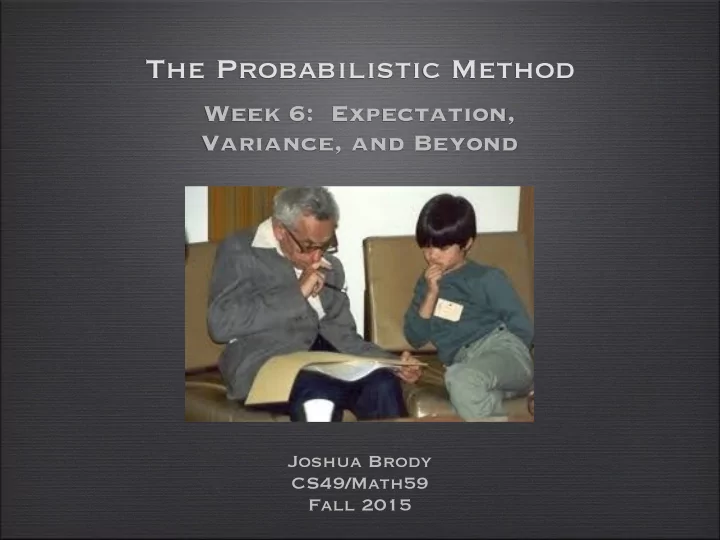
Week 6: Expectation, Variance, and Beyond

slide-2
SLIDE 2

Reading Quiz

(A)For any large number, there is always a larger number. (B) As n gets large, the sample mean of n identically distributed random variables closely approximates the expected value with high probability. (C)As n gets large, the expected value of the sum of n variables approaches the sum of the expected value of n variables. (D)Pr[X ≥α] ≤ E[X]/α (E) None of the above

What is the law of large numbers?

slide-3
SLIDE 3

Reading Quiz

(A)For any large number, there is always a larger number. (B) As n gets large, the sample mean of n identically distributed random variables closely approximates the expected value with high probability. (C)As n gets large, the expected value of the sum of n variables approaches the sum of the expected value of n variables. (D)Pr[X ≥α] ≤ E[X]/α (E) None of the above

What is the law of large numbers?

slide-4
SLIDE 4

Expectation and Variance

  • E[X] = ∑w X(w) P(w)
  • Var[X] := E[(X-E[X])2]

Markov’s Inequality: Pr[X ≥ α] ≤ E[X]/α

slide-5
SLIDE 5

Clicker Question

(A) at most 120k workers (B) at most 88k workers (C) at most 12k workers (D)at most 8333 workers (E) none of the above

There are 300k workers in Delaware County.

  • average income: 40k
  • variance: 100 million (10k)2

How many can make $100k?

slide-6
SLIDE 6

Clicker Question

(A) at most 120k workers (B) at most 88k workers (C) at most 12k workers (D)at most 8333 workers (E) none of the above

There are 300k workers in Delaware County.

  • average income: 40k
  • variance: 100 million (10k)2

How many can make $100k?

slide-7
SLIDE 7

Markov/Chebyshev Inequalities

There are 300k workers in Delaware County.

  • average income: 40k
  • variance: 100 million (10k)2

How many can make $100k?

max % of workers max # of workers Markov ≤ 40% ≤ 120,000 Markov + min wage ≤ 29% ≤ 88,235 Chebyshev ≤ 3% ≤ 8,333

slide-8
SLIDE 8

Clicker Question

(A) at most exp(-cn) (B) at most exp(-c2n) (C) at most exp(-c2) (D)at most exp(-c2n2) (E) none of the above

X1, ..., Xn : fair coins, X = ∑i Xi What is Pr[X ≥ n/2 + c√n]?

slide-9
SLIDE 9

Clicker Question

(A) at most exp(-cn) (B) at most exp(-c2n) (C) at most exp(-c2) (D)at most exp(-c2n2) (E) none of the above

X1, ..., Xn : fair coins, X = ∑i Xi What is Pr[X ≥ n/2 + c√n]?

slide-10
SLIDE 10

Error Reduction in Randomized Algorithms

Given randomized algorithm A:

  • answers YES or NO
  • is input prime number?
  • does graph have a large clique?
  • is this a picture of a cat?
  • runs in T steps
  • answers correctly with

probability 2/3

slide-11
SLIDE 11

Error Reduction in Randomized Algorithms

Given randomized algorithm A:

  • answers YES or NO
  • is input prime number?
  • does graph have a large clique?
  • is this a picture of a cat?
  • runs in T steps
  • answers correctly with

probability 2/3 Problem: Give efficient algorithm A’ that answers correctly with probability > 99%.

slide-12
SLIDE 12

The Probabilistic Method