Circuit Topology & Open & Short circuits Kirchhoffs Laws - - PowerPoint PPT Presentation

circuit topology
SMART_READER_LITE
LIVE PREVIEW

Circuit Topology & Open & Short circuits Kirchhoffs Laws - - PowerPoint PPT Presentation

1/30/20 Class Concepts Understanding circuit topology Identifying nodes, branches & loops in circuits Circuit Topology & Open & Short circuits Kirchhoffs Laws Implied resistance for the branch V across & I


slide-1
SLIDE 1

1/30/20 1

Circuit Topology & Kirchhoff’s Laws

EGR 220, Chapter 2 Jan 30, 2020

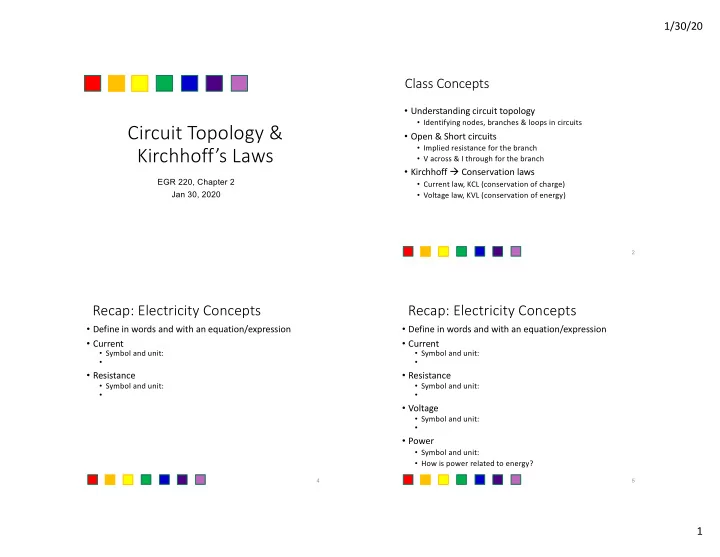
Class Concepts

  • Understanding circuit topology
  • Identifying nodes, branches & loops in circuits
  • Open & Short circuits
  • Implied resistance for the branch
  • V across & I through for the branch
  • Kirchhoff à Conservation laws
  • Current law, KCL (conservation of charge)
  • Voltage law, KVL (conservation of energy)

2

Recap: Electricity Concepts

  • Define in words and with an equation/expression
  • Current
  • Symbol and unit:
  • Resistance
  • Symbol and unit:
  • 4

Recap: Electricity Concepts

  • Define in words and with an equation/expression
  • Current
  • Symbol and unit:
  • Resistance
  • Symbol and unit:
  • Voltage
  • Symbol and unit:
  • Power
  • Symbol and unit:
  • How is power related to energy?

5

slide-2
SLIDE 2

1/30/20 2

Defining a Circuit

  • What elements can be in a circuit?
  • Energy source – independent and dependent
  • Energy dissipating element
  • Energy storage elements
  • A “load”
  • Give examples of each element

6

New Concepts: Open & Short Circuits

Tasks:

  • Draw an example of each type of branch
  • Relate each to Ohm’s Law (V = IR)
  • What are V and I in each example?

Ø(0? <0? >0? ∞?)

7

Open & Short Circuits Find

V & I for

resistors

R1 & R2

8

* Open & Short Circuits *

  • If there is no current, can there be a voltage drop?
  • Examples?
  • If there is no voltage drop, can there be current?
  • Examples?
  • Power Sources
  • What is the difference between a current source and a

voltage source?

9

slide-3
SLIDE 3

1/30/20 3

New Concepts & Laws

  • Node, Branch & Loop
  • Series resistors
  • Series elements; series branches
  • Shared: nodes? current? voltage?
  • Parallel resistors
  • Parallel elements; parallel branches
  • Shared: nodes? current? voltage?
  • KVL: Kirchhoff’s voltage law
  • KCL: Kirchhoff’s current law

10

Discuss: Nodes & Branches

  • A branch represents a single element such as a

voltage source or a resistor.

  • A node is the point of connection between two or

more branches.

11

Identify nodes, branches & loops

12

  • How many of each and where are they?
  • Which elements are in parallel and which are

in series? Identify nodes, branches & loops; series and || elements

13

slide-4
SLIDE 4

1/30/20 4

Nodes, Branches, Loops, Series & Parallel

14

Nodes, Branches, Loops, Series and Parallel

15

Kirchhoff’s Current and Voltage Laws: KVL & KCL

16

Kirchhoff’s Current Law, KCL

  • Current flowing in = current flowing out.
  • Principle of conservation of ____________?
  • The math expression is:

17

slide-5
SLIDE 5

1/30/20 5

Kirchhoff’s Current Law

  • Find i1, i2 and i3
  • Label nodes
  • Write KCL eqn’s
  • Solve
  • We will use Ohm’s law

when there are resistors in the circuit diagram

18 19

Kirchhoff’s Current Law

For EVERY loop: ΣVloop = 0 Kirchhoff’s Voltage Law, KVL

Ø Draw and label an electrical circuit that is consistent with the graph shown below.

Kirchhoff’s Voltage Law, KVL

slide-6
SLIDE 6

1/30/20 6

Kirchhoff’s Voltage Law, KVL

R1 R2

  • The conservation of _________
  • Combine Ohm’s law with KVL to

solve for ________?

+ v2 –

Kirchhoff’s Voltage Law

  • Apply KVL
  • Label voltages
  • Write KVL eqn’s
  • We will solve later with mesh analysis

24

New Terminology

  • Node
  • Branch
  • Loop
  • Series
  • Parallel

25

slide-7
SLIDE 7

1/30/20 7

New Analysis Tools

  • Ohm’s law
  • KVL: Kirchhoff’s voltage law
  • KCL: Kirchhoff’s current law
  • Current divider
  • Voltage divider
  • Equivalent resistance

26

Office & Tutor Hours

  • Office Hours
  • Monday: 10:15 – 11:45
  • Tuesday: 1:30 – 2:30
  • Master Tutor
  • Sunday – Thursday evenings there will always be 3 or so

master tutors in the Playground

  • https://www.smith.edu/qlc/tutoring.html?colEGR=open#PanelEGR
  • Tani Somolu point person for EGR 220

27

Summary

  • New Concepts
  • Kirchhoff’s current and voltage laws
  • Series and parallel combinations
  • Open and short circuits
  • Nodes, branches and loops
  • Labs
  • Pre-lab due before lab
  • One per team for ‘design your own lab’ days
  • Lab memo completed with partner, one memo per team

Questions?