Content Distribution Networks explicit transparent (hijacking - - PowerPoint PPT Presentation

content distribution networks
SMART_READER_LITE
LIVE PREVIEW

Content Distribution Networks explicit transparent (hijacking - - PowerPoint PPT Presentation

Design Space Caching Content Distribution Networks explicit transparent (hijacking connections) Outline Replication Implementation Techniques server farms Hashing Schemes Redirection Strategies geographically


slide-1
SLIDE 1

Spring 2002 CS 461 1

Content Distribution Networks

Outline

Implementation Techniques Hashing Schemes Redirection Strategies

Spring 2002 CS 461 2

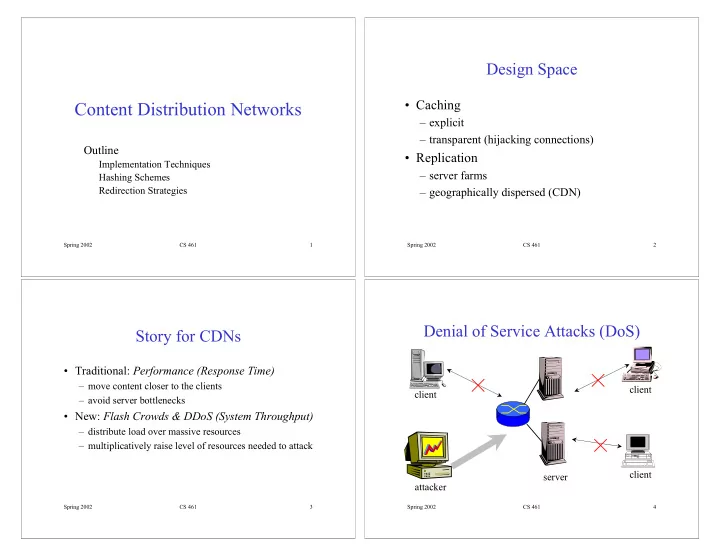
Design Space

  • Caching

– explicit – transparent (hijacking connections)

  • Replication

– server farms – geographically dispersed (CDN)

Spring 2002 CS 461 3

Story for CDNs

  • Traditional: Performance (Response Time)

– move content closer to the clients – avoid server bottlenecks

  • New: Flash Crowds & DDoS (System Throughput)

– distribute load over massive resources – multiplicatively raise level of resources needed to attack

Spring 2002 CS 461 4

Denial of Service Attacks (DoS)

client client client attacker server

slide-2
SLIDE 2

Spring 2002 CS 461 5

Distributed DoS (DDoS)

server client client client attacker slave attacker zombie zombie zombie zombie

Spring 2002 CS 461 6

Redirection Overlay

clients R R R R R R R Internet Backbone Distributed request-redirectors Geographically distributed server clusters R

Spring 2002 CS 461 7

CDN Components

Backen d server s Geogra phically distri bute d surroga te server s Redirect

  • rs

Clients Cache aaa.com bbb.com ccc.com

Spring 2002 CS 461 8

Techniques

  • DNS

– one name maps onto many addresses – works for both servers and reverse proxies

  • HTTP

– requires an extra round trip

  • Router

– one address, select a server (reverse proxy) – content-based routing (near client)

  • URL Rewriting

– embedded links

slide-3
SLIDE 3

Spring 2002 CS 461 9

Redirection: Which Replica?

  • Balance Load
  • Cache Locality
  • Network Delay

Spring 2002 CS 461 10

Hashing Schemes: Modulo

  • Easy to compute
  • Evenly distributed
  • Good for fixed number of

servers

  • Many mapping changes after a

single server change % URL (key)

svr0 svrN

Spring 2002 CS 461 11

Consistent Hashing (CHash)

  • Hash server, then URL
  • Closest match
  • Only local mapping changes

after adding or removing servers

  • Used by State-of-the-art CDNs

Unit circle

svr0 svr1 svr2 svrN url-0 url-1

Spring 2002 CS 461 12

Highest Random Weight (HRW)

  • Hash(url, svrAddr)
  • Deterministic order of access set of

servers

  • Different order for different URLs
  • Load evenly distributed after server

changes

RH

URL

svr0 svr1 svr2 svr svr svrN

sort

weight0 weight1 weight2 weight0 weightN

high low

slide-4
SLIDE 4

Spring 2002 CS 461 13

Redirection Strategies

  • Random (Rand)

– Requests randomly sent to cooperating servers – Baseline case, no pathological behavior

  • Replicated Consistent Hashing (R-CHash)

– Each URL hashed to a fixed # of server replicas – For each request, randomly select one replica

  • Replicated Highest Random Weight (R-HRW)

– Similar to R-CHash, but use HRW hashing – Less likely two URLs have same set of replicas

Spring 2002 CS 461 14

Redirection Strategies (cont)

  • Coarse Dynamic Replication (CDR)

– Using HRW hashing to generate ordered server list – Walk through server list to find a lightly loaded one – # of replicas for each URL dynamically adjusted – Coarse grained server load information

  • Fine Dynamic Replication (FDR)

– Bookkeeping min # of replicas of URL (popularity) – Let more popular URL use more replicas – Keep less popular URL from extra replication

Spring 2002 CS 461 15

Simulation

  • Identifying bottlenecks

– Server overload, network congestion…

  • End-to-end network simulator prototype

– Models network, application, and OS – Built on NS + LARD simulators – 100s of servers, 1000s of clients – >60,000 req/s using full-TCP transport – Measure capacity, latency, and scalability

Spring 2002 CS 461 16

Network Topology

PA CA WA SD CA TX NE CO GA MA MI IL

R

S S

DC

R

S

R

S

R R R

S S S

R R R R R R R R R R R

S S C C C C C C C C C C C C C

S – Server, C – Client, R - Router

slide-5
SLIDE 5

Spring 2002 CS 461 17

Simulation Setup

  • Workload

– Static documents from Web Server trace, available at each cooperative server – Attackers from random places, repeat requesting a subset of random files

  • Simulation process

– Gradually increase offered request load – End when servers very heavily overloaded

Spring 2002 CS 461 18

Capacity: 64 server case

Normal Operation A single server can handle ~600 req/s in simulation

5000 10000 15000 20000 25000 30000 35000

Throughput req/s

Rand R-CHash R-HRW CDR FDR FDR-Ideal

Spring 2002 CS 461 19

Capacity: 64 server case

Under Attack (250 zombies, 10 files, avg 6KB) A single server can handle ~600 req/s in simulation

10000 20000 30000 40000 50000

Throughput req/s

Rand R-CHash R-HRW CDR FDR FDR-Ideal

Spring 2002 CS 461 20

Latency: 64 Servers Under Attack

20 40 60 80 100 0.1 1 10 100 Response Time in Logscale (Seconds) CDF of Response R-HRW R-CHash FDR CDR Rand

Random’s Max: 11.2k req/s R-CHash Max: 19.8k req/s

20 40 60 80 100 0.1 1 10 100 Response Time in Logscale (Seconds) CDF of Response R-HRW R-CHash FDR CDR

slide-6
SLIDE 6

Spring 2002 CS 461 21

Latency At CDR’s Max: 35.1k req/s

20 40 60 80 100 0.1 1 10 100 Response Time in Logscale (Seconds) CDF of Response FDR CDR

Spring 2002 CS 461 22

Capacity Scalability

5000 10000 15000 20000 25000 30000 35000 40000 45000 16 32 48 64 80 96 112 128 Num of Servers Throughput req/s CDR R-HRW Rand

Under Attack (250 zombies, 10 files) Normal Operation

5000 10000 15000 20000 25000 30000 35000 40000 45000 50000 16 32 48 64 80 96 112 128

Num of Servers Throughput req/s

CDR R-HRW Rand Spring 2002 CS 461 23

Various Attacks (32 servers)

1 victim file, 1 KB 10 victim files, avg 6KB

5000 10000 15000 20000 25000 30000 35000 100 200 300 400 500 600 700 800

Num of Zombies (slave attackers) Throughput req/s

Rand R-HRW CDR 5000 10000 15000 20000 25000 30000 100 200 300 400 500 600 700 800

Num of Zombies (slave attackers) Throughput req/s

Rand R-HRW CDR Spring 2002 CS 461 24

Deployment Issues

  • Servers join DDoS protection overlay

– Same story as Akamai – Get protection and performance

  • Clients use DDoS protection service

– Same story as proxy caching – Incrementally deployable – Get faster response and help others