Outline Applications of Random Networks Random Networks - - PowerPoint PPT Presentation

outline
SMART_READER_LITE
LIVE PREVIEW

Outline Applications of Random Networks Random Networks - - PowerPoint PPT Presentation

Applications of Outline Applications of Random Networks Random Networks Applications of Random Networks Analysis of real Analysis of real networks networks How to build revisited How to build revisited Complex Networks, Course 295A,


slide-1
SLIDE 1

Applications of Random Networks Analysis of real networks

How to build revisited Motifs

References Frame 1/17

Applications of Random Networks

Complex Networks, Course 295A, Spring, 2008

  • Prof. Peter Dodds

Department of Mathematics & Statistics University of Vermont

Licensed under the Creative Commons Attribution-NonCommercial-ShareAlike 3.0 License. Applications of Random Networks Analysis of real networks

How to build revisited Motifs

References Frame 2/17

Outline

Analysis of real networks How to build revisited Motifs References

Applications of Random Networks Analysis of real networks

How to build revisited Motifs

References Frame 3/17

More on building random networks

◮ Problem: How much of a real network’s structure is

non-random?

◮ Key elephant in the room: the degree distribution Pk. ◮ First observe departure of Pk from a Poisson

distribution.

◮ Next: measure the departure of a real network with a

degree frequency Nk from a random network with the same degree frequency.

◮ Degree frequency Nk = observed frequency of

degrees for a real network.

◮ What we now need to do: Create an ensemble of

random networks with degree frequency Nk and then compare.

Applications of Random Networks Analysis of real networks

How to build revisited Motifs

References Frame 5/17

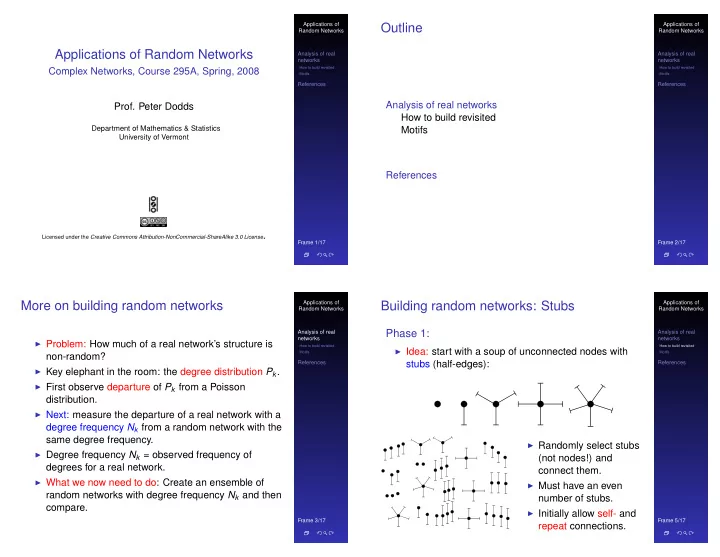
Building random networks: Stubs

Phase 1:

◮ Idea: start with a soup of unconnected nodes with

stubs (half-edges):

◮ Randomly select stubs

(not nodes!) and connect them.

◮ Must have an even

number of stubs.

◮ Initially allow self- and

repeat connections.

slide-2
SLIDE 2

Applications of Random Networks Analysis of real networks

How to build revisited Motifs

References Frame 6/17

Building random networks: First rewiring

Phase 2:

◮ Now find any (A) self-loops and (B) repeat edges and

randomly rewire them. (A) (B)

◮ Being careful: we can’t change the degree of any

node, so we can’t simply move links around.

◮ Simplest solution: randomly rewire two edges at a

time.

Applications of Random Networks Analysis of real networks

How to build revisited Motifs

References Frame 7/17

General random rewiring algorithm

1 1

i3 i4 i2 e

2

e i

◮ ◮ Randomly choose two edges.

(Or choose problem edge and a random edge)

◮ Check to make sure edges

are disjoint.

i3 i4 i2

1

e’

2

i e’

1

◮ Rewire one end of each edge. ◮ Node degrees do not change. ◮ Works if e1 is a self-loop or

repeated loop.

◮ Same as finding on/off/on/off

4-cycles. and rotating them.

Applications of Random Networks Analysis of real networks

How to build revisited Motifs

References Frame 8/17

Sampling random networks

Phase 2:

◮ Use rewiring algorithm to remove all self and repeat

loops.

Phase 3:

◮ Randomize network wiring by applying rewiring

algorithm liberally.

◮ Rule of thumb: # Rewirings ≃ 10 × # edges [1].

Applications of Random Networks Analysis of real networks

How to build revisited Motifs

References Frame 9/17

Random sampling

◮ Problem with only joining up stubs is failure to

randomly sample from all possible networks.

◮ Example from Milo et al. (2003) [1]:

1 configuration 90 configurations (a) (b)

0.5 1 0.5 1

% frequency of occurrence

0.5 1 switching algorithm go with the winners matching algorithm (c)

slide-3
SLIDE 3

Applications of Random Networks Analysis of real networks

How to build revisited Motifs

References Frame 10/17

Sampling random networks

◮ What if we have Pk instead of Nk? ◮ Must now create nodes before start of the

construction algorithm.

◮ Generate N nodes by sampling from degree

distribution Pk.

◮ Easy to do exactly numerically since k is discrete. ◮ Note: not all Pk will always give nodes that can be

wired together.

Applications of Random Networks Analysis of real networks

How to build revisited Motifs

References Frame 12/17

Network motifs

◮ Idea of motifs [2] introduced by Shen-Orr, Alon et al.

in 2002.

◮ Looked at gene expression within full context of

transcriptional regulation networks.

◮ Specific example of Escherichia coli. ◮ Directed network with 577 interactions (edges) and

424 operons (nodes).

◮ Used network randomization to produce ensemble of

alternate networks with same degree frequency Nk.

◮ Looked for certain subnetworks (motifs) that

appeared more or less often than expected

Applications of Random Networks Analysis of real networks

How to build revisited Motifs

References Frame 13/17

Network motifs

feedforward loop

Z X Y

X n Y

crp araC araBAD

a b

a

◮ Z only turns on in response to sustained activity in X. ◮ Turning of X rapidly turns of Z. ◮ Analogy to elevator doors.

Applications of Random Networks Analysis of real networks

How to build revisited Motifs

References Frame 14/17

Network motifs

single input module (SIM)

X n

X Z1 Z2 ... Zn

argR argCBH argD argE argF argI

c d e

◮ Master switch.

slide-4
SLIDE 4

Applications of Random Networks Analysis of real networks

How to build revisited Motifs

References Frame 15/17

Network motifs

dense overlapping regulons (DOR)

Z1 Z2 ... Zm Z3 Z4 X1 X2 ... Xn X3

nhaR fis alkA katG dps

  • smC

nhaA proP ada rpoS

  • xyR

ihf lrp hns rcsA crp ftsQAZ

X1 X2 X3 Xn

e f

Applications of Random Networks Analysis of real networks

How to build revisited Motifs

References Frame 16/17

Network motifs

◮ Note: selection of motifs to test is reasonable but

nevertheless ad-hoc.

◮ For more, see work carried out by Wiggins et al. at

Columbia.

Applications of Random Networks Analysis of real networks

How to build revisited Motifs

References Frame 17/17

References I

  • R. Milo, N. Kashtan, S. Itzkovitz, M. E. J. Newman,

and U. Alon. On the uniform generation of random graphs with prescribed degree sequences, 2003. pdf (⊞)

  • S. S. Shen-Orr, R. Milo, S. Mangan, and U. Alon.

Network motifs in the transcriptional regulation network of Escherichia coli. Nature Genetics, pages 64–68, 2002. pdf (⊞)