Repeating Hyperbolic Pattern Algorithms Special Cases Douglas - - PDF document

repeating hyperbolic pattern algorithms special cases
SMART_READER_LITE
LIVE PREVIEW

Repeating Hyperbolic Pattern Algorithms Special Cases Douglas - - PDF document

Repeating Hyperbolic Pattern Algorithms Special Cases Douglas Dunham Department of Computer Science University of Minnesota, Duluth Duluth, MN 55812-3036, USA E-mail: ddunham@d.umn.edu Web Site: http://www.d.umn.edu/ddunham/ 1 Outline


slide-1
SLIDE 1

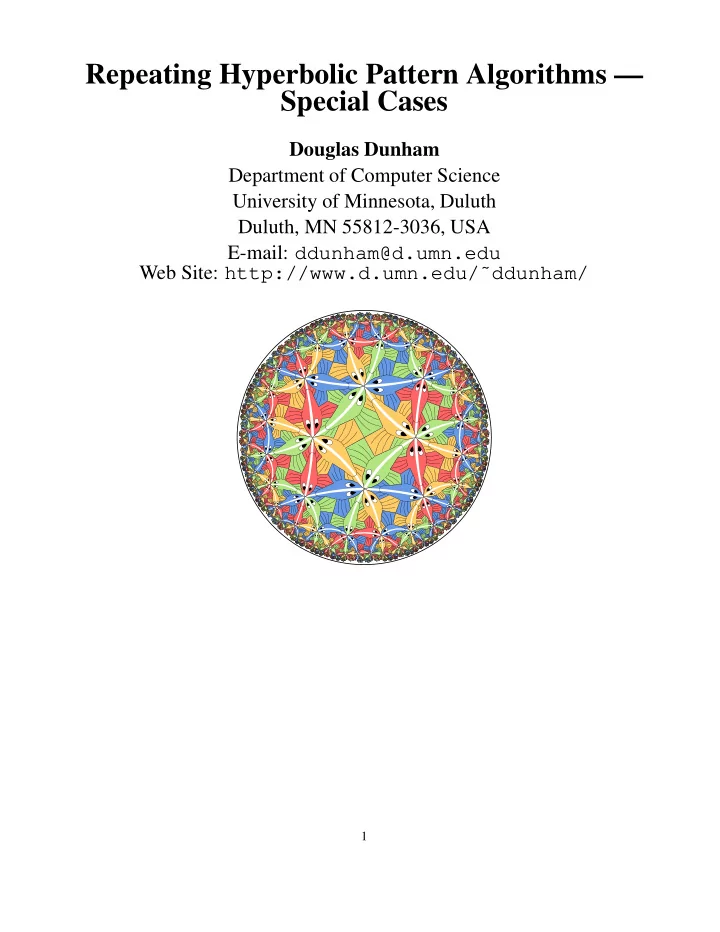
Repeating Hyperbolic Pattern Algorithms — Special Cases

Douglas Dunham Department of Computer Science University of Minnesota, Duluth Duluth, MN 55812-3036, USA E-mail: ddunham@d.umn.edu Web Site: http://www.d.umn.edu/˜ddunham/

1
slide-2
SLIDE 2

Outline

  • 1. History
  • 2. A Repeating hyperbolic pattern algorithm based on reg-

ular tessellations

  • 3. A Repeating hyperbolic pattern algorithm based on non-

regular tessellations

  • 4. Future work

2

slide-3
SLIDE 3
  • 1. History
  • 1. Pre-Escher
  • 2. Escher’s patterns
  • 3. Post-Escher = Dunham, Ferguson, Sazdanovic, etc.

3

slide-4
SLIDE 4

Triangle group (7,3,2) tessellation Originally in Vorlesungen ¨ uber die Theorie der elliptischen Modulfunctionen

  • F. Klein and R. Fricke, 1890.

4

slide-5
SLIDE 5

H.S.M. Coseter’s Figure 7 in Crystal Symmetry and Its Generalizations

  • Trans. Royal Soc. of Canada, 1957.

5

slide-6
SLIDE 6

M.C. Escher’s “Circle Limit” Patterns Circle Limit I

6

slide-7
SLIDE 7

Circle Limit II

7

slide-8
SLIDE 8

Circle Limit III

8

slide-9
SLIDE 9

Circle Limit IV

9

slide-10
SLIDE 10
  • 2. Generation of Repeating Hyperbolic Patterns

Following Escher, we use the Poincar´ e disk model of hyper- bolic geometry.

10

slide-11
SLIDE 11

The Pattern Generation Process

Consists of two steps:

  • 1. Design the basic subpattern or motif — done by a hyper-

bolic drawing program.

  • 2. Transform copies of the motif about the hyperbolic plane:

replication

11

slide-12
SLIDE 12

Repeating Patterns

A repeating pattern is composed of congruent copies of the

  • motif. A motif for Circle Limit I.

12

slide-13
SLIDE 13

The Regular Tessellations {p, q}

  • Escher based his four “Circle Limit” patterns (and many
  • f his Euclidean and spherical patterns) on regular tes-

sellations.

  • The regular tessellation {p, q} is a tiling composed of

regular p-sided polygons, or p-gons meeting q at each vertex.

  • It is necessary that (p − 2)(q − 2) > 4 for the tessel-

lation to be hyperbolic.

  • If (p − 2)(q − 2) = 4 or (p − 2)(q − 2) < 4 the tes-

sellation is Euclidean or spherical respectively.

13

slide-14
SLIDE 14

The Regular Tessellation {6, 4}

14

slide-15
SLIDE 15

A Table of the Regular Tessellations

. . . . . . . . . . . . . . . . . . . . . . . . . . . . . . 11 * * * * * * * * * · · · 10 * * * * * * * * * · · · 9 * * * * * * * * * · · · 8 * * * * * * * * * · · · 7 * * * * * * * * * · · · q 6 * * * * * * * * · · · 5

  • *

* * * * * * * · · · 4

  • *

* * * * * * · · · 3

  • *

* * * * · · · 2 1 1 2 3 4 5 6 7 8 9 10 11 · · · p

  • Euclidean tessella-

tions

  • spherical tessella-

tions *

  • hyperbolic tessella-

tions

15

slide-16
SLIDE 16

Replicating the Pattern

In order to reduce the number of transformations and to simplify the replication process, we form the p-gon pattern from all the copies of the motif touching the center of the bounding circle.

  • Thus to replicate the pattern, we need only apply trans-

formations to the p-gon pattern rather than to each in- dividual motif.

  • Some parts of the p-gon pattern may protrude from the

enclosing p-gon, as long as there are corresponding in- dentations, so that the final pattern will fit together like a jigsaw puzzle.

  • The p-gon pattern is often called the translation unit for

repeating Euclidean patterns.

16

slide-17
SLIDE 17

The p-gon pattern for Circle Limit I

17

slide-18
SLIDE 18

Layers of p-gons

We note that the p-gons of a {p, q} tessellation are ar- ranged in layers as follows:

  • The first layer is just the central p-gon.
  • The k + 1st layer consists of all p-gons sharing and edge
  • r a vertex with a p-gon in the kth layer (and no previous

layers).

  • Theoretically a repeating hyperbolic pattern has an in-

finite number of layers, however if we only replicate a small number of layers, this is usually enough to appear to fill the bounding circle to our Euclidean eyes.

18

slide-19
SLIDE 19

The Regular Tessellation {6, 4} — Revisited

To show the layer structure and exposure of p-gons.

19

slide-20
SLIDE 20

Exposure of a p-gon

We also define the exposure of a p-gon in terms of the num- ber of edges it has in common with the next layer.

  • A p-gon has minimum exposure if it has the fewest edges

in common with the next layer, and thus shares an edge with the previous layer.

  • A p-gon has maximum exposure if it has the most edges

in common with the next layer, and thus only shares a vertex with the previous layer.

  • In the pseudo-code, we abbreviate these values as MAX EXP

and MIN EXP respectively.

20

slide-21
SLIDE 21

The Replication Algorithm

The replication algorithm consists of two parts:

  • 1. A top-level “driver” routine replicate() that draws

the first layer, and calls a second routine, recursiveRep(), to draw the rest of the layers.

  • 2. A routine recursiveRep() that recursively draws the

rest of the desired number of layers. A tiling pattern is determined by how the p-gon pattern is transformed across p-gon edges. These transformations are in the array edgeTran[]

21

slide-22
SLIDE 22

The Top-level Routine replicate()

Replicate ( motif ) { drawPgon ( motif, IDENT ) ; // Draw central p-gon for ( i = 1 to p ) { // Iterate over each vertex qTran = edgeTran[i-1] for ( j = 1 to q-2 ) { // Iterate about a vertex exposure = (j == 1) ? MIN_EXP : MAX_EXP ; recursiveRep ( motif, qTran, 2, exposure ) ; qTran = addToTran ( qTran, -1 ) ; } } }

The function addToTran() is described next.

22

slide-23
SLIDE 23

The Function addToTran()

Transformations contain a matrix, the orientation, and an index, pPosition, of the edge across which the last trans- formation was made (edgeTran[i].pPosition is the edge matched with edge i in the tiling). Here is addToTran() addToTran ( tran, shift ) { if ( shift % p == 0 ) return tran ; else return computeTran ( tran, shift ) ; } where computeTran() is: computeTran ( tran, shift ) { newEdge = (tran.pPosition + tran.orientation * shift) % p ; return tranMult(tran, edgeTran[newEdge]) ; } and where tranMult ( t1, t2 ) multiplies the matri- ces and orientations, sets the pPosition to t2.pPosition, and returns the result.

23

slide-24
SLIDE 24

The Routine recursiveRep()

recursiveRep ( motif, initialTran, layer, exposure ) { drawPgon ( motif, initialTran ) ; // Draw p-gon pattern if ( layer < maxLayers ) { // If any more layers pShift = ( exposure == MIN_EXP ) ? 1 : 0 ; verticesToDo = ( exposure == MIN_EXP ) ? p-3 : p-2 ; for ( i = 1 to verticesToDo ) { // Iterate over vertices pTran = computeTran ( initialTran, pShift ) ; qSkip = ( i == 1 ) ? -1 : 0 ; qTran = addToTran ( pTran, qSkip ) ; pgonsToDo = ( i == 1 ) ? q-3 : q-2 ; for ( j = 1 to pgonsToDo ) { // Iterate about a vertex newExposure = ( i == 1 ) ? MIN_EXP : MAX_EXP ; recursiveRep(motif, qTran, layer+1, newExposure); qTran = addToTran ( qTran, -1 ) ; } pShift = (pShift + 1) % p ; // Advance to next vertex } } }

24

slide-25
SLIDE 25

Special Cases

The algorithm above works for p > 3 and q > 3. If p = 3 or q = 3, the same algorithm works, but with differ- ent values of pShift, verticesToDo, qSkip, etc.

25

slide-26
SLIDE 26

The case p = 3

In replicate() the calculation of exposure in the in- ner loop is the same as the general case. In recursiveRep():

  • pShift = 1 regardless of exposure.
  • verticesToDo = 1 regardless of exposure.
  • qSkip

is -1 for MIN EXP and 0 for MAX EXP.

  • pgonsToDo

is q - 4 for MIN EXP and q - 3 for MAX EXP.

  • newExposure

is the same as the general case. In both replicate() and recursiveRep() at the last iteration of the inner loop, the call to recursiveRep() is replaced by a non-recursive call to drawPgon().

26

slide-27
SLIDE 27

The case q = 3

In replicate(), exposure = MAX EXP in the inner loop regardless of whether it is the first iteration or not. In recursiveRep():

  • pShift is 3 for MIN EXP and 2 for MAX EXP.
  • verticesToDo

is p - 5 for MIN EXP and p - 4 for MAX EXP.

  • qSkip = 0

for all cases.

  • pgonsToDo = 1

for all cases.

  • newExposure

is MIN EXP if i = 1 and MAX EXP if i > 1.

27

slide-28
SLIDE 28

Some New Hyperbolic Patterns

Escher’s Euclidean Notebook Drawing 20, based on the {4, 4} tessellation.

28

slide-29
SLIDE 29

Escher’s Spherical Fish Pattern Based on {4, 3}

29

slide-30
SLIDE 30

A Hyperbolic Fish Pattern Based on {4, 5}

30

slide-31
SLIDE 31

Escher’s Euclidean Notebook Drawing 45, based

  • n the {4, 4} tessellation.

31

slide-32
SLIDE 32

Escher’s Spherical “Heaven and Hell” Based on {4, 3}

32

slide-33
SLIDE 33

A Hyperbolic “Heaven and Hell” Pattern Based

  • n {4, 5}

33

slide-34
SLIDE 34

Escher’s Euclidean Notebook Drawing 70, based

  • n the {6, 3} tessellation.

34

slide-35
SLIDE 35

A Hyperbolic Butterfly Pattern Based on {7, 3}

35

slide-36
SLIDE 36
  • 3. Pattens Based on Non-Regular Polygon

Tessellations

A non-regular p-sided polygon with q1, q2, . . . , qp copies around the respective vertices forms a hyperbolic tessellation pro- vided

p

  • i=1

1 qi < p 2 − 1 (so the interior angle at the ith vertex is 2π/qi). This tessellation is denoted {p; q1, q2, . . . , qp} The pattern drawing algorithm is similar to the case for reg- ular tessellations: a non-recursive “driver”, replicate() calls a recursive routine replicateMotif(). Unfortunately this algorithm draws multiple copies of the motif if p = 3 or if any of the qi = 3. There are only a few duplications near the center, but the number of them grows exponentially in the number of layers.

36

slide-37
SLIDE 37

A {4; 6, 3, 6, 4} Polygon Tessellation

37

slide-38
SLIDE 38

The Top-level “Driver” replicate()

The replication process starts with the following top-level “driver”, which calls the recursive routine replicateMotif() to create the rest of the pattern. replicate ( motif ) { for ( j = 1 to q[1] ) { qTran = edgeTran[1] ; replicateMotif(motif,qTran,2,MAX_EXP); qTran = addToTran ( qTran, -1 ) ; } }

38

slide-39
SLIDE 39

The Recursive Routine replicateMotif()

replicateMotif(motif, inTran, layer, exposure) { drawMotif ( motif, inTran ) ; if ( layer < maxLayers ) { pShift = pShiftArray[exposure] ; verticesToDo = p - verticesToSkipArray[exposure] ; for ( i = 1 to verticesToDo ) { pTran = computeTran(initialTran, pShift) ; first_i = ( i == 1 ) ; qTran = addToTran(pTran, qShiftArray[first_i]) ; if ( pTran.orientation > 0 ) vertex = (pTran.pposition-1) % p ; else vertex = pTran.pposition ; polygonsToDo = q[vertex] - polygonsToSkipArray[first_i] ; for ( j = 1 to polygonsToDo ) { first_j = ( j == 1 ) ; newExpose = exposureArray[first_j] ; replicateMotif(motif, qTran, layer+1, newExpose) ; qTran = addToTran ( qTran, -1 ) ; } pShift = (pShift + 1) % p ; } } }

39

slide-40
SLIDE 40

A “Three Element” Pattern with Different Numbers of Animals Meeting at their Heads

40

slide-41
SLIDE 41

A “Three Element” Pattern with 3 Bats, 5 Lizards, and 4 Fish Meeting at their Heads

41

slide-42
SLIDE 42

A “Three Element” Pattern with 3 Bats, 5 Lizards, and 4 Fish Meeting at their Heads

42

slide-43
SLIDE 43
  • 4. Future Work
  • Fix the non-regular polygon tessellation algorithm so that

it does not make duplicate copies of the motif at some lo- cations.

  • Allow some or all of the vertices of the fundamental poly-

gon to lie on the bounding circle.

  • Automatically generate patterns with color symmetry.

43

slide-44
SLIDE 44

The End

I hope not!

44

slide-45
SLIDE 45

Escher’s Euclidean Notebook Drawing 42, based

  • n the {4, 4} tessellation.

45

slide-46
SLIDE 46

A Hyperbolic Shell Pattern Based on {4, 5}

46