
Craig Chambers 73 CSE 341
A common pattern: map
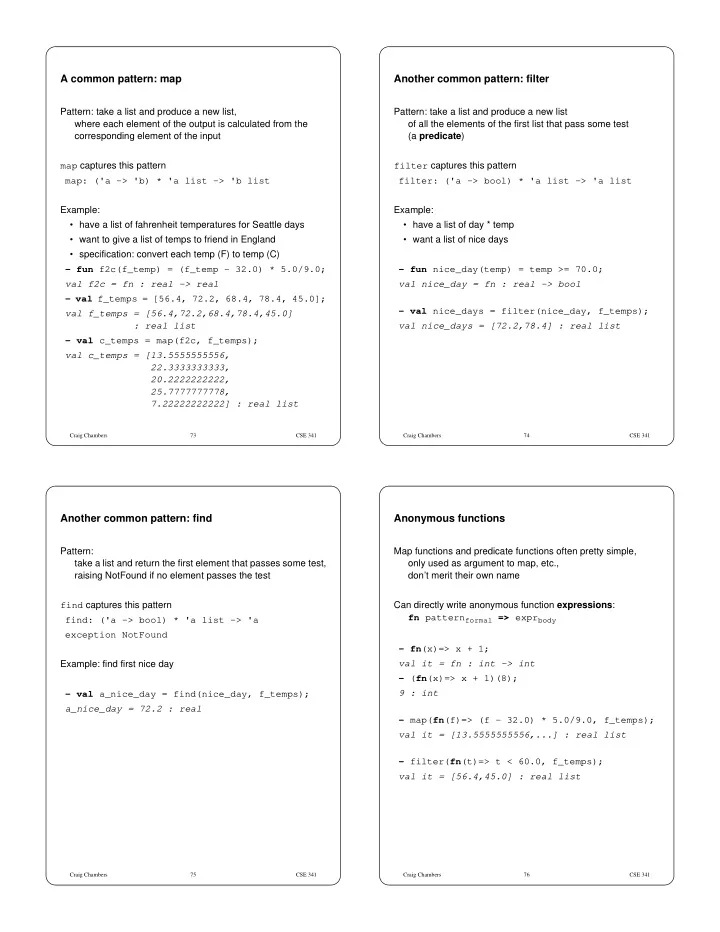
Pattern: take a list and produce a new list, where each element of the output is calculated from the corresponding element of the input map captures this pattern map: ('a -> 'b) * 'a list -> 'b list Example:
- have a list of fahrenheit temperatures for Seattle days
- want to give a list of temps to friend in England
- specification: convert each temp (F) to temp (C)
- fun f2c(f_temp) = (f_temp - 32.0) * 5.0/9.0;
val f2c = fn : real -> real
- val f_temps = [56.4, 72.2, 68.4, 78.4, 45.0];
val f_temps = [56.4,72.2,68.4,78.4,45.0] : real list
- val c_temps = map(f2c, f_temps);
val c_temps = [13.5555555556, 22.3333333333, 20.2222222222, 25.7777777778, 7.22222222222] : real list
Craig Chambers 74 CSE 341
Another common pattern: filter
Pattern: take a list and produce a new list
- f all the elements of the first list that pass some test
(a predicate) filter captures this pattern filter: ('a -> bool) * 'a list -> 'a list Example:
- have a list of day * temp
- want a list of nice days
- fun nice_day(temp) = temp >= 70.0;
val nice_day = fn : real -> bool
- val nice_days = filter(nice_day, f_temps);
val nice_days = [72.2,78.4] : real list
Craig Chambers 75 CSE 341
Another common pattern: find
Pattern: take a list and return the first element that passes some test, raising NotFound if no element passes the test find captures this pattern find: ('a -> bool) * 'a list -> 'a exception NotFound Example: find first nice day
- val a_nice_day = find(nice_day, f_temps);
a_nice_day = 72.2 : real
Craig Chambers 76 CSE 341
Anonymous functions
Map functions and predicate functions often pretty simple,
- nly used as argument to map, etc.,
don’t merit their own name Can directly write anonymous function expressions: fn patternformal => exprbody
- fn(x)=> x + 1;
val it = fn : int -> int
- (fn(x)=> x + 1)(8);
9 : int
- map(fn(f)=> (f - 32.0) * 5.0/9.0, f_temps);
val it = [13.5555555556,...] : real list
- filter(fn(t)=> t < 60.0, f_temps);
val it = [56.4,45.0] : real list