
SLIDE 1
1
Consistency and Replication
COP 6611 Advanced Operating System
Chi Zhang czhang@cs.fiu.edu
2
Consistency and Replication Chi Zhang czhang@cs.fiu.edu Object - - PDF document
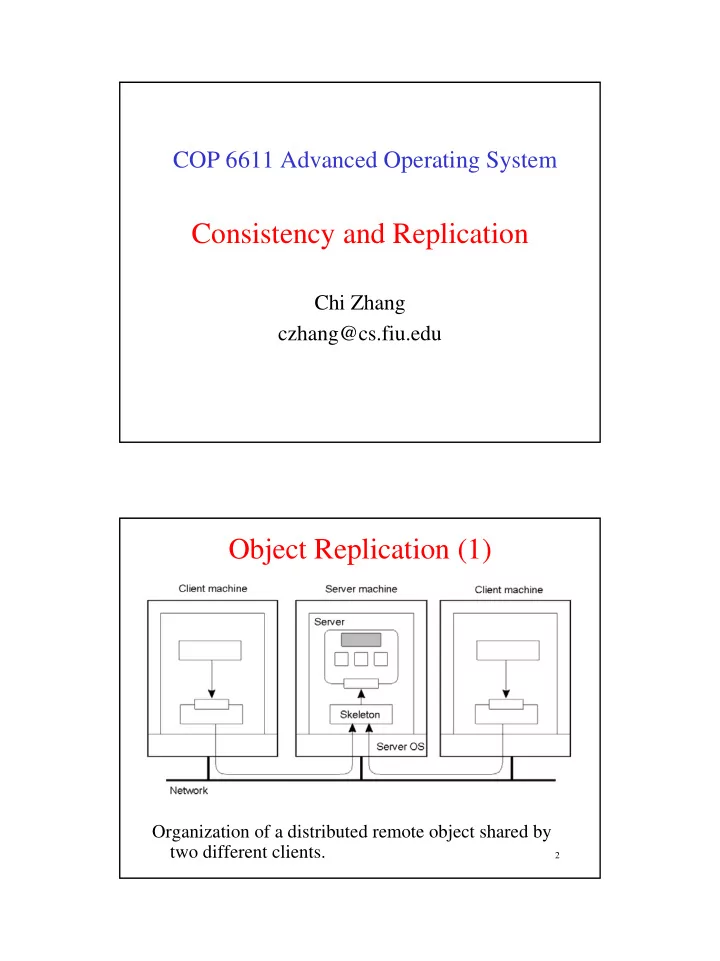
COP 6611 Advanced Operating System Consistency and Replication Chi Zhang czhang@cs.fiu.edu Object Replication (1) Organization of a distributed remote object shared by two different clients. 2 1 Object Replication (2) a) A remote object
2
3
a) A remote object capable of handling concurrent invocations on its own. b) A remote object for which an object adapter is required to handle concurrent invocations
4
5
6
7
8
9
10
11
12
13
14
15
16
17
18
19
20
21
a) Consistency models not using synchronization operations. b) Models with synchronization operations.
Consistency Description Strict Absolute time ordering of all shared accesses matters. Linearizability All processes must see all shared accesses in the same order. Accesses are furthermore ordered according to a (nonunique) global timestamp Sequential All processes see all shared accesses in the same order. Accesses are not ordered in time Causal All processes see causally-related shared accesses in the same order. FIFO All processes see writes from each other in the order they were used. Writes from different processes may not always be seen in that order (a) Consistency Description Weak Shared data can be counted on to be consistent only after a synchronization is done Release Shared data are made consistent when a critical region is exited Entry Shared data pertaining to a critical region are made consistent when a critical region is entered. (b) 22
Totally-ordered Multicast
23
24
25
26
27
28
29
Three examples of the voting algorithm: a) A correct choice of read and write set b) A choice that may lead to write-write conflicts c) A correct choice, known as ROWA (read one, write all) NR + NW > N (no r/w conflicts) ; NW> N/2 (no w/w conflicts). When writing, update the version number on the servers that give
number.
30
31
32
33
34
35
36
37
38
39
40
41