1 Applications ? Trading Consistency for Performance Applications - - PDF document

1
SMART_READER_LITE
LIVE PREVIEW

1 Applications ? Trading Consistency for Performance Applications - - PDF document

Consistency in Replication Consistency in Replication ! Replication comes with consistency cost: Continuous Consistency Continuous Consistency ! Reasons for replication: Better performance and availability and Availability and Availability !


slide-1
SLIDE 1

1

Continuous Consistency Continuous Consistency and Availability and Availability

Haifeng Yu

CPS 212 Fall 2002

2

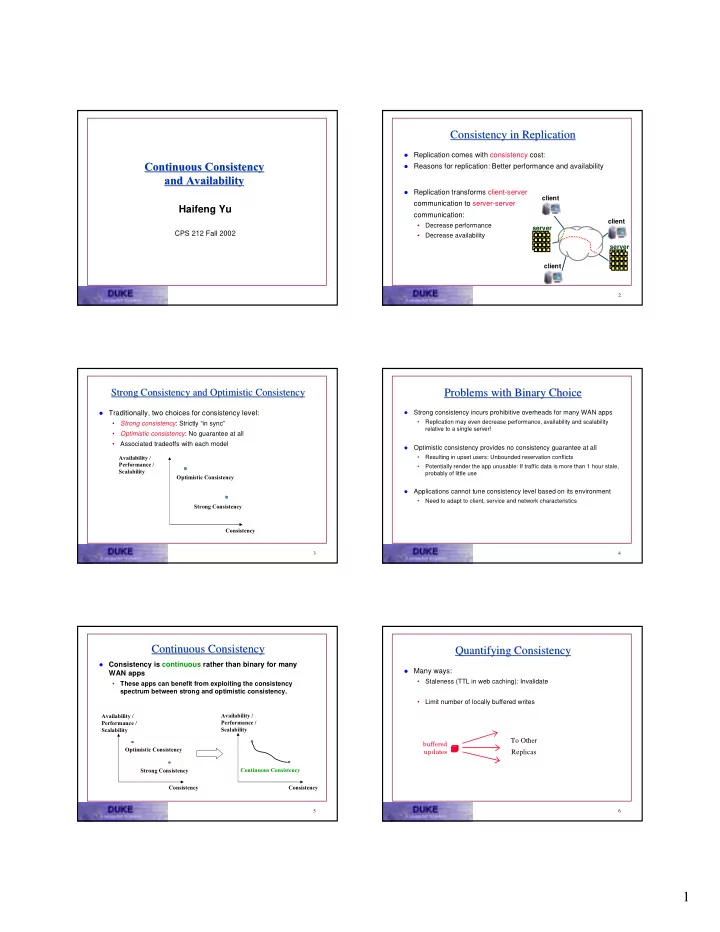
Consistency in Replication Consistency in Replication

! Replication comes with consistency cost: ! Reasons for replication: Better performance and availability

client client client server server server

! Replication transforms client-server

communication to server-server communication:

  • Decrease performance
  • Decrease availability

3

Strong Consistency and Optimistic Consistency Strong Consistency and Optimistic Consistency

! Traditionally, two choices for consistency level:

  • Strong consistency: Strictly “in sync”
  • Optimistic consistency: No guarantee at all
  • Associated tradeoffs with each model

Availability / Performance / Scalability Consistency Optimistic Consistency Strong Consistency

4

Problems with Binary Choice Problems with Binary Choice

!

Strong consistency incurs prohibitive overheads for many WAN apps

  • Replication may even decrease performance, availability and scalability

relative to a single server!

!

Optimistic consistency provides no consistency guarantee at all

  • Resulting in upset users: Unbounded reservation conflicts
  • Potentially render the app unusable: If traffic data is more than 1 hour stale,

probably of little use

!

Applications cannot tune consistency level based on its environment

  • Need to adapt to client, service and network characteristics

5

Continuous Consistency Continuous Consistency

! Consistency is continuous rather than binary for many

WAN apps

  • These apps can benefit from exploiting the consistency

spectrum between strong and optimistic consistency.

Availability / Performance / Scalability Consistency Optimistic Consistency Strong Consistency Consistency Continuous Consistency Availability / Performance / Scalability

6

Quantifying Consistency Quantifying Consistency

! Many ways:

  • Staleness (TTL in web caching): Invalidate
  • Limit number of locally buffered writes

buffered updates

To Other Replicas

slide-2
SLIDE 2

2

7

Applications ? Applications ?

! Applications:

  • Web caching
  • Airline reservation
  • Distributed games
  • Shared editor

! Non-Applications:

  • Some scientific computing problems
  • Banking system
  • Any application that has binary output

! Application’s nature determines whether continuous consistency

is applicable

8

Trading Consistency for Performance Trading Consistency for Performance

! Airline reservation: running at Berkeley, Utah, Duke 10 20 30 40 50 0% 50% 100% Inconsistency Throughput (updates/sec)

Strong Consistency Optimistic Consistency [Yu’02, TOCS]

9

The Cost of Increased Performance The Cost of Increased Performance

! Increased performance comes with a cost

  • Adaptively trade consistency for performance based on client,

network, and service conditions

0% 5% 10% 15% 20% 25% 0% 20% 40% 60% 80% 100% Inconsistency

  • Resv. Conflict Rate

10

Model vs. Protocol Model vs. Protocol

! Continuous consistency model is a spec. ! Protocol is anything that can enforce the spec.

  • Corollary: Strong consistency protocol is a protocol for any model

! Many protocols for a specific model, some are good, others are

not

11

Designing a Continuous Consistency Model Designing a Continuous Consistency Model

! Model is a spec, thus quantifying consistency (in a bad way) is

trivial

! Only applications know its definition of consistency

  • Airline reservation vs. distributed games

! What is a “good” continuous consistency model?

  • Can be used by diverse apps
  • Practical

12

Distributed Consensus and Leader Election Distributed Consensus and Leader Election

! What does “continuous consistency” mean ?

  • Allow at most k decision values
  • Allow at most k leaders

! Helps overcome some impossibilities

  • Unique decision value requires ½ majority
  • K decision values allow any partition with 1/(k + 1) nodes to decide
slide-3
SLIDE 3

3

13

Group Membership Service Group Membership Service

! Def: Keep track of which nodes belong to which group ! Traditionally, group membership only maintain a single group

  • Primary-partition membership services
  • Corresponds to strong consistency

! Recently, partitionable membership services

  • Still active area of research
  • Corresponds to optimistic consistency

! Continuous consistency:

  • Allow at most k groups
  • Again, helps overcome the ½ majority limitation

14

Continuous Consistency Summary Continuous Consistency Summary

! WAN replication needs dynamically tunable consistency ! Tradeoff between consistency and performance ! How to design a continuous consistency model ! Continuous consistency in other context ! Next: Availability 15

What is Availability ? What is Availability ?

! No well-accepted availability metric for Internet services ! “Uptime” metric can be misleading for Internet services

  • Server may be inaccessible because of network partition

! Available: “present or ready for immediate use”

  • From Webster’s Collegiate Dictionary
  • What does “immediate” mean?
  • Time-out

! Availability = (accepted accesses) / (submitted accesses)

  • Implicit time-out in the definition

16

Perform Perform-

  • ability

ability

! User satisfaction is not binary

  • What if a partial result is returned before time-out ?
  • What if the result is sent back after an hour, or a day ?
  • Availability is related to performance

! Performability = reward function (quality and timeliness of

result)

! Determining reward function is hard ! 17

Availability of an Internet Service Availability of an Internet Service

! We use user-observed availability in our study:

Availability = (accepted accesses) / (submitted accesses)

Server client

×

2% [Chandra et.al., USITS’01]

reject due to server failure

×

0.1% [MS press release,Jan’01]

18

Effects of Replication Effects of Replication

! Consistency may force a replica to reject an otherwise

acceptable request

  • Network Failure Rate Replica Rejection Rate

client

×

< 2%

× reject

Replica Replica reject

×

communication to maintain consistency failed > 0.1%

slide-4
SLIDE 4

4

19

Limitations of Strong Consistency Limitations of Strong Consistency

: Replicas : Clients Option 1: accept reads accept reads reject writes reject writes Option 2: accept reads reject reads accept writes reject writes

20

Effects of Continuous Consistency Effects of Continuous Consistency

Option 1: accept reads accept reads reject writes reject writes New Option 1: accept reads accept reads accept first 10 writes accept first 5 writes

allow replica to buffer 5 writes

21

Effects of Continuous Consistency Effects of Continuous Consistency

Option 2: accept reads reject reads accept writes reject writes New Option 2: accept reads accept first few reads accept writes accept first 5 writes

allow replica to buffer 5 writes

22

Consistency Impact is Consistency Impact is Inherent Inherent

Availability Inconsistency Hard Bound

0% Consistency 100% Availability 100% Consistency

! Hard bound always exist ! We always know the to end points, but may not know the exact

shape of the curve

23

Effects of Consistency Protocol Effects of Consistency Protocol

! Achieved availability also depends on protocol

  • Design better protocols
  • Job of system designers

Availability Inconsistency Upper Bound Protocol A Protocol B

24

Availability Optimizations Availability Optimizations

! Technique should not be tied to model ! Focus on two techniques:

  • Retiring replicas
  • Aggressive write propagation
slide-5
SLIDE 5

5

25

Limitations of Strong Consistency Limitations of Strong Consistency

: Replicas : Clients Option 1: accept reads accept reads reject writes reject writes Option 2: accept reads reject reads accept writes reject writes

26

Retiring Replicas Retiring Replicas

! Obviously, such decision may not be optimal unless we have

future knowledge

  • Importance of prediction

! Even with future knowledge, it is hard ! In option 2, all replicas much reach an agreement

  • Leader election
  • We are experiencing partitions
  • One option: Voting
  • What if we don’t have majority?

27

Aggressive Write Propagation Aggressive Write Propagation

! Applicable to continuous consistency ! Continuous consistency gives us “buffers” that can be utilized in

case of network partition

! Keep the buffer empty:

  • Cannot predict the occurrence of network partitions
  • Propagate writes more aggressively
  • Cut down the amount of inconsistency accumulated in times of

good connectivity

28

Effects of Aggressive Propagation Effects of Aggressive Propagation

!

Baseline: Propagate writes only when necessary (lazily)

!

Aggressive: When necessary and every 3 seconds 0.993 0.994 0.995 0.996 0.997 0.998 Inconsistency Availability Avail Upper Bound Aggressive Baseline 8 replicas with measured faultload From [Yu’01, SOSP]

29

More Aggressive Propagation More Aggressive Propagation

! Aggressive write propagation does not work in all cases ! Availability optimizations can incur more communication

  • Best availability achieved when we use a strong consistency

protocol

! Speaks of availability / performance tradeoffs 30

Availability of Other Systems Availability of Other Systems

! Consensus and leader election

  • Blocks without majority

! Group membership

  • Blocks without majority

! Relaxing consistency enables them to make progress

  • Open Question: But will these systems still be useful ?
slide-6
SLIDE 6

6

31

Availability Summary Availability Summary

! Availability definition ! Inherent impact of consistency on availability ! Availability also depends on consistency protocols ! Availability optimizations:

  • Replica retirement
  • Aggressive write propagation

32

Why can we easily approach the upper bound? Why can we easily approach the upper bound?

! Simple protocols in our study can approach the upper bound

closely

  • Remember reaching the upper bound in general needs future

knowledge

! Related to the characteristics of the faultloads we measured and

simulated

  • Most partitions are singleton partitions
  • Most transitions are:

fully-connected → singleton partition → fully-connected

! These characteristics are consistent with

  • Internet hierarchical architecture

33

Dual Effects of Replication Scale on Dual Effects of Replication Scale on Availability Availability

! Consistency may force a replica to reject a request ! Adding more replicas:

  • Network Failure Rate Replica Rejection Rate

! Availability = (1 - Network Failure Rate) * ( 1 - Rejection Rate)

  • Too large or too small replication scale can hurt availability

34

Optimal Replication Scale Optimal Replication Scale

! Optimal replication scale: Adding more replicas can hurt!

  • Increase in “replica rejection rate” outweighs decrease in “network

failure rate”

! Optimal replication scale depends on

  • Consistency level
  • Network failure rate among replicas

0.984 0.986 0.988 0.99 0.992 0.994 0.996 0.998 1

1 2 3 4 5 6 7 Number of Replicas Availability Upper Bound Failure Rate = 1% , Numerical Error = 250 Failure Rate = 1% , Numerical Error = 0 Failure Rate = 5% , Numerical Error = 250 Failure Rate = 5% , Numerical Error = 0