Container-based virtualization: Docker Corso di Sistemi Distribuiti - - PDF document

container based virtualization docker
SMART_READER_LITE
LIVE PREVIEW

Container-based virtualization: Docker Corso di Sistemi Distribuiti - - PDF document

Universit degli Studi di Roma Tor Vergata Dipartimento di Ingegneria Civile e Ingegneria Informatica Container-based virtualization: Docker Corso di Sistemi Distribuiti e Cloud Computing A.A. 2018/19 Valeria Cardellini Case study:


slide-1
SLIDE 1

Container-based virtualization: Docker

Università degli Studi di Roma “Tor Vergata” Dipartimento di Ingegneria Civile e Ingegneria Informatica

Corso di Sistemi Distribuiti e Cloud Computing A.A. 2018/19 Valeria Cardellini

Case study: Docker

  • Lightweight, open and secure container-based

virtualization

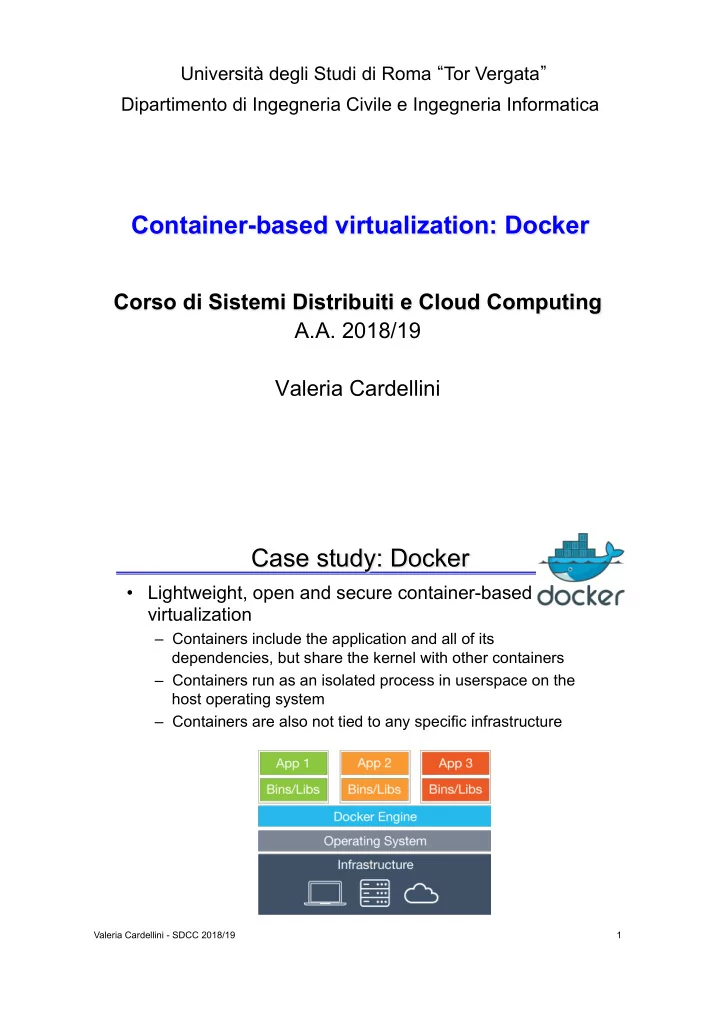
– Containers include the application and all of its dependencies, but share the kernel with other containers – Containers run as an isolated process in userspace on the host operating system – Containers are also not tied to any specific infrastructure

Valeria Cardellini - SDCC 2018/19 1

slide-2
SLIDE 2

Docker internals

  • Docker is written in Go language
  • With respect to other OS-level virtualization solutions,

Docker is a higher-level platform that exploits Linux kernel mechanisms such as cgroups and namespaces

– First versions based on LXC – Then based on its own libcontainer runtime that uses Linux kernel namespaces and cgroups directly – libcontainer (now included in opencontainers/runc): cross- system abstraction layer aimed to support a wide range of isolation technologies

  • Dockers adds to LXC

– Portable deployment across machines – Versioning, i.e., git-like capabilities – Component reuse – Shared libraries, see Docker Hub hub.docker.com

Valeria Cardellini - SDCC 2018/19 2

Docker engine

  • Docker Engine: client-

server application composed by:

– A server, called daemon process – A REST API which specifies interfaces that programs can use to control and interact with the daemon – A command line interface (CLI) client

Valeria Cardellini - SDCC 2018/19 3

See https://docs.docker.com/engine/docker-overview/

slide-3
SLIDE 3

Docker architecture

  • Docker uses a client-server architecture

– The Docker client talks to the Docker daemon, which builds, runs, and distributes Docker containers – Client and daemon communicate via sockets or REST API

Valeria Cardellini - SDCC 2018/19 4

Docker image

  • Read-only template containing instructions for creating a

Docker container

– Described in text file called Dockerfile, with simple, well-defined syntax – The Build component of Docker – Enables the distribution of applications with their runtime environment

  • Incorporates all the dependencies and configuration necessary for

it to run, eliminating the need to install packages and troubleshoot

– Target machine must be Docker-enabled

  • The Docker Image

– Can be pulled and pushed towards a registry – Image names have the form [registry/][user/]name[:tag] – Default for tag is latest

Valeria Cardellini - SDCC 2018/19 5

slide-4
SLIDE 4

Docker image: Dockerfile

  • Images can be created from a Dockerfile and a context:

– Dockerfile: instructions to assemble the image – Context: set of files (e.g., application, libraries) – Often, an image is based on another image (e.g., ubuntu)

  • Example of a Dockerfile

6 Valeria Cardellini - SDCC 2018/19

Docker image: build

  • Build an image from a Dockerfile

$ docker build -t hello-world .

Valeria Cardellini - SDCC 2018/19 7

$ docker run [OPTIONS] PATH | URL | -

slide-5
SLIDE 5

Docker image: layers

  • Layered image

– Each image consists of a series of layers – Docker uses union file systems to combine these layers into a single unified view

  • Layers are stacked on top of each other to form a base for a

container’s root file system

  • Based on the copy-on-write (COW) principle

Valeria Cardellini - SDCC 2018/19 8

Docker image: layers

  • Layering pros
  • Enable layer sharing and reuse, installing common layers only
  • nce and saving bandwidth and storage space
  • Manage dependencies and separate concerns
  • Facilitate software specializations
  • See https://docs.docker.com/storage/storagedriver/

Valeria Cardellini - SDCC 2018/19 9

slide-6
SLIDE 6

Docker image: storage

  • Containers should be stateless. Ideally:

– Very little data is written to the container’s writable layer – Data should be written on Docker volumes – Nevertheless: some workloads require to write data to the container’s writable layer

  • The storage driver controls how images and containers

are stored and managed on the Docker host

  • Multiple choices for the storage driver
  • Including AuFS and OverlayFS (both operate at file level), Device

Mapper, Btrfs and zfs (that operate at block level)

  • Storage driver’s choice can affect the performance of the

containerized applications

  • See https://dockr.ly/2FstUe6

Valeria Cardellini - SDCC 2018/19 10

Docker container and registry

  • Docker container: runnable instance of a Docker

image

– Run, start, stop, move, or delete a container using Docker API

  • r CLI commands

– The Run component of Docker

  • Docker registry: stateless server-side application that

stores and lets you distribute Docker images

  • Provides an open library of images
  • The Distribute component of Docker
  • Docker-hosted registries: Docker Hub, Docker Store (open

source and enterprise verified images)

Valeria Cardellini - SDCC 2018/19 11

  • Docker containers are stateless:

when a container is deleted, any data written that is not stored in a data volume is deleted along with the container

slide-7
SLIDE 7

Docker: run command

  • When you run a container whose image is not yet

installed but is available on Docker Hub

Valeria Cardellini - SDCC 2018/19 12

Courtesy of “Docker in Action” by J. Nickoloff

State transitions of Docker containers

Valeria Cardellini - SDCC 2018/19 13

Courtesy of “Docker in Action” by J. Nickoloff

slide-8
SLIDE 8

Commands: Docker info

  • Obtain detailed info on your Docker installation

$ docker info E.g., to know the used storage driver (e.g., AuFS)

14 Valeria Cardellini - SDCC 2018/19

Commands: image handling

  • List images on host (i.e., local repository)

$ docker images

  • r $ docker image ls
  • To list every image, including intermediate image layers:

$ docker images –a

  • r $ docker image ls –a

– Options to list images by name and tag, to list image digests (sha256), to filter images, to format the output, e.g., $ docker images --filter reference=ubuntu

  • Inspect an image

– Display detailed information, including image layers $ docker [image] inspect imageid

  • Remove an image

$ docker rmi imageid

  • r $ docker image rm imageid

15 Valeria Cardellini - SDCC 2018/19

Can also use imagename instead of imageid

slide-9
SLIDE 9

Command: run

  • Most common options
  • -name assign a name to the container

–d detached mode (in background) –i interactive (keep STDIN open even if not attached)

  • t allocate a pseudo-tty
  • -expose expose a range of ports inside the container
  • p publish a container's port or a range of ports to the host

–v bind and mount a volume –e set environment variables

  • -link add link to other containers
  • The “Hello World” container

$ docker run alpine /bin/echo 'Hello world'

  • Alpine: lightweight Linux distro with reduced image size

16

$ docker run [OPTIONS] IMAGE [COMMAND] [ARGS]

Valeria Cardellini - SDCC 2018/19

Commands: containers management

  • List containers

– Only running containers: $ docker ps

  • Alternatively, $ docker container ls

– All containers (even stopped or killed containers): $ docker ps -a

  • Container lifecycle

– Stop running container $ docker stop containerid – Start stopped container $ docker start containerid – Kill running container $ docker kill containerid – Remove container (need to stop the container before attempting removal) $ docker rm containerid

17

Can also use containername instead of containerid

Valeria Cardellini - SDCC 2018/19

slide-10
SLIDE 10

Commands: containers management

  • Inspect a container

– Most detailed view of the environment in which a container was launched $ docker inspect containerid

  • Copy files from and to docker container

$ docker cp containerid:path localpath $ docker cp localpath containerid:path

18 Valeria Cardellini - SDCC 2018/19

Examples of using Docker

  • Run a nginx Web server inside a container
  • Also bind the container to a specific port

$ docker run –d –p 80:80 --name web nginx

  • Send HTTP request through Web browser
  • First retrieve the hostname of the host machine
  • Send HTTP request through an interactive container using

the Docker internal network

$ docker run -i -t --link web:web --name web_test busybox / # wget -O - http://web:80/ / # exit

  • To not use --link, let us define a bridge network

$ docker network create my_net $ docker run -d –p 80:80 --name web --net=my_net nginx $ docker run –i -t --net=my-net --name web_test busybox /# ...

Valeria Cardellini - SDCC 2018/19 19

  • -link: legacy flag to manually create links between

the containers wget: -O FILE Save to FILE ('-' for stdout)

slide-11
SLIDE 11

Examples of using Docker

  • Sending an HTTP request through an Alpine Linux

container with curl installed and set as entrypoint

$ docker run --rm byrnedo/alpine-curl http://…

  • Checking the logs of the container

$ docker logs containerid_or_name

Valeria Cardellini - SDCC 2018/19 20

Examples of using Docker

  • Running Apache web server with minimal index page

– Define container image with Dockerfile

  • Define image starting from Ubuntu, install and configure Apache
  • Incoming port set to 80 using EXPOSE instruction

Valeria Cardellini - SDCC 2018/19 21

FROM ubuntu # Install dependencies RUN apt-get update RUN apt-get -y install apache2 # Install apache and write hello world message RUN echo 'Hello World!' > /var/www/html/index.html # Configure apache RUN echo '. /etc/apache2/envvars' > /root/run_apache.sh RUN echo 'mkdir -p /var/run/apache2' >> /root/run_apache.sh RUN echo 'mkdir -p /var/lock/apache2' >> /root/run_apache.sh RUN echo '/usr/sbin/apache2 -D FOREGROUND' >> /root/run_apache.sh RUN chmod 755 /root/run_apache.sh EXPOSE 80 CMD /root/run_apache.sh

slide-12
SLIDE 12

Examples of using Docker

– Build container image from Dockerfile $ docker build -t hello-apache . – Run container and bind $ docker run -d -p 80:80 hello-apache

  • Option –p: publish container port (80) to host port (80)

Valeria Cardellini - SDCC 2018/19 22

Examples of using Docker

23 Valeria Cardellini - SDCC 2018/19

$ docker ps CONTAINER ID IMAGE COMMAND CREATED STATUS PORTS NAMES 2b2b39d05fe0 hello_world "/bin/sh -c /root/ru…" 3 seconds ago Up 2 seconds 0.0.0.0:80->80/tcp pedantic_austin

  • Stopping and removing a container

$ docker ps $ docker stop containerid_or_name $ docker ps -a $ docker rm containerid_or_name

  • Stopping and removing all container

$ docker stop $(docker ps -a –q) $ docker rm $(docker ps -a –q)

slide-13
SLIDE 13

Examples of using Docker

24 Valeria Cardellini - SDCC 2018/19

  • Running a Python web app in Docker

– See https://docs.docker.com/get-started/part2/ – Define container image with Dockerfile

  • Define image with Python runtime and Python app
  • Incoming port set to 80 using EXPOSE instruction

– Write app code in Python using Flask and Redis packages and create file requirements.txt to specify those packages needed by app

  • Redis: in-memory data store
  • Redis is used to keep the counter of the number of visits to web app

– Build container image $ docker build -t friendlyhello . – Run container and bind $ docker run -d -p 4000:80 friendlyhello

  • Option –p: publish container port (80) to host port (4000)

Multi-container Docker applications

  • How to run multi-container Docker apps?
  • Docker Compose

– Deployment on single host

  • Docker Swarm

– The native orchestration tool for Docker – Deployment on multiple hosts

  • Kubernetes

Valeria Cardellini - SDCC 2018/19 25

slide-14
SLIDE 14

Docker Compose

  • To coordinate the execution of multiple containers,

we can use Docker Compose

– See https://docs.docker.com/compose/

  • Docker Compose

– Not bundled within Docker installation (on Linux) – Can be installed following the official Docker documentation https://docs.docker.com/compose/install/

  • Allows to easily express the containers to be

instantiated at once, and the relations among them

  • Runs the composition on a single machine (i.e.,

single Docker engine)

  • Use Docker Swarm to deploy containers on multiple

nodes

26 Valeria Cardellini - SDCC 2018/19

Docker Compose

  • We specify how to compose containers in a easy-to-

read file, by default named docker-compose.yml

  • To start the Docker composition (background -d):
  • To stop the Docker composition:
  • By default, Docker Compose looks for the docker-

compose.yml file in the current working directory

– Change file using -f flag

27

$ docker-compose up -d $ docker-compose down

Valeria Cardellini - SDCC 2018/19

slide-15
SLIDE 15

Docker Compose

  • Different versions of the Docker compose file format

– Latest: version 3 is supported from Docker Compose 1.13

28

Docker compose file format: https://docs.docker.com/compose/compose-file/

Valeria Cardellini - SDCC 2018/19

Docker Compose: example

  • Simple Python web app running on Docker Compose

– Two containers: Python web app and Redis – Use Flask framework and maintain a hit counter in Redis – See https://docs.docker.com/compose/gettingstarted/

  • Steps:

– Write Python app – Define Python container image with Dockerfile – Define services in docker-compose.yml file

  • Two services: web (image defined by Dockerfile) and redis

(image pulled from Docker Hub)

– Build and run your app with Compose $ docker-compose up –d – Send HTTP requests using curl (now counter is increased) – Stop Compose $ docker-compose down

Valeria Cardellini - SDCC 2018/19 29

slide-16
SLIDE 16

Docker: Swarm mode

  • Docker includes the swarm mode for natively

managing a cluster of Docker Engines, which is called swarm

– See https://docs.docker.com/engine/swarm/

  • Task: running container part of a swarm service
  • Basic features of swarm mode:

– Scaling: allows to declare the number of tasks for each service – State reconciliation: Swarm monitors the cluster state and reconciles any differences w.r.t. the expressed desired state – Multi-host networking: allows to specify an overlay network among services – Load balancing: allows to expose the ports for services to an external load balancer. Internally, the swarm lets you specify how to distribute service containers among nodes

30 Valeria Cardellini - SDCC 2018/19

Docker: Swarm mode

  • A swarm consists of multiple Docker hosts which run in swarm

mode

  • Node: an instance of the Docker engine

– Manager node dispatches tasks to worker nodes – Worker nodes receive and execute tasks

  • Load balancing

– The swarm manager can automatically assign the service a (configurable) PublishedPort – External components can access the service on the PublishedPort. All nodes in the swarm route ingress connections to a running task

31 Valeria Cardellini - SDCC 2018/19

slide-17
SLIDE 17

Commands: Swarm cluster

  • Create a swarm: manager node
  • Create a swarm: worker node
  • Inspect status

32 Valeria Cardellini - SDCC 2018/19

$ docker swarm init --advertise-addr <MANAGER-IP> Swarm initialized: current node (<nodeid>) is now a manager. To add a worker to this swarm, run the following command: docker swarm join --token <token> <manager-ip>:port $ docker swarm join --token <token> <manager-ip>:port $ docker info $ docker node ls

ID HOSTNAME STATUS AVAILABILITY MANAGER STATUS <nodeid> * controller Ready Active Leader <nodeid> storage Ready Active

Commands: Swarm cluster

  • Leave the swarm

If the node is a manager node, you will receive a warning about maintaining the quorum. To override the warning, pass the --force flag

  • After a node leaves the swarm, you can run docker node

rm command on a manager node to remove the node from the node list

33 Valeria Cardellini - SDCC 2018/19

$ docker swarm leave $ docker node rm node-id

slide-18
SLIDE 18

Commands: manage services

  • Deploy a service to the swarm (from the manager node)
  • List running services

34 Valeria Cardellini - SDCC 2018/19

$ docker service create -d --replicas 1 \

  • -name helloworld alpine ping docker.com

$ docker service ls

ID NAME MODE REPLICAS IMAGE PORTS <serviceid> helloworld replicated 1/1 alpine:latest

Commands: manage services

  • Inspect the service
  • Inspect the container

35 Valeria Cardellini - SDCC 2018/19

$ docker ps <cont.id1>

# Manager node CONTAINER ID IMAGE COMMAND CREATED STATUS ... NAMES <cont.id1> alpine:latest "ping docker.com" 2 min ago Up 2 min helloworld.1.iuk1sj… # Worker node CONTAINER ID IMAGE COMMAND CREATED STATUS ... NAMES <cont.id2> alpine:latest "ping docker.com" 2 min ago Up 2 min helloworld.2.skfos4…

$ docker service inspect --pretty <SERVICE-ID> $ docker service ps <SERVICE-ID>

ID NAME IMAGE NODE DESIRED ST CURRENT ST ERROR PORTS <cont.id1> helloworld.1 alpine:latest controller Running Running … <cont.id2> helloworld.2 alpine:latest storage Running Running …

slide-19
SLIDE 19

Commands: manage services

  • Scale the service

The swarm manager will automatically enact the updates

  • Apply rolling updates to a service
  • Roll back an update
  • Remove a service

36 Valeria Cardellini - SDCC 2018/19

$ docker service update --image redis:3.0.7 redis $ docker service update --replicas 2 helloworld

$ docker service rm <SERVICE-ID>

$ docker service rollback [OPTIONS] <SERVICE-ID>

$ docker service scale <SERVICE-ID>=<NUMBER-OF-TASKS>

Docker Swarm: example

  • Let’s use Docker Swarm to scale Python web app on the same

host and load balance the traffic among the container replicas – See https://docs.docker.com/get-started/part3/

  • Steps:

– Define services in docker-compose.yml file

  • Only one service called web
  • Set replication degree to 5
  • Set resource limits to be used by each single replica
  • Set restart policy to on-failure so that a failed container is

automatically restarted

  • Docker supports 4 restart policies

» no » on-failure » unless-stopped » always

  • Instruct web’s containers to share port 80 via a load-balanced

network called webnet

  • Define webnet network (load-balanced overlay network)

Valeria Cardellini - SDCC 2018/19 37

slide-20
SLIDE 20

Docker Swarm: example

– Start the swarm $ docker swarm init – Deploy the stack

$ docker stack deploy -c docker-compose.yml getstartedlab

– Send multiple requests to Python web app and see how they are served by different replicas chosen in a round-robin fashion – Take down the app and the swarm $ docker stack rm getstartedlab $ docker swarm leave --force

38 Valeria Cardellini - SDCC 2018/19