Connectivity of the Olfactory System CB 1 Plasticity Squire et al., - - PDF document

connectivity of the olfactory system cb 1 plasticity
SMART_READER_LITE
LIVE PREVIEW

Connectivity of the Olfactory System CB 1 Plasticity Squire et al., - - PDF document

4/1/2014 Nature Neuroscience The Endocannabinoid System Founded in May 1998, as subset of the journal Controls Food Intake via Olfactory Nature Processes Impact factor: 15. 251 Edgar Soria-Gmez, Luigi Bellocchio, Leire Reguero,


slide-1
SLIDE 1

4/1/2014 1

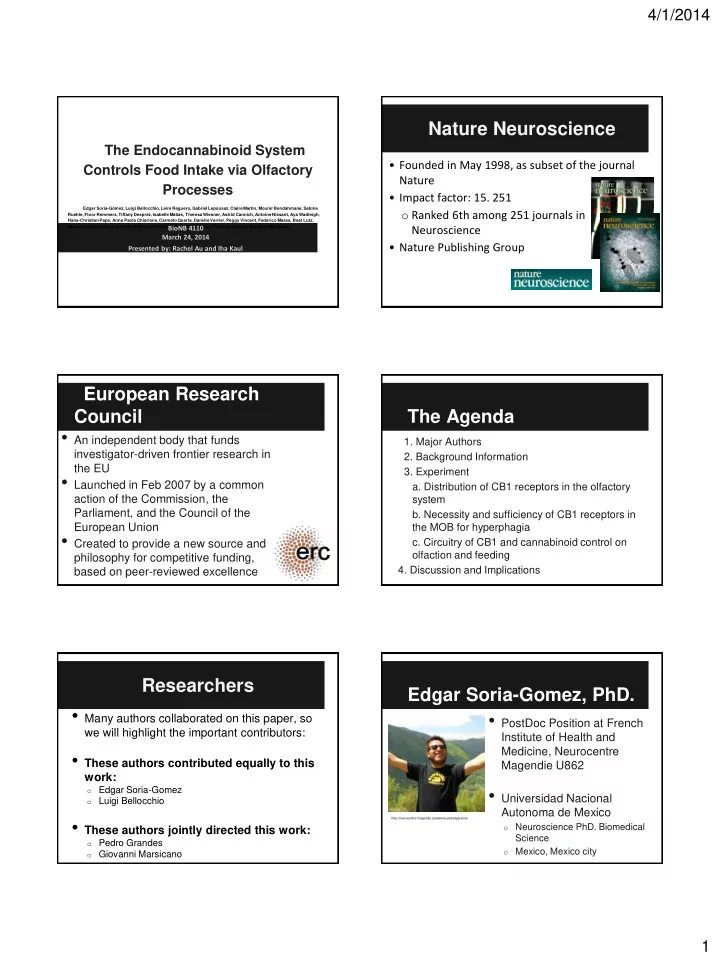
The Endocannabinoid System Controls Food Intake via Olfactory Processes

Edgar Soria-Gómez, Luigi Bellocchio, Leire Reguero, Gabriel Lepousez, Claire Martin, Mounir Bendahmane, Sabine Ruehle, Floor Remmers, Tiffany Desprez, Isabelle Matias, Theresa Wiesner, Astrid Cannich, Antoine Nissant, Aya Wadleigh, Hans-Christian Pape, Anna Paola Chiarlone, Carmelo Quarta, Daniéle Verrier, Peggy Vincent, Federico Massa, Beat Lutz, Manuel Guzmán, Hirac Gurden, Guillaume Ferreira, Pierre-Marie Lledo, Pedro Grandes & Giovanni Marsicano

BioNB 4110 March 24, 2014 Presented by: Rachel Au and Iha Kaul

Nature Neuroscience

  • Founded in May 1998, as subset of the journal

Nature

  • Impact factor: 15. 251
  • Ranked 6th among 251 journals in

Neuroscience

  • Nature Publishing Group

European Research Council

  • An independent body that funds

investigator-driven frontier research in the EU

  • Launched in Feb 2007 by a common

action of the Commission, the Parliament, and the Council of the European Union

  • Created to provide a new source and

philosophy for competitive funding, based on peer-reviewed excellence

The Agenda

  • 1. Major Authors
  • 2. Background Information
  • 3. Experiment
  • a. Distribution of CB1 receptors in the olfactory

system

  • b. Necessity and sufficiency of CB1 receptors in

the MOB for hyperphagia

  • c. Circuitry of CB1 and cannabinoid control on
  • lfaction and feeding
  • 4. Discussion and Implications

Researchers

  • Many authors collaborated on this paper, so

we will highlight the important contributors:

  • These authors contributed equally to this

work:

  • Edgar Soria-Gomez
  • Luigi Bellocchio
  • These authors jointly directed this work:
  • Pedro Grandes
  • Giovanni Marsicano

Edgar Soria-Gomez, PhD.

  • PostDoc Position at French

Institute of Health and Medicine, Neurocentre Magendie U862

  • Universidad Nacional

Autonoma de Mexico

  • Neuroscience PhD. Biomedical

Science

  • Mexico, Mexico city

http://neurocentre-magendie.academia.edu/edgarsoria

slide-2
SLIDE 2

4/1/2014 2

Luigi Bellocchio, PhD.

  • PostDoc in Cannabinoid

signaling group, Department of Biochemistry and Molecular Biology at Complutense University, Madrid, Spain

  • Magendie Institute, Bordeaux
  • Neuroscience PhD.
  • Thesis work on role of

endocannabinoid system in food intake under Dr. Giovanni Marsicano

http://www.bbm1.ucm.es/cannabis/manuelguzmanequipo_e n.htm

Pedro Grandes, PhD.

  • Professor of

Anatomy and Human Embryology in the Department of Neurosciences at the UPV/EHU (University

  • f the Basque

Country)

  • Leioa, Spain

http://www.actualidaduniversitaria.com/2011/12/un-estudio-demuestra-que-la- modulacio%CC%81n-del-sistema-endocannabinoide-puede-ser-efectiva-contra-el- estre%CC%81s/

Giovanni Marsicano, PhD.

  • University of Bordeaux,

Neurocentre Magendie U862, Bordeaux, France

  • PhD, PostDoc at Max-

Planck Institute Munich

  • CR1 level at the

Neurocentre Magendie

http://www.neurocentre- magendie.fr/NCM_Pages/Equipes/UK_acc_eq_perso_dynamic.php?team= Marsicano

Overview of the Study

  • Hunger triggers a set of mechanisms that encourage

feeding, one of which includes increasing sensory perceptions such as sense of smell.

  • CB1 cannabinoid receptors control a circuit that connects the
  • lfactory bulb to the olfactory cortex.
  • Hunger triggers CB1 receptors to activate the olfactory

circuit making it more responsive.

  • ⇒ Increased sensitivity to smell during hunger explains food

intake and attraction to food.

Key Terms

  • glutamatergic CB1 receptors - CB1 receptors that are

found on neurons that release glutamate

  • CB1 receptors - type-1 cannabinoid receptors that are

inhibitory on glutamatergic neurons

  • centrifugal glutamatergic neurons/projections - project

from the brain/cortex outwards

  • NMDA receptors - excitatory receptors that induce

glutamate release on glutamatergic neurons

  • hyperphagia - excessive hunger or increased appetite
  • hypophagia - reduction in feeding
  • THC - tetrahydrocannabinol, an exogenous

cannabinoid that is often found in marijuana

Components of the Olfactory System

http://images.flatworldknowledge.com/stangor/stangor- fig04_020.jpg

slide-3
SLIDE 3

4/1/2014 3

Connectivity of the Olfactory System

Squire et al., 2013; Holy, 2010

CB1 Plasticity

Kauer and Malenka, 2007

Past Research

  • the endocannabinoid system is an important component of the

central regulation of energy balance, and cannabinoid intoxication increases food intake (DiPatrizio & Piomelli, 2012; Pagotto et al., 2006)

  • the use of CB1 receptor KO from cortical glutamatergic neurons in

the telencephalon revealed that (endo)cannabinoid-dependent control of excitatory neurotransmission from cortical glutamatergic neurons is necessary to promote fasting-induced food intake (Bellocchio et al., 2010)

  • cannabinoid drugs alter sensory perception, including olfaction

(Tart, 1970; Wang et al., 2012), suggesting a potential link between these two effects of brain (endo)cannabinoid signalling

Purpose

To determine the mechanisms in which hunger arouses sensory perceptions, particularly

  • lfaction, and induces increased food intake.

Hypothesis

Cannabinoid activation of glutamatergic type-1 cannabinoid (CB1) receptors control excitatory neurotransmission from centrifugal feedback projections of cortical glutamatergic neurons to the olfactory bulb to determine the efficiency of olfactory processes and food intake in fasted mice.

Test Subjects

  • Wild-type C57BL/6N mice were used, dark brown mice that are

genetically identical, were used

  • All experiments involving mutant mice were littermates, except in

experiments depicted in Figure 4b, where mice were originated from independent breedings

  • male mice, aged 2-5 months, were maintained under standard

conditions with food and water ad libitum

slide-4
SLIDE 4

4/1/2014 4

CB1 receptor expression in glutamatergic projections to the MOB

Figure 1. a-f: CB1 receptor is expressed in centrifugal glutamatergic projections to the MOB

CB1 receptor expression in glutamatergic projections to the MOB

Figure 1. j,k: CB1 receptor is expressed in centrifugal glutamatergic projections to the MOB

CB1 in the MOB is necessary for hyperphagia after fasting

Figure 2. a-c: Endocannabinoid signalling in the MOB is activated by fasting and promotes food intake by dampening glutamatergic transmission

CB1 in the MOB is necessary for hyperphagia after fasting

Figure 2. d: Endocannabinoid signalling in the MOB is activated by fasting and promotes food intake by dampening glutamatergic transmission

CB1 in the MOB is sufficient for hyperphagia after fasting

Figure 3: CB1 receptors on GCL-projecting feedback glutamatergic cortical neurons are necessary for fasting-induced hyperphagie

CB1 in the MOB is sufficient for hyperphagia after fasting

Figure 4. a,b: CB1 receptors on GCL-projecting feedback glutamatergic cortical neurons are sufficient for fasting-induced hyperphagia

slide-5
SLIDE 5

4/1/2014 5

CB1 in the MOB is sufficient for hyperphagia after fasting

Figure 4. c,d: CB1 receptors on GCL-projecting feedback glutamatergic cortical neurons are sufficient for fasting-induced hyperphagia

CB1 controls feeding via olfactory corticofugal circuits

Figure 5. a,b: Centrifugal glutamatergic transmission in the MOB mediates fasting-induced food intake and the hyperphagic effect of THC in C57BL/6N mice

CB1 controls feeding via olfactory corticofugal circuits

Figure 5. c: Centrifugal glutamatergic transmission in the MOB mediates fasting-induced food intake and the hyperphagic effect of THC in C57BL/6N mice

CB1 controls feeding via olfactory corticofugal circuits

Figure 5. d,e: Centrifugal glutamatergic transmission in the MOB mediates fasting-induced food intake and the hyperphagic effect of THC in C57BL/6N mice

CB1 signalling in the MOB couples

  • lfaction to feeding

Figure 6: CB1 receptor activation decreases olfactory habituation in fasted mice

CB1 signalling in the MOB couples

  • lfaction to feeding

Figure 7. a,b,g,h: CB1 receptor signalling in the MOB enhances

  • lfactory

detection in fasted mice and proportionally promotes food intake. Exploration of increasing concentrations of an odor under vehicle or THC treatment in

slide-6
SLIDE 6

4/1/2014 6

CB1 signalling in the MOB couples

  • lfaction to feeding

Figure 7. c-f: CB1 receptor signalling in the MOB enhances

  • lfactory

detection in fasted mice and proportionally promotes food intake. Exploration of increasing concentrations

  • f an odor under

vehicle or THC treatment in

Cannabinoids modulate synaptic activity in the MOB

Figure 8. a,b: CB1 receptors control synaptic activity in the corticofugal system

Cannabinoids modulate synaptic activity in the MOB

Figure 8. c,d: CB1 receptors control synaptic activity in the corticofugal system

Cannabinoids modulate synaptic activity in the MOB

Figure 8. e-g: CB1 receptors control synaptic activity in the corticofugal system

The endocannabinoid system controls fasting-induced food intake via olfactory processes

Supplementary Figure 9. Schematic representation of the putative mechanisms mediating the (endo) cannabinoids effects on olfactory circuits of fasted mice.

Discussion and Implication of Results

  • CB1 cannabinoid receptors control a circuit that connects the
  • lfactory bulb to the olfactory cortex
  • Electrophysiological in vivo recordings revealed that

cannabinoids can decrease glutamatergic centrifugal activity

  • Hyperphagic doses of exogenous cannabinoids are able to

modulate both olfactory habituation and odor detection. However, the lack of clear correlations between habituation and successive food intake in individual mice suggests that this pharmacological effect might be unrelated to cannabinoid control of food intake, and instead is related to

  • lfaction (Detection of low concentration odors was decreased

in Glu-CB1 KO mice)

slide-7
SLIDE 7

4/1/2014 7

Continued...

  • c-Fos expression study showed the inhibitory effect of CB1

receptor signaling on glu transmission led to decreased activity in granule cells of the MOB

  • Optogenetic electrophysiological recordings demonstrate

that cannabinoids decrease local potentials induced by centrifugal glu activity onto Inhibitory feedforward granule cells, which dis-inhibits the mitral cells.

  • There may be extensions of this research in studying the

involvement of olfactory processess to different modalities

  • f stimulated food intake like exposure to palatable food, or

deprevation of specific nutrients or hormonal treatments

Discussion Questions

  • 1. What is the connectivity of the AON/APC to the olfactory bulb, and

what are the different cell layers and connectivities of the olfactory bulb? Describe which cells are excitatory or inhibitory in this circuit. Make sure to include the epithelial cells, glomeruli, mitral cells, granule cells, and any others

  • 2. How do CB1 receptors affect glutamate transmission?
  • 3. Describe the effect of THC on the activation of the GCL and how this

affects food intake.

  • 4. How did the authors directly test the effect of cannabinoid signalling on

glutamatergic transmission from the AON/APC to the MOB? What about this method made it a direct test?

  • 5. In the discussion, the authors mention the possible effect that THC has
  • n memory processes, and how this might alter odour detection. Do

you think THC’s effect on memory affected the results? Why or why not?

References

Bellocchio, L. et al. (2010). Bimodal control of stimulated food intake by the endocannabinoid system. Nat. Neurosci. 13: 281- 283. DiPatrizio, NC., Piomelli, D. (2012). The thrifty lipids: endocannabinoids and the neural control of energy conservation. Trends

  • Neurosci. 35: 403-411.

Holy, T. (2010). “Yes! We’re all individuals!”:redundancy in neuronal circuits. Natur Neuroscience. 13: 1306-1307. Kauer, JA., Malenka, RC. (2007) Synaptic plasticity and addiction. Nature Reviews Neuroscience. 8: 844-858. Pagotto, U., Marsciano, G., Cota, D., Lutz, B., Pasquali, R. (2006). The emerging role of the endocannabinoid system in endocrine regulation and energy balance. Endocr. Rev. 27: 73-100. Soria-Gómez et al. (2013). The endocannabinoid system controls food intake via olfactory processes. Nature Neuroscience. 17(3): 407-415. Squire et al. (2013) Fundamental Neuroscience 4th ed. Elsevier Inc: Waltham, MA. 526. Tart, CT. (1970). Marijuana intoxication common experiences. Nature. 225: 701-704. Wang, ZH., Sun, L., Heinbockel, T. (2012). Cannabinoid receptor-mediated regulation of neuronal activity and signalling in glomeruli of the main olfactory bulb. J. Neurosci. 32: 8475-8479.