
SLIDE 1
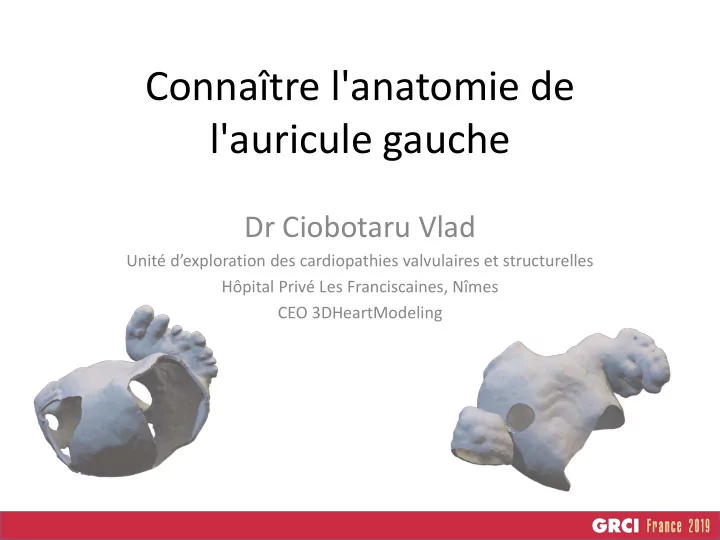
Connaître l'anatomie de l'auricule gauche
Dr Ciobotaru Vlad
Unité d’exploration des cardiopathies valvulaires et structurelles Hôpital Privé Les Franciscaines, Nîmes CEO 3DHeartModeling
Connatre l'anatomie de l'auricule gauche Dr Ciobotaru Vlad Unit - - PowerPoint PPT Presentation
Connatre l'anatomie de l'auricule gauche Dr Ciobotaru Vlad Unit dexploration des cardiopathies valvulaires et structurelles Hpital Priv Les Franciscaines, Nmes CEO 3DHeartModeling Disclosure Statement of Financial Interest Within
Dr Ciobotaru Vlad
Unité d’exploration des cardiopathies valvulaires et structurelles Hôpital Privé Les Franciscaines, Nîmes CEO 3DHeartModeling
Disclosure Statement of Financial Interest
Within the past 12 months, I or my spouse/partner have had a financial interest/arrangement or affiliation with the organization(s) listed below.
Affiliation/Financial Relationship Company
and low morbidity for 2 devices
3D TEE method of landing zone measurements
Percutaneous Left Atrial Appendage Closure Is a Reasonable Option for Patients With Atrial Fibrillation at High Risk for Cerebrovascular Events, Volume: 11, Issue: 3, DOI: (10.1161/CIRCINTERVENTIONS.117.005841)
Data from FLAAC registry: 57% thromboembolic events reduction but caution to serious complications in some patients
7.2% > 2devices 96% successful after 1 procedure 2.3% two procedures 7.2% procedure-related Serious Adverse Events
LAAC should be made on an individual basis and integrate a preprocedural assessment of risk/benefice ratio
Of nearly 3,000 adverse events reported to the agency’s Manufacturer and User Facility Device Experience (MAUDE) database, 2015-2018 Watchman device
16.9% )
Awareness of, and preparation for, the management of procedural complications can increase patient safety and improve the risk-benefit ratio for LAA closure. Further improvements in the technology and refinements in the implanting techniques should be focused at preventing this dreaded complication
TOE and CT : multiple plane analysis
X Iriart, V Ciobotaru Arch Cardiovasc Dis. 2018 Jun Korsholm K and col JACC Cardiovasc Interv. 2019 Oct 23
Shape, Depth, Diameter of the neck Ellipticity, Orientation of LAA ostium LAA position Pulmonary Ridge preeminence, LA volume, Size of interatrial Fossa Angle from fossa to LAA ostium
Procedural risk depends on:
Inter atrial Puncture site Shape of Catheter Catheter alignment Prothesis type and shape
Anatomical Factors Procedural Factors Manufacturers’ recommendations are based only on the LAA neck diameter.
A.LAA gram (RAO 350/caudal 110) showing small LAA with prominent pectinate muscles. Note: position of distal marker
Shape:
B.LAA gram (RAO 350/caudal 110)
prominent pectinate muscles. Note: distal marker of DC
depth 13 mm
A B
Small LAA With Protruding Pectinate Muscles
Watchman Device Implantation
LAA lobes covered, compression was good (26%), no leakage, tug test was good, mild protrusion to LA
appeared deformed by pectinate muscles
Protrusion < 4.2 mm
A B C Immediately after release, Watchman device was embolized to the LA – LV - aorta
Depth + Ellipticity:
Depth + Ellipticity:
Depth+shape:
Depth+shape:
Retro-Orientation of a small LAA
Auricule bilobé avec ridge interne proéminent
Shape: bilobed
24x31mm 16x18mm
Shape: bilobed
Amulet 25 Couvrir l’ostium avec un disc plus large avec une surcompression du lobe
In situ
Shape: bilobed
Pulmonary Ridge preeminence:
Long distance between IVC outlet and IAS, Short distance between IAS and LAA
LAA orifice normal vectors might be good predictors for incomplete LAA occlusion JACC March 21, 2017 Volume 69, Issue 11
Angle from fossa to LAA ostium:
In situ: misalignment Simulation Optimal Off axis Off-axis simulation
3D printing guide the transseptal puncture
Ciobotaru V;
Inter atrial Puncture site Shape of Catheter & Catheter alignment
SIMULATION DE PONCTION POSTERO-INFERIEURE SIMULATION DE PONCTION ANTERO-INFERIEURE post ant inf ant inf Exemple de ridge prononcé avec un LAA orienté vers l’arrière post ant inf
Inter atrial Puncture site Shape of Catheter & Catheter alignment
3D Printing simulation accurately predicts procedures risks
VCS VCI AVANT ARR SCHEMATISATION DES SITES DE PONCTION TRANSSEPTALE INF-POST et INF-ANT ANT-INF POST-INF SUP-POST MED-INF Ao vci vcs TEE35° vcs TEE90° TEE110° TEE10° Mi
Retro-Orientation of LAA, large ostium
Korsholm K and col JACC Cardiovasc Interv. 2019 Oct 23
Clinical Impact of 3D Printing Sizing
Unique Protocol ID:* RECHMPL17_0230 Brief Title:* Use lay language. Left Atrial Appendage Occlusion Guided by 3D printing Acronym: LAA-Print registry Official Title:* National Longitudinal Registry for Mid-Term Clinical Outcome And Procedure Efficacy Evaluation In Using A Novel Preprocedural Planning Method For Left Atrial Appendage Occlusion Guided By 3D Printing Study Type:* Observational Interventional Expanded access Official Title:* National Longitudinal Registry for Mid-Term Clinical Outcome And Procedure Efficacy Evaluation In Using A Novel Preprocedural Planning Method For Left Atrial Appendage Occlusion Guided By 3D Printing
Clinical aim:
to predict the risk of procedural complications to Improve Safety: by decreasing operating time and complications
ClinicalTrials.gov ID: NCT03330210
Study Start: Jan 18th, 2018
Grants : AG2RFondation Region Occitanie BRL, Philips, Boston Scientific,
Operative Prospective Risk Score for LAAC
The puncture site of the thin inter atrial septum of the fossa ovalis: The alignment of the catheter with the LAA axis: Deployment of the prosthesis:
Standard: posteroinferior: 1pt Another site (anteroinferior): 2pt Optimal alignment: 1pt Misalignment but resolved with a maximal rotation of the catheter (torq): 2pt Important misalignment despite a torq movement inducing a deformation of the model 3pt Optimal seal: stable, adequate compression, no bulging, nor leaks, nor obliquity, covering all LAA lobes 1pt Sub-optimal deployment: large gap, bulging or obliquity, over-compressed: 2pt Instable when tug test or prosthesis eject: 3pt TOTAL OPERATIVE RISK SCORE Low if the global Score=3, Moderate risk if the global score: 4 or 5, High risk if the global score ≥6 or if one item is scored 3
Nb of patients N=200 Operative Predicted Low risk N=104 Operative Predicted Moderate risk N=59 Operative Predicted High Risk N=37 P High risk vs low risk Failure 12 (32%) <0,05 Recaptures>2 3 (3%) 5 (10%) 7 (19%) <0,05 Prosthesis ≥2 1 (1%) 6 (2%) 8 (21%) <0,05 Inappropriate implantation 7 (10%) 11 (30%) <0,05 SAEs 5 (8%) 10 (27%) <0,05 Pericardial effusion>10mm Pericardiocentesis 4(4%) 1 3(5%) 2 4(11%) 2 Haemorrhage (≥2points) 2 8 Coronary syndrome 4 Time (intraLA) min 21±7 28±13 58±25 <0,05
Anatomical Factors associated with operative predicted high risk group were: retroversion (50% of cases), elliptical LAA ostium (41%), flat chicken wing shape(58%), reduced depth (38%), double ostium (20%).
Logistic regression- Primary end point Source DDL Khi² (Wald) Pr > Wald Khi² (LR) Pr > LR Max Diameter 1 0,445 0,505 0,437 0,509 Depth 1 1,007 0,316 0,976 0,323 Depth/diameter 1 0,886 0,346 0,851 0,356 Volume 1 0,004 0,949 0,004 0,949 Risk score 2 25,022 < 0,0001 65,324 < 0,0001 Shape 4 3,820 0,431 4,072 0,396 LAA Orientation (retroversion) 1 0,030 0,863 0,030 0,863 Ellipticity 1 1,157 0,282 1,194 0,275
Predictive parameter for occurrence of a primary end point*
Primary end point: Safety combined criteria including : SAEs, (tamponade, bleeding, transfusion, coronary syndrome, renal impairment),
Take Home Messages
appendage planning
to use for that patient's specific anatomy
high risk group)
complexes cases
Conclusion The key of a better treatment is anticipation