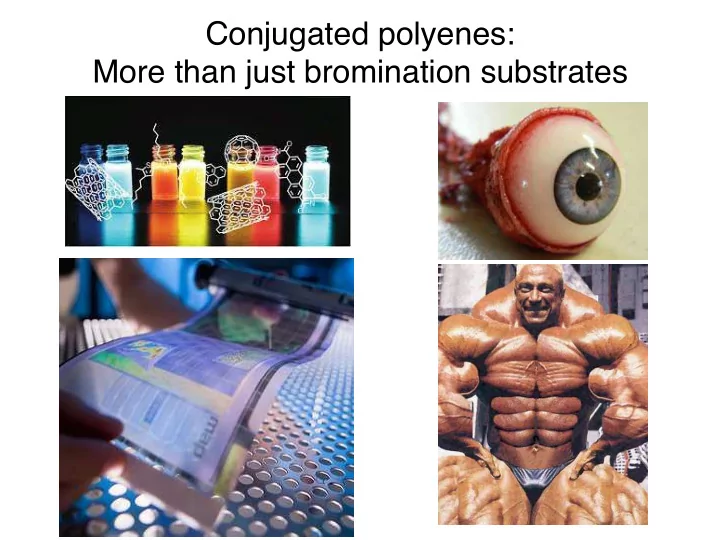
SLIDE 1
Conjugated polyenes:
More than just bromination substrates
SLIDE 2 The catalyst
- Phys. Rev. Lett. 1977, 39, 1098-1101
SLIDE 3
Shirakawa’s synthesis of “carbon films”
Exposure to chlorine resulted in a strongly absorbing film …
SLIDE 4 Shirakawa’s synthesis of “carbon films”
Not halogenation but doping, and the birth of organic conducting polymer research Nobel Prize 2000
Cl Cl Cl Cl Cl Cl Cl Cl
Exposure to chlorine resulted in a strongly absorbing film …
SLIDE 5
A survey of organic photovoltaics (2011)
Beaujuge and Fréchet, J. Am. Chem. Soc. 2011, 133, 20009-20029
SLIDE 6 Biosynthesis: From terpenes to …
- A monoterpene contains 10 carbons.
- A sesquiterpene contains 15 carbons.
- A diterpene contains 20 carbons.
Terpenes contain carbon atoms in multiples of five: Bruice p 1196
SLIDE 7
… to terpene oligomers
Bruice Ch 25
SLIDE 8
… to small “essential oils”
Bruice Ch 25
SLIDE 9
… to longer oligomers
Bruice Ch 25
SLIDE 10
Bruice Ch 25
SLIDE 11
From cis-trans isomerization to vision
Bruice page 151
SLIDE 12
Michael Faraday: just looking for better lamp oil …
Faraday ultimately isolated and described the properties of this product A remarkable feat given that this was done in the 1820s! ““Bicarburet of hydrogen” appears in common circumstances as a colorless transparent liquid, having an odor resembling that of oil gas, and partaking also of that of almonds” Oil gas, used to power 19th century English lamps, left a liquid that deposited on the gas valves and subsequently decreased performance. What was this oil decomposition product? Faraday determined the molecular formula to be C2H (atomic weight of carbon then was 6 …) Michael Faraday 1791-1867
SLIDE 13 Benzene / phène … and “aromatic”
Whence benzene? Eilhard Mitscherlich distilled benzoic acid (PhCOOH) And a strong caustic base (we now call this “decarboxylation”) Benzoic acid is obtained form benzoin resin, found in SE Asian perfumes Thus, يواج نابل or “Frankincense from Java” (luban jawi) Whence phenyl?
- A. Laurent, Ann. Chem. Phys. 1836, 63, 27-45
SLIDE 14 Kekulé’s dream of benzene
- Bull. Soc. Chem. Paris 1865, 3, 98-110
Ouroboros
SLIDE 15
“Hückel’s rule” and non/antiaromaticity
Erich Hückel 1896-1980 Hückel developed the quantum mechanical framework, a simplified version of which (Hückel MO Theory) can be used quickly to calculate energetics for pi-conjugated systems in 1931. This led to the realization that 6 pi electron circuits Has special stability/resonance/aromaticity. Bill Doering actually coined the “2+4n” rule in 1951 Richard Wilstatter 1872-1942 Synthesized Cyclooctatetraene (8 pi-electrons) “non aromatic” Ron Breslow (Columbia) Studied Cyclopropyl Anions (4 pi) “anti-aromatic”
SLIDE 16 Proof of structure
Lewis, Pauling, Hückel, provided theoretical framework. Can we measure? Kathleen Lonsdale 1903-1971 Unlike typical newly married women in 1920s-1930s England who were expected to become scientists, Lonsdale wanted to be homemaker and raise her children. Her husband helped persuaded her otherwise. She published benzene’s structure in 1929
- Proc. Royal. Soc. A 1929, 123, 494
SLIDE 17
Mono-substituted benzenes: common names Jones, Fig 12.50
SLIDE 18
Disubstituted Benzene rings: Common names Jones Fig. 12.54