Transplantation Society development of the science and clinical - - PDF document

transplantation society
SMART_READER_LITE
LIVE PREVIEW

Transplantation Society development of the science and clinical - - PDF document

9/28/2016 Transplantation Society development of the science and clinical practice Transplantation Building Bridges scientific communication to Excellence continuing education guidance on the ethical practice How can we use our


slide-1
SLIDE 1

9/28/2016 1

Transplantation‐Building Bridges to Excellence

How can we use our collective wisdom/education to optimize transplantation outcomes?

Transplantation Society

  • development of the science and clinical

practice

  • scientific communication
  • continuing education
  • guidance on the ethical practice

Outline

  • “State of the World” in transplantation
  • Current Limitations
  • Potential Solutions

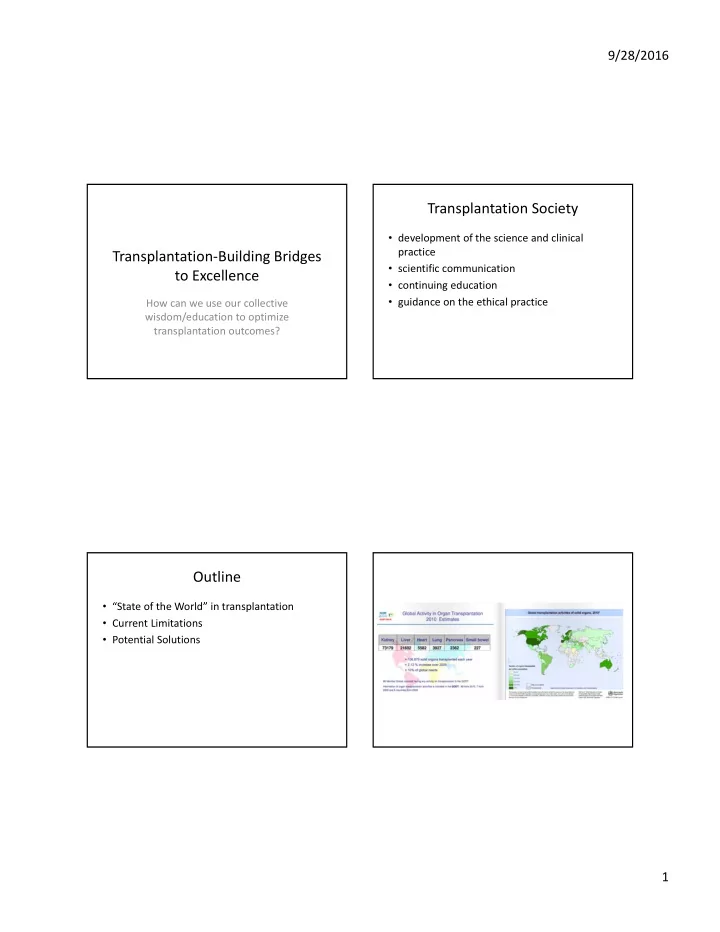
World Wide Transplantation

slide-2
SLIDE 2

9/28/2016 2

T e rrito ry size is disto rte d in pro po rtio n to the numbe r o f o rgan transplants re po rte d fo r e ac h c o untry in 2010

<6 6 to <20 20 to <40 T r ansplantation r ate (pmp) 40 to <70 >70

Global distribution of transplantation activity

2010

Data source: Global Observatory on Donation and Transplantation (www.transplant-observatory.org), slide courtesy of S White

Provided by Sarah White, George Institute

= 10,000 tr e ate d case s of kidne y failur e

76,118 kidney tr

ansplants per for med in 2011

2.16 million Patients living on

dialysis at 31st Dec ember 2011

Data sources: Global Observatory on Donation and Transplantation (www.transplant-observatory.org) ESRD Patients in 2011: A Global Perspective. Fresenius Medical Care. Bad Homburg, Germany. On a waiting list for kidne y tr ansplantation in 2011

Provided by Sarah White

slide-3
SLIDE 3

9/28/2016 3

Current Issues in Transplantation

  • Inadequate number of donor organs
  • Quality of donor organs
  • Long term complications of

immunosuppression

  • Work force
  • Best practice

Inadequate Numbers of Donors

  • Increasing numbers of recipients
  • Stagnant numbers of donors

Decreasing Demand‐Kidney

  • Weight loss‐dietary restriction
  • Bariatric surgery
  • Diabetic control
  • Control hypertension
  • Control rejection
  • compliance

Decreasing Demand‐Liver

  • HCV Rx
  • Bariatric surgery
  • Treatment of fibrosis
  • Lifestyle changes
  • Compliance
  • Lifestyle changes
  • HCV treatment
slide-4
SLIDE 4

9/28/2016 4

Quality of Donor Organs

  • Fatty infiltration
  • Older donors
  • DCD
  • HCV+ donors
  • HIV+ donors
  • Fibrosis

Mitigating Strategies

  • Systemic Heparin
  • High‐Dose Tissue Plasminogen Activator Flush
  • Aortic and portal vein flush
  • TPA prior to reperfusion

Mitigating Strategies

  • Machine preservation

hypothermic vs. normothermic

slide-5
SLIDE 5

9/28/2016 5

Prevention/treatment of diseased organs

Heart

  • cells
  • Mechanical support

Liver

  • HCV Rx
  • Reversal of fibrosis
  • Reversal of fat infiltration

Workforce Issues in Transplantation

  • Develop network of transplant providers
  • Historically multidisciplinary
  • TTS partnership with ITNS
  • Education

Professional education Guidelines

  • To whom it may concern,

Our hospital is located in Herat province of Afghanistan and We are a first ranked private 100 bed hospital in Afghanistan and the only hospital that is doing the kidney transplantation surgeries inside the country for the very first time. We have been able to successfully transplant approx 20 patients since we started three months

  • ago. In these three months we have to come know that

the number of ESRD patients are much more than what we have expected at first,therefore, we are in need of your experiences and support to accomplish this procedure smoothly. Looking forward to hearing from you ASAP. Best Regards ‐‐ Masoud Ghafoori

Minimum requirements to perform deceased donor transplantation

Source: J Chapman, Global Alliance for Transplantation meeting, Durban 2013

Data Systems Chronic Dialysis Program ICU Organ procurement program Waiting list HLA lab Drug program On call team Post Tx care Funding mechanisms Minimum requirements Clinical care teams (surgeons, physicians and nursing) Legislation/regulation, financing and organization of health services delivery Infrastructure/other specialist personnel Legislative and Regulatory Framework Deceased donor transplantation

TTS has assisted Myanmar & Fiji Develop Legislative Framework for Organ Donation & Transplantation Partnership wth ISN for Renal Transplant Programs Sister Centers Programs Linking Developing Centres with established ones. Facilitating links developed by members

slide-6
SLIDE 6

9/28/2016 6

Withdrawal of Immunosuppression

  • Major goal of transplantation
  • Many different strategies
  • Liver safer than kidney
  • Long term withdrawal after liver

transplantation possible

  • Best case

– Children – Living donor – Further from transplant the better

ITN029ST Conclusions

  • Immunosuppression reduction / withdrawal with

intense allograft monitoring has, thus far, been safe

  • 12 / 20 participants are off of immunosuppression

>1year with stable allograft function

  • 8 / 20 participants have failed withdrawal

– 1 violation of inclusion / exclusion criteria – 5 for indeterminate ACR – 2 for biopsy proven acute rejection – Protocol biopsies over 5+ years do not show systematic increase in either inflammation or fibrosis

iWITH: Immunosuppression Withdrawal for Stable Pediatric Liver Transplant Recipients

  • Define the prevalence of operational tolerance in

pediatric recipients of deceased and living donor liver transplants

  • Determine safety of immunosuppression

withdrawal

  • Derive biomarker of operational tolerance

– Peripheral blood multi‐parameter flow cytometry – Peripheral blood and tissue microarray and QT‐PCR

12 center, 100 patient prospective withdrawal trial

Building Organs

  • Clinical trials with stem cells are proceeding
  • Development of hepatocytes from patient’s

stem cells eliminates need for immunosuppression

slide-7
SLIDE 7

9/28/2016 7

Reprogramming

direct partial pluri- potency

Hepatocytes Made from Skin Cells

Post-Transplant Proliferation

From Stem Cells to Liver Transplant

  • Organs need structure for long term function
  • Need to replace the original liver cells with

recipient cells

  • Leave scaffold in place for function

Porcine liver decellularization. Whole native liver (A) before perfusion with Triton X‐100 (B) and SDS

(C). Indicated by panels on the SDS‐treated liver, the preserved major (D) and minor (E) vessels are visible at the end of the protocol American Journal of Pathology, Volume 183, Issue 2, 2013

slide-8
SLIDE 8

9/28/2016 8

Building Organs

  • Infuse ghosts with hepatocytes.
  • Need endothelial cells, cholangiocytes,

Kupffer cells?

Novel Organs

  • EuroStemCell 2015‐MRC Centre for Regenerative

Medicine‐hepatic progenitors used to regrow damaged livers in mice

  • Cincinnati Children’s Hospital‐induced stem cells‐

become human intestine and human stomach and implanted in mouse

  • MRC (US)‐ghost kidney and ghost

heart(UPitt)repopulated and functioned

  • Kings College and UCSF‐skin cells
  • Inst Mol Biotech(Austria and U Edinburgh)‐brain
  • rganoids

Ban lifted‐Human Stem cell work

NIH to lift ban on funding research using injected human stem cells into animals with the specific purpose of try to grow human tissues and organs in animals ‐understand human diseases ‐develop therapies for disease ‐develop human organs for transplantation

slide-9
SLIDE 9

9/28/2016 9

Xeno‐transplant

  • Pig organs may be ideal in terms of size and

function

  • Past use inhibited by presence of porcine

endogenous retro‐viruses (PERV) because of concern of disease transmission.

  • Surface proteins leading to rejection also

present

Pig Genome Modification

  • CRISPR/CAS 9 used to inactivate 62 PERVs in

pig embryos

  • Modification of 20 surface proteins thought

to be responsible for human immune response to pig cells.

  • Science. 2015 Oct 11.