Components and Projections - - PDF document

components and projections
SMART_READER_LITE
LIVE PREVIEW

Components and Projections - - PDF document

7.7 Projections P. Danziger Components and Projections u v


slide-1
SLIDE 1

7.7 Projections

  • P. Danziger

Components and Projections

✁ ✁ ✁ ✁ ✁ ✁ ✁ ✁ ✁ ✁ ✟✟✟✟✟✟✟✟✟✟✟✟✟✟✟ ❆ ❆ ❆ ❆ ❆ ❆ ✟ ❵ ❵ ✁ ✁

θ

✟❆

v u

✟✟✟✟✟✟✟✟ ❵ ❵ ✁ ✁

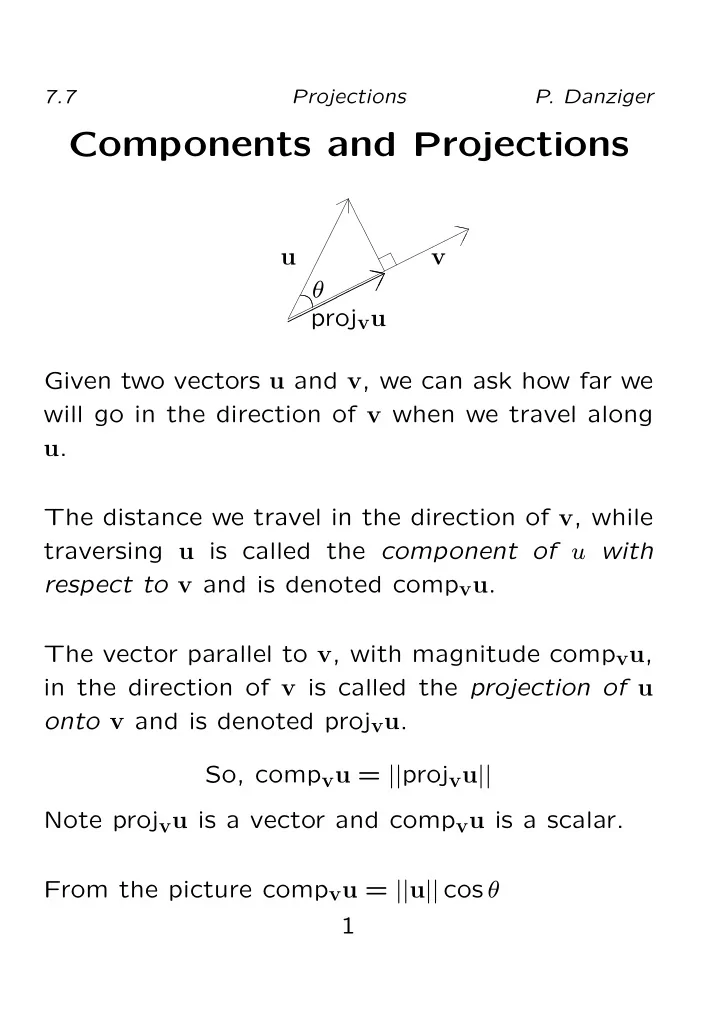
projvu Given two vectors u and v, we can ask how far we will go in the direction of v when we travel along

u.

The distance we travel in the direction of v, while traversing u is called the component of u with respect to v and is denoted compvu. The vector parallel to v, with magnitude compvu, in the direction of v is called the projection of u

  • nto v and is denoted projvu.

So, compvu = ||projvu|| Note projvu is a vector and compvu is a scalar. From the picture compvu = ||u|| cos θ 1

slide-2
SLIDE 2

7.7 Projections

  • P. Danziger

We wish to find a formula for the projection of u

  • nto v.

Consider

u · v = ||u||||v|| cos θ

Thus ||u|| cos θ = u · v ||v|| So compvu = u · v ||v|| The unit vector in the same direction as v is given by

v

||v||. So projvu =

  • u · v

||v||2

  • v

2

slide-3
SLIDE 3

7.7 Projections

  • P. Danziger

Example 1

  • 1. Find the projection of u = i+2j onto v = i+j.

u · v = 1 + 2 = 3, ||v||2 =

2

2 = 2

projvu =

u · v

||v||2

  • v = 3

2(i + j) = 3 2i + 3 2j

  • 2. Find projvu, where u = (1, 2, 1) and v = (1, 1, 2)

u·v = 1+2+2 = 5, ||v||2 =

  • 12 + 12 + 22

2

= 6 So, projvu = 5 6(1, 1, 2)

  • 3. Find the component of u = i+j in the direction
  • f v = 3i + 4j.

u · v = 3 + 4 = 7, ||v|| =

  • 32 + 42 =

√ 25 = 5 compvu = u · v ||v|| = 7 5 3

slide-4
SLIDE 4

7.7 Projections

  • P. Danziger
  • 4. Find the components of u = i + 3j − 2k in the

directions i, j and k.

u · i = 1, u · j = 3, u · k = −2,

||i|| = ||j|| = ||k|| = 1 So compiu = 1, compju = 3, compku = −2. So the use of the term component is justified in this context. Indeed, coordinate axes are arbitrarily chosen and are subject to change. If u is a new coordinate vector given in terms of the old set then compuw gives the component

  • f the vector w in the new coordinate system.

4

slide-5
SLIDE 5

7.7 Projections

  • P. Danziger

Example 2 If coordinates in the plane are rotated by 45o, the vector i is mapped to u =

1 √ 2i + 1 √ 2j, and

the vector j is mapped to v = − 1

√ 2i+ 1 √

  • 2j. Find

the components of w = 2i − 5j with respect to the new coordinate vectors u and v. i.e. Express w in terms of u and v. − →

❅ ❅ ❅ ❅ ❅ ❅ ❅ ❅ ❅

w w i j u v

❅ ❅ ■

❅ ✲ ✻ ✲ ✻ ✁ ✁ ✁ ✁ ✕ ✁ ✁ ✁ ✁ ✕

w · u = −3

√ 2, w · v = −7 √

  • 2. ||u|| = ||v|| = 1

So compuw = −3 √ 2, compvw = −7 √ 2. and

w = −3

√ 2u + −7 √ 2v 5

slide-6
SLIDE 6

7.7 Projections

  • P. Danziger

Orthogonal Projections

Given a non-zero vector v, we may represent any vector u as a sum of a vector, u|| parallel to v and a vector u⊥ perpendicular to v. So,

u = u|| + u⊥.

Now,

u|| = projvu.

and so

u⊥ = u − projvu.

6

slide-7
SLIDE 7

7.7 Projections

  • P. Danziger

Example 3 Express u = 2i+4j+2k as a sum of vectors parallel and perpendicular to v = i + 2j − k.

u·v = 2+8−2 = 8, ||v||2 =

  • 12 + 22 + 12

2

= 6

u|| = projvu =

u · v

||v||2

  • v = 4

3(i + 2j − k)

u⊥

= u − projvu = (2i + 4j + 2k) − 4

3(i + 2j − k)

=

  • 2 − 4

3

  • i +
  • 4 − 8

3

  • j +
  • 2 + 4

3

  • k

=

6−4 3 i + 12−8 3

j + 6+4

3 k

=

2 3i + 4 3j + 10 3 k

=

2 3(i + 2j + 5k)

Check

u|| · u⊥

=

2

3(i + 2j + 5k)

  • ·

4

3(i + 2j − k)

  • =

8 9 ((i + 2j + 5k) · (i + 2j − k))

=

8 9(1 + 4 − 5)

= So u|| and u⊥ are orthogonal. 7